

Evolution of Global Secondary Lead Production
13
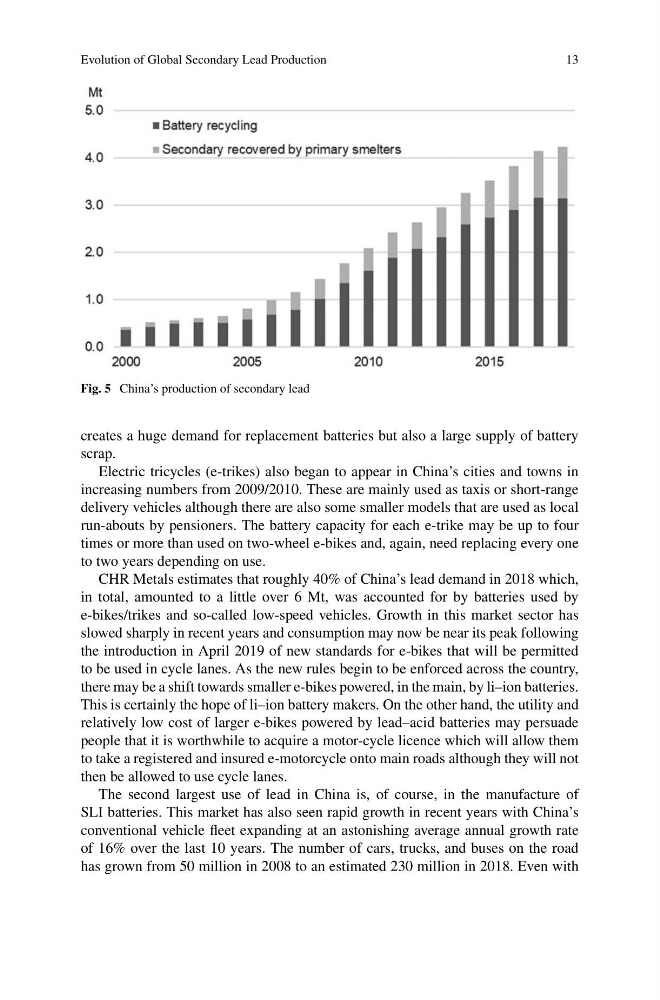
Fig. 5 China’s production of secondary lead
creates a huge demand for replacement batteries but also a large supply of battery
scrap.
Electric tricycles (e-trikes) also began to appear in China’s cities and towns in
increasing numbers from 2009/2010. These are mainly used as taxis or short-range
delivery vehicles although there are also some smaller models that are used as local
run-abouts by pensioners. The battery capacity for each e-trike may be up to four
times or more than used on two-wheel e-bikes and, again, need replacing every one
to two years depending on use.
CHR Metals estimates that roughly 40% of China’s lead demand in 2018 which,
in total, amounted to a little over 6 Mt, was accounted for by batteries used by
e-bikes/trikes and so-called low-speed vehicles. Growth in this market sector has
slowed sharply in recent years and consumption may now be near its peak following
the introduction in April 2019 of new standards for e-bikes that will be permitted
to be used in cycle lanes. As the new rules begin to be enforced across the country,
there may be a shift towards smaller e-bikes powered, in the main, by li–ion batteries.
This is certainly the hope of li–ion battery makers. On the other hand, the utility and
relatively low cost of larger e-bikes powered by lead–acid batteries may persuade
people that it is worthwhile to acquire a motor-cycle licence which will allow them
to take a registered and insured e-motorcycle onto main roads although they will not
then be allowed to use cycle lanes.
The second largest use of lead in China is, of course, in the manufacture of
SLI batteries. This market has also seen rapid growth in recent years with China’s
conventional vehicle fleet expanding at an astonishing average annual growth rate
of 16% over the last 10 years. The number of cars, trucks, and buses on the road
has grown from 50 million in 2008 to an estimated 230 million in 2018. Even with
13
Fig. 5 China’s production of secondary lead
creates a huge demand for replacement batteries but also a large supply of battery
scrap.
Electric tricycles (e-trikes) also began to appear in China’s cities and towns in
increasing numbers from 2009/2010. These are mainly used as taxis or short-range
delivery vehicles although there are also some smaller models that are used as local
run-abouts by pensioners. The battery capacity for each e-trike may be up to four
times or more than used on two-wheel e-bikes and, again, need replacing every one
to two years depending on use.
CHR Metals estimates that roughly 40% of China’s lead demand in 2018 which,
in total, amounted to a little over 6 Mt, was accounted for by batteries used by
e-bikes/trikes and so-called low-speed vehicles. Growth in this market sector has
slowed sharply in recent years and consumption may now be near its peak following
the introduction in April 2019 of new standards for e-bikes that will be permitted
to be used in cycle lanes. As the new rules begin to be enforced across the country,
there may be a shift towards smaller e-bikes powered, in the main, by li–ion batteries.
This is certainly the hope of li–ion battery makers. On the other hand, the utility and
relatively low cost of larger e-bikes powered by lead–acid batteries may persuade
people that it is worthwhile to acquire a motor-cycle licence which will allow them
to take a registered and insured e-motorcycle onto main roads although they will not
then be allowed to use cycle lanes.
The second largest use of lead in China is, of course, in the manufacture of
SLI batteries. This market has also seen rapid growth in recent years with China’s
conventional vehicle fleet expanding at an astonishing average annual growth rate
of 16% over the last 10 years. The number of cars, trucks, and buses on the road
has grown from 50 million in 2008 to an estimated 230 million in 2018. Even with