

340
E. Jak et al.
Table 1 Summary of phases and elements described in the current internal PYROSEARCH solution
databases (UQPY-2019) important for Pb–Cu–Zn pyrometallurgical processing. Further detailed
description is provided in [5]
Slag:(Cu 1+ , Fe 2+ , Fe 3+ , Si 4+ , Al 3+ , Ca 2+ , Mg 2+ , Pb 2+ , Zn 2+ , Ni 2+ , Sn 2+ , Sb 3+ , As 3+ , Bi 3+ ,
Ag 1+ , Au 1+ )(O 2− , S 2− ), modified quasichemical formalism in quadruplet approximation
Spinel: [Cu 2+ , Fe 2+ , Fe 3+ , Ni 2+ , Al 3+ , Mg 2+ , Zn 2+ ] tetr [Cu 2+ , Fe 2+ , Fe 3+ , Ni 2+ , Al 3+ , Ca 2+ ,
Mg 2+ , Zn 2+ , vacancy 0 ] oct
2 O 4 , compound energy formalism
Liquid matte/metal/speiss: (Cu I , Cu II , Fe II , Fe III , Pb II , Zn II , Ni II , Sn II , Sb III , As III , Bi III , Ag I ,
Au I , O II+ , S II+ ), modified quasichemical formalism in pair approximation
Monoxide: (CuO, FeO, FeO 1.5 , NiO, AlO 1.5 , CaO, MgO), Bragg-Williams formalism
Mullite: (Al 3+ , Fe 3+ ) 2 (Al 3+ , Si 4+ )(O 2− , vacancy 0 ) 5 , compound energy formalism
Olivine: [Fe 2+ , Ni 2+ , Ca 2+ , Mg 2+ , Zn 2+ ] M2 [Fe 2+ , Ni 2+ , Ca 2+ , Mg 2+ , Zn 2+ ] M1 SiO 4 ,
compound energy formalism
Melilite: [Ca 2+ , Pb 2+ ] 2 [Fe 2+ , Fe 3+ , Al 3+ , Zn 2+ ][Fe 3+ , Al 3+ , Si 4+ ] 2 O 7 , compound energy
formalism
Pyroxenes: [Fe 2+ , Ca 2+ , Mg 2+ , Ni 2+ ] M2 [Fe 2+ , Fe 3+ , Mg 2+ , Al 3+ , Ni 2+ ] M1 [Fe 3+ , Al 3+ ,
Si 4+ ] B Si A O 6 , compound energy formalism
Dicalcium silicates: (Ca 2 SiO 4 , Fe 2 SiO 4 , Mg 2 SiO 4 , Pb 2 SiO 4 , Zn 2 SiO 4 ), Bragg-Williams
formalism
Wollastonite: (CaSiO 3 , FeSiO 3 , MgSiO 3 , ZnSiO 3 ), Bragg-Williams formalism
Willemite: [Zn 2+ , Fe 2+ , Mg 2+ ][Zn 2+ , Fe 2+ , Mg 2+ ]SiO 4
Corundum: (FeO 1.5 , AlO 1.5 , NiO), Bragg-Williams formalism
Fcc and bcc solids alloys: (Fe, Cu, Ni, O, S, Pb, Zn, As, Sb), Bragg-Williams formalism
Digenite-bornite: (Cu 2 S, FeS, PbS, ZnS, Ni 2 S, vacancy 2 S), Bragg-Williams formalism
MeS cubic: (FeS, PbS, CaS, MgS, vacancyS), Bragg-Williams formalism
Solid stoichiometric compounds: (over 150 phases) including solid oxide, metal, sulfide, and
sulfate solids
Ideal gas: >100 species including N 2 , H 2 O, CO, CO 2 , SO 2 , SO, As 2 , AsS, AsO, Zn, ZnS,
ZnO, AgS, Pb, PbS, PbO, Bi, Bi 2 , BiO, BiS, Sn, SnO, SnS, Ag, AgO, AgS, Sb, Sb 2 , SbO,
SbS
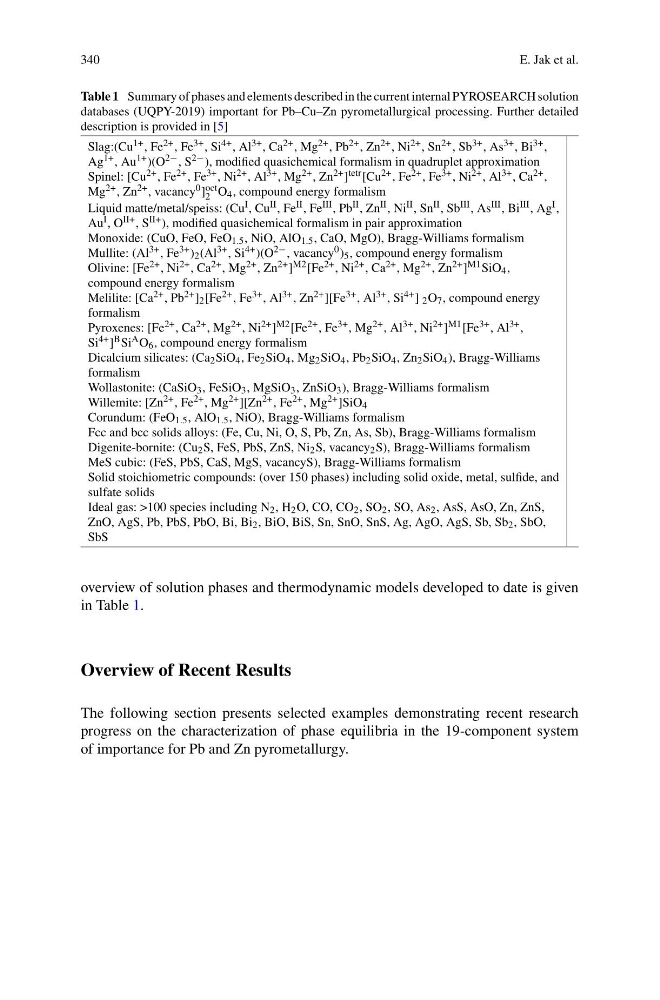
overview of solution phases and thermodynamic models developed to date is given
in Table 1.
Overview of Recent Results
The following section presents selected examples demonstrating recent research
progress on the characterization of phase equilibria in the 19-component system
of importance for Pb and Zn pyrometallurgy.
E. Jak et al.
Table 1 Summary of phases and elements described in the current internal PYROSEARCH solution
databases (UQPY-2019) important for Pb–Cu–Zn pyrometallurgical processing. Further detailed
description is provided in [5]
Slag:(Cu 1+ , Fe 2+ , Fe 3+ , Si 4+ , Al 3+ , Ca 2+ , Mg 2+ , Pb 2+ , Zn 2+ , Ni 2+ , Sn 2+ , Sb 3+ , As 3+ , Bi 3+ ,
Ag 1+ , Au 1+ )(O 2− , S 2− ), modified quasichemical formalism in quadruplet approximation
Spinel: [Cu 2+ , Fe 2+ , Fe 3+ , Ni 2+ , Al 3+ , Mg 2+ , Zn 2+ ] tetr [Cu 2+ , Fe 2+ , Fe 3+ , Ni 2+ , Al 3+ , Ca 2+ ,
Mg 2+ , Zn 2+ , vacancy 0 ] oct
2 O 4 , compound energy formalism
Liquid matte/metal/speiss: (Cu I , Cu II , Fe II , Fe III , Pb II , Zn II , Ni II , Sn II , Sb III , As III , Bi III , Ag I ,
Au I , O II+ , S II+ ), modified quasichemical formalism in pair approximation
Monoxide: (CuO, FeO, FeO 1.5 , NiO, AlO 1.5 , CaO, MgO), Bragg-Williams formalism
Mullite: (Al 3+ , Fe 3+ ) 2 (Al 3+ , Si 4+ )(O 2− , vacancy 0 ) 5 , compound energy formalism
Olivine: [Fe 2+ , Ni 2+ , Ca 2+ , Mg 2+ , Zn 2+ ] M2 [Fe 2+ , Ni 2+ , Ca 2+ , Mg 2+ , Zn 2+ ] M1 SiO 4 ,
compound energy formalism
Melilite: [Ca 2+ , Pb 2+ ] 2 [Fe 2+ , Fe 3+ , Al 3+ , Zn 2+ ][Fe 3+ , Al 3+ , Si 4+ ] 2 O 7 , compound energy
formalism
Pyroxenes: [Fe 2+ , Ca 2+ , Mg 2+ , Ni 2+ ] M2 [Fe 2+ , Fe 3+ , Mg 2+ , Al 3+ , Ni 2+ ] M1 [Fe 3+ , Al 3+ ,
Si 4+ ] B Si A O 6 , compound energy formalism
Dicalcium silicates: (Ca 2 SiO 4 , Fe 2 SiO 4 , Mg 2 SiO 4 , Pb 2 SiO 4 , Zn 2 SiO 4 ), Bragg-Williams
formalism
Wollastonite: (CaSiO 3 , FeSiO 3 , MgSiO 3 , ZnSiO 3 ), Bragg-Williams formalism
Willemite: [Zn 2+ , Fe 2+ , Mg 2+ ][Zn 2+ , Fe 2+ , Mg 2+ ]SiO 4
Corundum: (FeO 1.5 , AlO 1.5 , NiO), Bragg-Williams formalism
Fcc and bcc solids alloys: (Fe, Cu, Ni, O, S, Pb, Zn, As, Sb), Bragg-Williams formalism
Digenite-bornite: (Cu 2 S, FeS, PbS, ZnS, Ni 2 S, vacancy 2 S), Bragg-Williams formalism
MeS cubic: (FeS, PbS, CaS, MgS, vacancyS), Bragg-Williams formalism
Solid stoichiometric compounds: (over 150 phases) including solid oxide, metal, sulfide, and
sulfate solids
Ideal gas: >100 species including N 2 , H 2 O, CO, CO 2 , SO 2 , SO, As 2 , AsS, AsO, Zn, ZnS,
ZnO, AgS, Pb, PbS, PbO, Bi, Bi 2 , BiO, BiS, Sn, SnO, SnS, Ag, AgO, AgS, Sb, Sb 2 , SbO,
SbS
overview of solution phases and thermodynamic models developed to date is given
in Table 1.
Overview of Recent Results
The following section presents selected examples demonstrating recent research
progress on the characterization of phase equilibria in the 19-component system
of importance for Pb and Zn pyrometallurgy.