

310
J. Antrekowitsch and G. Hanke
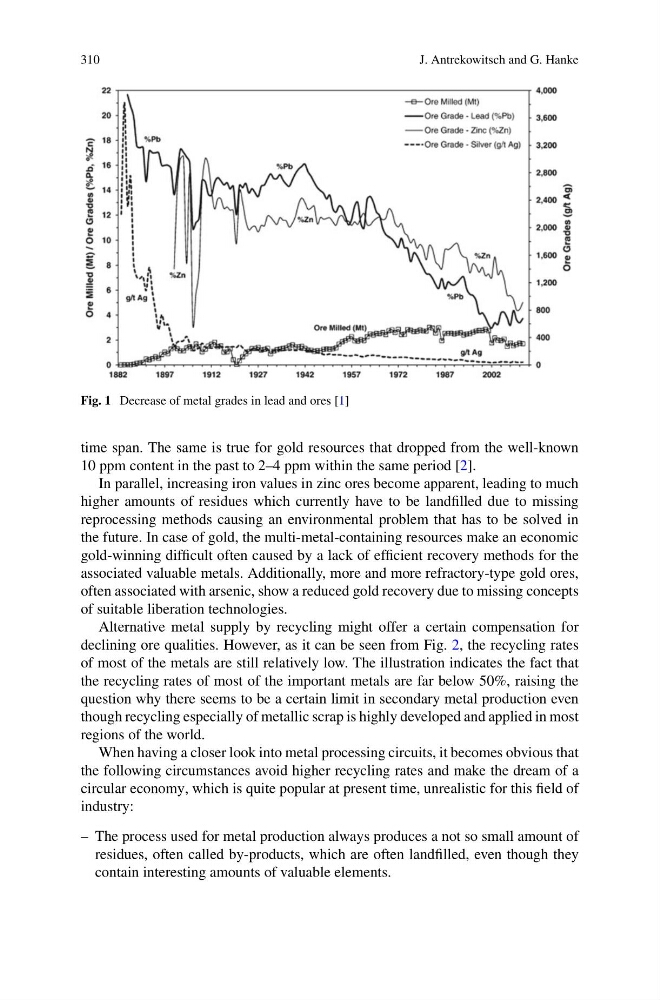
Fig. 1 Decrease of metal grades in lead and ores [1]
time span. The same is true for gold resources that dropped from the well-known
10 ppm content in the past to 2–4 ppm within the same period [2].
In parallel, increasing iron values in zinc ores become apparent, leading to much
higher amounts of residues which currently have to be landfilled due to missing
reprocessing methods causing an environmental problem that has to be solved in
the future. In case of gold, the multi-metal-containing resources make an economic
gold-winning difficult often caused by a lack of efficient recovery methods for the
associated valuable metals. Additionally, more and more refractory-type gold ores,
often associated with arsenic, show a reduced gold recovery due to missing concepts
of suitable liberation technologies.
Alternative metal supply by recycling might offer a certain compensation for
declining ore qualities. However, as it can be seen from Fig. 2, the recycling rates
of most of the metals are still relatively low. The illustration indicates the fact that
the recycling rates of most of the important metals are far below 50%, raising the
question why there seems to be a certain limit in secondary metal production even
though recycling especially of metallic scrap is highly developed and applied in most
regions of the world.
When having a closer look into metal processing circuits, it becomes obvious that
the following circumstances avoid higher recycling rates and make the dream of a
circular economy, which is quite popular at present time, unrealistic for this field of
industry:
– The process used for metal production always produces a not so small amount of
residues, often called by-products, which are often landfilled, even though they
contain interesting amounts of valuable elements.
J. Antrekowitsch and G. Hanke
Fig. 1 Decrease of metal grades in lead and ores [1]
time span. The same is true for gold resources that dropped from the well-known
10 ppm content in the past to 2–4 ppm within the same period [2].
In parallel, increasing iron values in zinc ores become apparent, leading to much
higher amounts of residues which currently have to be landfilled due to missing
reprocessing methods causing an environmental problem that has to be solved in
the future. In case of gold, the multi-metal-containing resources make an economic
gold-winning difficult often caused by a lack of efficient recovery methods for the
associated valuable metals. Additionally, more and more refractory-type gold ores,
often associated with arsenic, show a reduced gold recovery due to missing concepts
of suitable liberation technologies.
Alternative metal supply by recycling might offer a certain compensation for
declining ore qualities. However, as it can be seen from Fig. 2, the recycling rates
of most of the metals are still relatively low. The illustration indicates the fact that
the recycling rates of most of the important metals are far below 50%, raising the
question why there seems to be a certain limit in secondary metal production even
though recycling especially of metallic scrap is highly developed and applied in most
regions of the world.
When having a closer look into metal processing circuits, it becomes obvious that
the following circumstances avoid higher recycling rates and make the dream of a
circular economy, which is quite popular at present time, unrealistic for this field of
industry:
– The process used for metal production always produces a not so small amount of
residues, often called by-products, which are often landfilled, even though they
contain interesting amounts of valuable elements.