

294
L. Zhang et al.
reported to the dust collector for desulfurization, while the dust is returned to the
smelting proportioning operation. The reduction slag enters through the chute to the
fuming furnace, where the pulverized coal is added through the nozzle of the fuming
furnace. The metal zinc in the reduction slag is reduced into zinc steam, which is
oxidized in the tertiary tuyere of the fuming furnace to form secondary zinc oxide. The
resultant heat energy is recovered by the waste heat boiler. High-temperature fume
is sent to desulfurization process after heat recovery in the waste heat boiler and dust
collection. The fuming and converting slag are reported to the granulation process
before sold to the cement factory. In the actual production process, some crude lead
is produced in the oxidation furnace. The oxidation furnace hearth is provided with
an intermediate slag tap to discharge intermediate slag with high content of Cu. The
end of the reduction furnace hearth is also provided with an intermediate slag tap to
discharge the intermediate metal layer in the smelting process.
Principle of the Smelting Process
Oxidation Stage
Lead in Pb-bearing polymetallic materials exists mainly in the form of lead oxide or
lead sulfate.
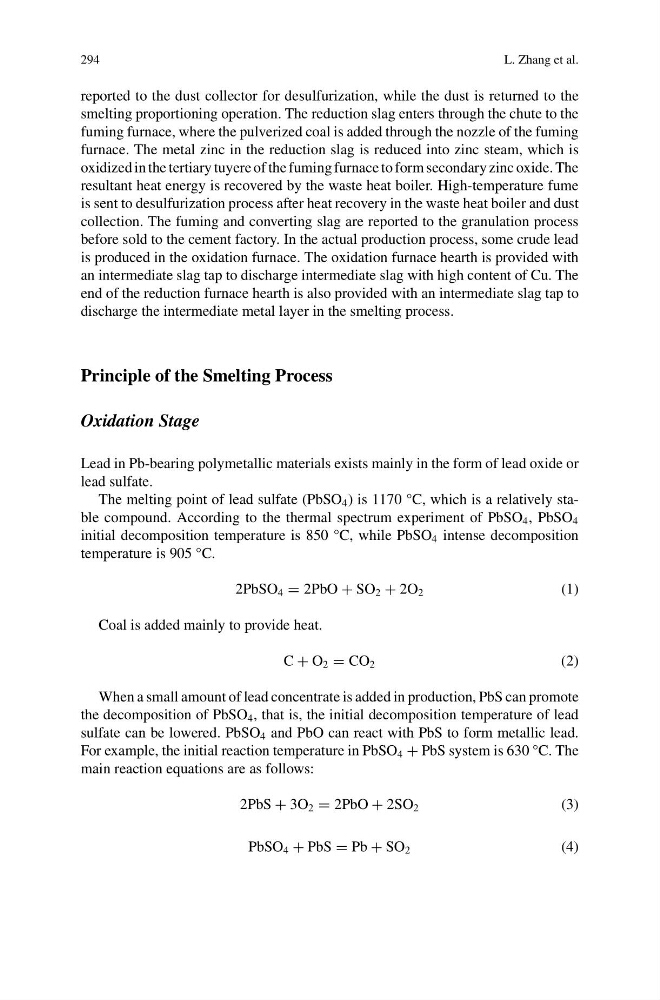
The melting point of lead sulfate (PbSO 4 ) is 1170 °C, which is a relatively stable compound. According to the thermal spectrum experiment of PbSO 4 , PbSO 4
initial decomposition temperature is 850 °C, while PbSO 4 intense decomposition
temperature is 905 °C.
2PbSO 4 = 2PbO + SO 2 + 2O 2
(1)
Coal is added mainly to provide heat.
C + O 2 = CO 2
(2)
When a small amount of lead concentrate is added in production, PbS can promote
the decomposition of PbSO 4 , that is, the initial decomposition temperature of lead
sulfate can be lowered. PbSO 4 and PbO can react with PbS to form metallic lead.
For example, the initial reaction temperature in PbSO 4 + PbS system is 630 °C. The
main reaction equations are as follows:
2PbS + 3O 2 = 2PbO + 2SO 2
(3)
PbSO 4 + PbS = Pb + SO 2
(4)
L. Zhang et al.
reported to the dust collector for desulfurization, while the dust is returned to the
smelting proportioning operation. The reduction slag enters through the chute to the
fuming furnace, where the pulverized coal is added through the nozzle of the fuming
furnace. The metal zinc in the reduction slag is reduced into zinc steam, which is
oxidized in the tertiary tuyere of the fuming furnace to form secondary zinc oxide. The
resultant heat energy is recovered by the waste heat boiler. High-temperature fume
is sent to desulfurization process after heat recovery in the waste heat boiler and dust
collection. The fuming and converting slag are reported to the granulation process
before sold to the cement factory. In the actual production process, some crude lead
is produced in the oxidation furnace. The oxidation furnace hearth is provided with
an intermediate slag tap to discharge intermediate slag with high content of Cu. The
end of the reduction furnace hearth is also provided with an intermediate slag tap to
discharge the intermediate metal layer in the smelting process.
Principle of the Smelting Process
Oxidation Stage
Lead in Pb-bearing polymetallic materials exists mainly in the form of lead oxide or
lead sulfate.
The melting point of lead sulfate (PbSO 4 ) is 1170 °C, which is a relatively stable compound. According to the thermal spectrum experiment of PbSO 4 , PbSO 4
initial decomposition temperature is 850 °C, while PbSO 4 intense decomposition
temperature is 905 °C.
2PbSO 4 = 2PbO + SO 2 + 2O 2
(1)
Coal is added mainly to provide heat.
C + O 2 = CO 2
(2)
When a small amount of lead concentrate is added in production, PbS can promote
the decomposition of PbSO 4 , that is, the initial decomposition temperature of lead
sulfate can be lowered. PbSO 4 and PbO can react with PbS to form metallic lead.
For example, the initial reaction temperature in PbSO 4 + PbS system is 630 °C. The
main reaction equations are as follows:
2PbS + 3O 2 = 2PbO + 2SO 2
(3)
PbSO 4 + PbS = Pb + SO 2
(4)