

278
Y. Song et al.
The sintered process has been applied to recycle and reutilize the zinc smelting
slag [18]. In the first stage, zinc and lead were reduced by the carbon and volatilized
into the dust as a secondary zinc resource. In the second stage, a lightweight brick
was produced.
Ferro-silicate slag produced from zinc smelting by imperial smelting furnace
(ISF). Some occasional research attempts seen in the literature are to its use as a
replacement for aggregates in construction related applications, such as the sand
in cementitious mixes [19]. The latest research shows that ISF zinc smelting slag
can be used as a building material using geopolymerization process, which involves
formation of a new rock like species from various aluminosilicate minerals under
strong alkaline environment [20].
Progress of Zinc Leach Slag Recovery and Recycling
For the efficient treatment of zinc leach residue, the pulverized coal injection system
of rotary kiln has been reformed and improved by a zinc smelting plant in Yunnan
province [21]. Different from the traditional coal injection way, 15% of the pulverized
coal is injected from the head of rotary kiln. The ratio of zinc leach residue to coal
is only 100:20. By the technology, 40% of coal can be saved. The product quality is
improved and the number of nodulations becomes smaller.
Side-submerged combustion smelting process (SSC) is a new technology to treat
zinc leach residue, which is designed and developed by China ENFI Engineering
Corporation. By multi-channel side-submerged spray guns, the oxygen-enriched air
and fuel are injected into the melt at high speed. The melt is stirred and heated directly.
After the furnace charge added, carbonate or sulfate materials are rapidly dispersed
into the melt. The heat and mass transfer occur rapidly. The heating, decomposition,
and melting of the furnace charge are promoted. After more than ten years of design
and development, the technology has been applied by Yunnan Chihong Zn & Ge
Co., Ltd to treat 350 t/d zinc leach residue in 2019.
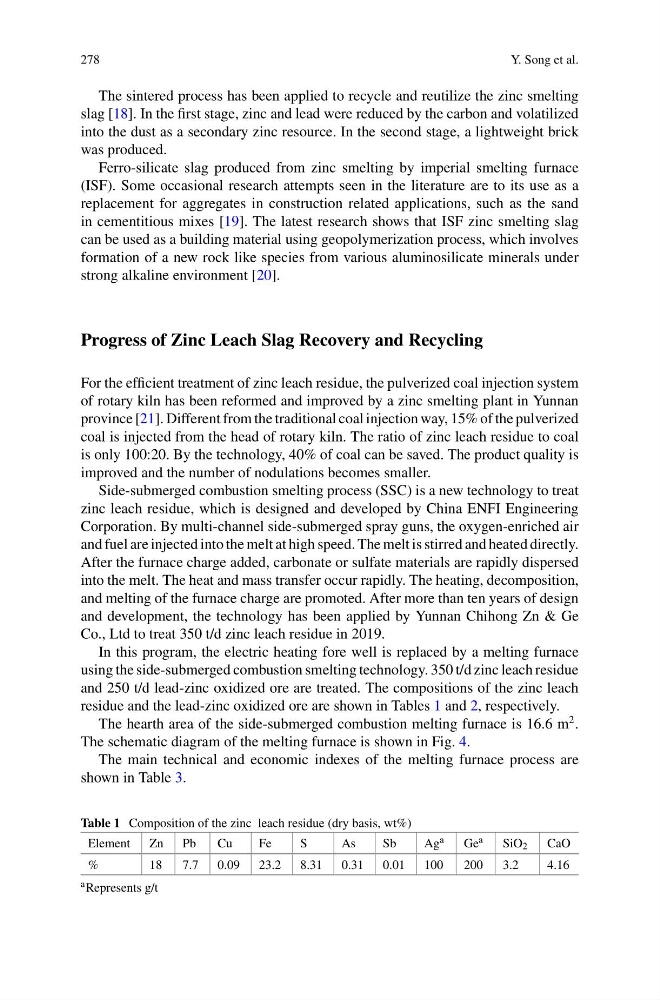
In this program, the electric heating fore well is replaced by a melting furnace
using the side-submerged combustion smelting technology. 350 t/d zinc leach residue
and 250 t/d lead-zinc oxidized ore are treated. The compositions of the zinc leach
residue and the lead-zinc oxidized ore are shown in Tables 1 and 2, respectively.
The hearth area of the side-submerged combustion melting furnace is 16.6 m
2 .
The schematic diagram of the melting furnace is shown in Fig. 4.
The main technical and economic indexes of the melting furnace process are
shown in Table 3.
Table 1 Composition of the zinc leach residue (dry basis, wt%)
Element Zn
Pb
Cu
Fe
S
As
Sb
Ag a
Ge a
SiO 2
CaO
%
18
7.7
0.09
23.2
8.31
0.31
0.01
100
200
3.2
4.16
a Represents g/t
Y. Song et al.
The sintered process has been applied to recycle and reutilize the zinc smelting
slag [18]. In the first stage, zinc and lead were reduced by the carbon and volatilized
into the dust as a secondary zinc resource. In the second stage, a lightweight brick
was produced.
Ferro-silicate slag produced from zinc smelting by imperial smelting furnace
(ISF). Some occasional research attempts seen in the literature are to its use as a
replacement for aggregates in construction related applications, such as the sand
in cementitious mixes [19]. The latest research shows that ISF zinc smelting slag
can be used as a building material using geopolymerization process, which involves
formation of a new rock like species from various aluminosilicate minerals under
strong alkaline environment [20].
Progress of Zinc Leach Slag Recovery and Recycling
For the efficient treatment of zinc leach residue, the pulverized coal injection system
of rotary kiln has been reformed and improved by a zinc smelting plant in Yunnan
province [21]. Different from the traditional coal injection way, 15% of the pulverized
coal is injected from the head of rotary kiln. The ratio of zinc leach residue to coal
is only 100:20. By the technology, 40% of coal can be saved. The product quality is
improved and the number of nodulations becomes smaller.
Side-submerged combustion smelting process (SSC) is a new technology to treat
zinc leach residue, which is designed and developed by China ENFI Engineering
Corporation. By multi-channel side-submerged spray guns, the oxygen-enriched air
and fuel are injected into the melt at high speed. The melt is stirred and heated directly.
After the furnace charge added, carbonate or sulfate materials are rapidly dispersed
into the melt. The heat and mass transfer occur rapidly. The heating, decomposition,
and melting of the furnace charge are promoted. After more than ten years of design
and development, the technology has been applied by Yunnan Chihong Zn & Ge
Co., Ltd to treat 350 t/d zinc leach residue in 2019.
In this program, the electric heating fore well is replaced by a melting furnace
using the side-submerged combustion smelting technology. 350 t/d zinc leach residue
and 250 t/d lead-zinc oxidized ore are treated. The compositions of the zinc leach
residue and the lead-zinc oxidized ore are shown in Tables 1 and 2, respectively.
The hearth area of the side-submerged combustion melting furnace is 16.6 m
2 .
The schematic diagram of the melting furnace is shown in Fig. 4.
The main technical and economic indexes of the melting furnace process are
shown in Table 3.
Table 1 Composition of the zinc leach residue (dry basis, wt%)
Element Zn
Pb
Cu
Fe
S
As
Sb
Ag a
Ge a
SiO 2
CaO
%
18
7.7
0.09
23.2
8.31
0.31
0.01
100
200
3.2
4.16
a Represents g/t