

266
L. Xu and S. Ma
(1) Waelz
The technology is most widely used. Its advantages are simple operation and mature
technology. However, there are some shortcomings, such as large area, high processing cost, easy formation of kiln accretion and difficult to clean up, low silver recovery
rate, and high cost of offgas treatment.
(2) FF
There are two smelters in China using the technology. Its advantage is that soft coal
is used as fuel, the processing cost is low, and the waste heat recovery efficiency is
high. However, there are some problems such as low smelting efficiency, high cost
of offgas treatment, and high investment in construction.
(3) TSL
There is only one smelter in China using this technology. Its advantage is that it
adopts oxygen-enriched smelting and has smelting efficiency and high waste heat
recovery efficiency. However, there are shortcomings such as frequent replacement
of spray guns, high cost of offgas treatment, and high investment in construction.
In view of the problems in the above technology, ENFI has developed sidesubmerged combustion furnace (SSC) + fuming furnace (FF) to treat zinc leaching
residue technology, and it was successfully put into operation in July 2019. The
technology has the advantages of simple operation, low energy consumption, high
recovery rate of valuable metals, and less pollutant discharge. The technology is
described below.
SSC + FF Technology
Reaction Principle of Zinc Residues Smelting
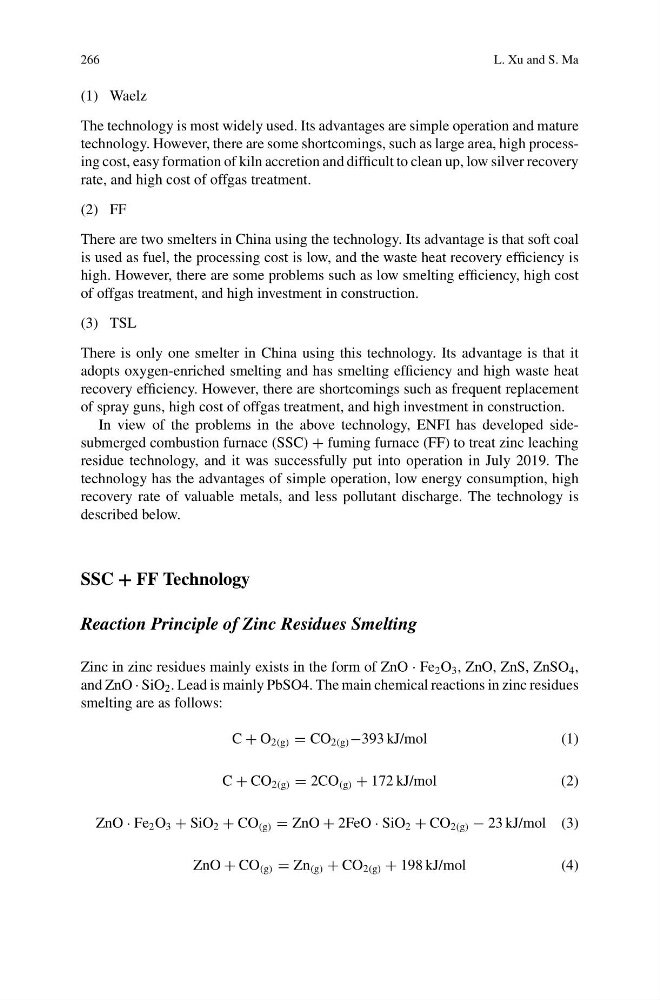
Zinc in zinc residues mainly exists in the form of ZnO · Fe 2 O 3 , ZnO, ZnS, ZnSO 4 ,
and ZnO · SiO 2 . Lead is mainly PbSO4. The main chemical reactions in zinc residues
smelting are as follows:
C + O 2(g) = CO 2(g) −393 kJ/mol
(1)
C + CO 2(g) = 2CO (g) + 172 kJ/mol
(2)
ZnO · Fe 2 O 3 + SiO 2 + CO (g) = ZnO + 2FeO · SiO 2 + CO 2(g) − 23 kJ/mol (3)
ZnO + CO (g) = Zn (g) + CO 2(g) + 198 kJ/mol
(4)
L. Xu and S. Ma
(1) Waelz
The technology is most widely used. Its advantages are simple operation and mature
technology. However, there are some shortcomings, such as large area, high processing cost, easy formation of kiln accretion and difficult to clean up, low silver recovery
rate, and high cost of offgas treatment.
(2) FF
There are two smelters in China using the technology. Its advantage is that soft coal
is used as fuel, the processing cost is low, and the waste heat recovery efficiency is
high. However, there are some problems such as low smelting efficiency, high cost
of offgas treatment, and high investment in construction.
(3) TSL
There is only one smelter in China using this technology. Its advantage is that it
adopts oxygen-enriched smelting and has smelting efficiency and high waste heat
recovery efficiency. However, there are shortcomings such as frequent replacement
of spray guns, high cost of offgas treatment, and high investment in construction.
In view of the problems in the above technology, ENFI has developed sidesubmerged combustion furnace (SSC) + fuming furnace (FF) to treat zinc leaching
residue technology, and it was successfully put into operation in July 2019. The
technology has the advantages of simple operation, low energy consumption, high
recovery rate of valuable metals, and less pollutant discharge. The technology is
described below.
SSC + FF Technology
Reaction Principle of Zinc Residues Smelting
Zinc in zinc residues mainly exists in the form of ZnO · Fe 2 O 3 , ZnO, ZnS, ZnSO 4 ,
and ZnO · SiO 2 . Lead is mainly PbSO4. The main chemical reactions in zinc residues
smelting are as follows:
C + O 2(g) = CO 2(g) −393 kJ/mol
(1)
C + CO 2(g) = 2CO (g) + 172 kJ/mol
(2)
ZnO · Fe 2 O 3 + SiO 2 + CO (g) = ZnO + 2FeO · SiO 2 + CO 2(g) − 23 kJ/mol (3)
ZnO + CO (g) = Zn (g) + CO 2(g) + 198 kJ/mol
(4)