

262
J. Kim et al.
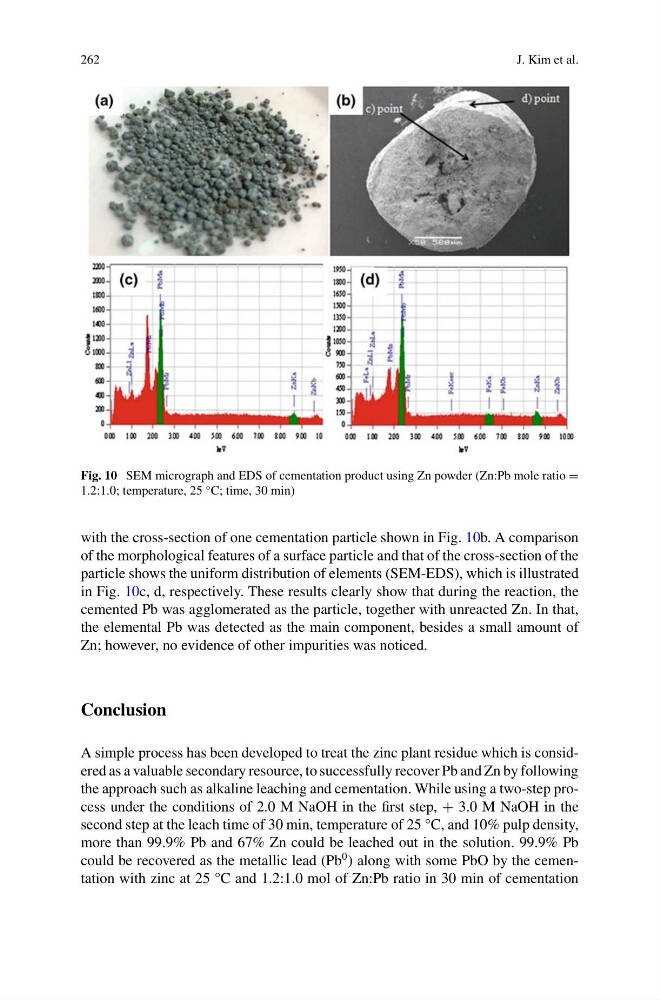
Fig. 10 SEM micrograph and EDS of cementation product using Zn powder (Zn:Pb mole ratio =
1.2:1.0; temperature, 25 °C; time, 30 min)
with the cross-section of one cementation particle shown in Fig. 10b. A comparison
of the morphological features of a surface particle and that of the cross-section of the
particle shows the uniform distribution of elements (SEM-EDS), which is illustrated
in Fig. 10c, d, respectively. These results clearly show that during the reaction, the
cemented Pb was agglomerated as the particle, together with unreacted Zn. In that,
the elemental Pb was detected as the main component, besides a small amount of
Zn; however, no evidence of other impurities was noticed.
Conclusion
A simple process has been developed to treat the zinc plant residue which is considered as a valuable secondary resource, to successfully recover Pb and Zn by following
the approach such as alkaline leaching and cementation. While using a two-step process under the conditions of 2.0 M NaOH in the first step, + 3.0 M NaOH in the
second step at the leach time of 30 min, temperature of 25 °C, and 10% pulp density,
more than 99.9% Pb and 67% Zn could be leached out in the solution. 99.9% Pb
could be recovered as the metallic lead (Pb
0 ) along with some PbO by the cementation with zinc at 25 °C and 1.2:1.0 mol of Zn:Pb ratio in 30 min of cementation
J. Kim et al.
Fig. 10 SEM micrograph and EDS of cementation product using Zn powder (Zn:Pb mole ratio =
1.2:1.0; temperature, 25 °C; time, 30 min)
with the cross-section of one cementation particle shown in Fig. 10b. A comparison
of the morphological features of a surface particle and that of the cross-section of the
particle shows the uniform distribution of elements (SEM-EDS), which is illustrated
in Fig. 10c, d, respectively. These results clearly show that during the reaction, the
cemented Pb was agglomerated as the particle, together with unreacted Zn. In that,
the elemental Pb was detected as the main component, besides a small amount of
Zn; however, no evidence of other impurities was noticed.
Conclusion
A simple process has been developed to treat the zinc plant residue which is considered as a valuable secondary resource, to successfully recover Pb and Zn by following
the approach such as alkaline leaching and cementation. While using a two-step process under the conditions of 2.0 M NaOH in the first step, + 3.0 M NaOH in the
second step at the leach time of 30 min, temperature of 25 °C, and 10% pulp density,
more than 99.9% Pb and 67% Zn could be leached out in the solution. 99.9% Pb
could be recovered as the metallic lead (Pb
0 ) along with some PbO by the cementation with zinc at 25 °C and 1.2:1.0 mol of Zn:Pb ratio in 30 min of cementation