

Recovery of Lead from Zinc Plant Residue by Alkaline Leaching …
259
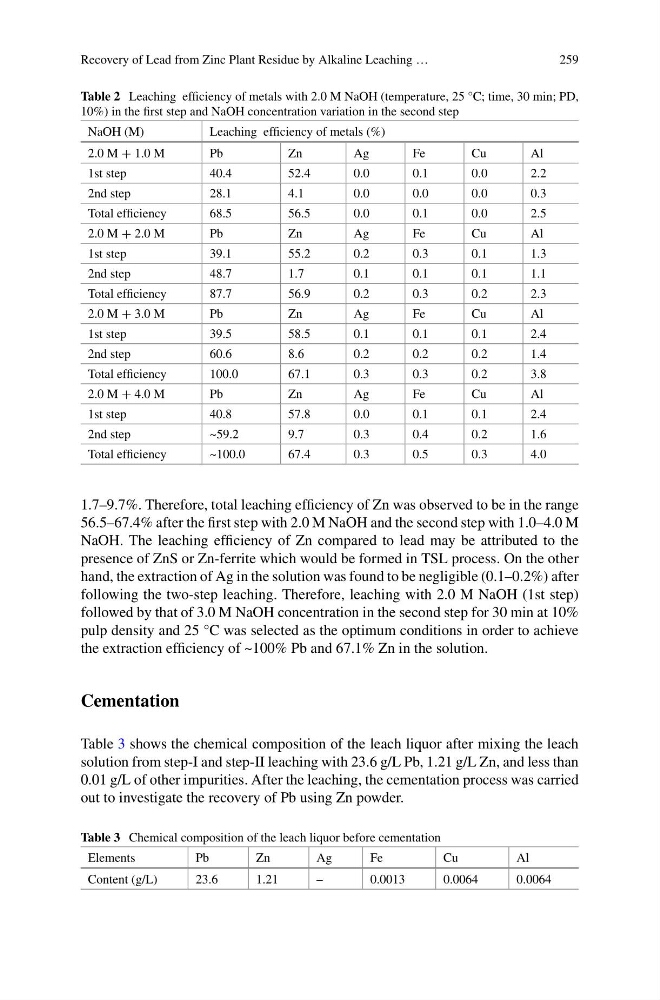
Table 2 Leaching efficiency of metals with 2.0 M NaOH (temperature, 25 °C; time, 30 min; PD,
10%) in the first step and NaOH concentration variation in the second step
NaOH (M)
Leaching efficiency of metals (%)
2.0 M + 1.0 M
Pb
Zn
Ag
Fe
Cu
Al
1st step
40.4
52.4
0.0
0.1
0.0
2.2
2nd step
28.1
4.1
0.0
0.0
0.0
0.3
Total efficiency
68.5
56.5
0.0
0.1
0.0
2.5
2.0 M + 2.0 M
Pb
Zn
Ag
Fe
Cu
Al
1st step
39.1
55.2
0.2
0.3
0.1
1.3
2nd step
48.7
1.7
0.1
0.1
0.1
1.1
Total efficiency
87.7
56.9
0.2
0.3
0.2
2.3
2.0 M + 3.0 M
Pb
Zn
Ag
Fe
Cu
Al
1st step
39.5
58.5
0.1
0.1
0.1
2.4
2nd step
60.6
8.6
0.2
0.2
0.2
1.4
Total efficiency
100.0
67.1
0.3
0.3
0.2
3.8
2.0 M + 4.0 M
Pb
Zn
Ag
Fe
Cu
Al
1st step
40.8
57.8
0.0
0.1
0.1
2.4
2nd step
~59.2
9.7
0.3
0.4
0.2
1.6
Total efficiency
~100.0
67.4
0.3
0.5
0.3
4.0
1.7–9.7%. Therefore, total leaching efficiency of Zn was observed to be in the range
56.5–67.4% after the first step with 2.0 M NaOH and the second step with 1.0–4.0 M
NaOH. The leaching efficiency of Zn compared to lead may be attributed to the
presence of ZnS or Zn-ferrite which would be formed in TSL process. On the other
hand, the extraction of Ag in the solution was found to be negligible (0.1–0.2%) after
following the two-step leaching. Therefore, leaching with 2.0 M NaOH (1st step)
followed by that of 3.0 M NaOH concentration in the second step for 30 min at 10%
pulp density and 25 °C was selected as the optimum conditions in order to achieve
the extraction efficiency of ~100% Pb and 67.1% Zn in the solution.
Cementation
Table 3 shows the chemical composition of the leach liquor after mixing the leach
solution from step-I and step-II leaching with 23.6 g/L Pb, 1.21 g/L Zn, and less than
0.01 g/L of other impurities. After the leaching, the cementation process was carried
out to investigate the recovery of Pb using Zn powder.
Table 3 Chemical composition of the leach liquor before cementation
Elements
Pb
Zn
Ag
Fe
Cu
Al
Content (g/L)
23.6
1.21
–
0.0013
0.0064
0.0064
259
Table 2 Leaching efficiency of metals with 2.0 M NaOH (temperature, 25 °C; time, 30 min; PD,
10%) in the first step and NaOH concentration variation in the second step
NaOH (M)
Leaching efficiency of metals (%)
2.0 M + 1.0 M
Pb
Zn
Ag
Fe
Cu
Al
1st step
40.4
52.4
0.0
0.1
0.0
2.2
2nd step
28.1
4.1
0.0
0.0
0.0
0.3
Total efficiency
68.5
56.5
0.0
0.1
0.0
2.5
2.0 M + 2.0 M
Pb
Zn
Ag
Fe
Cu
Al
1st step
39.1
55.2
0.2
0.3
0.1
1.3
2nd step
48.7
1.7
0.1
0.1
0.1
1.1
Total efficiency
87.7
56.9
0.2
0.3
0.2
2.3
2.0 M + 3.0 M
Pb
Zn
Ag
Fe
Cu
Al
1st step
39.5
58.5
0.1
0.1
0.1
2.4
2nd step
60.6
8.6
0.2
0.2
0.2
1.4
Total efficiency
100.0
67.1
0.3
0.3
0.2
3.8
2.0 M + 4.0 M
Pb
Zn
Ag
Fe
Cu
Al
1st step
40.8
57.8
0.0
0.1
0.1
2.4
2nd step
~59.2
9.7
0.3
0.4
0.2
1.6
Total efficiency
~100.0
67.4
0.3
0.5
0.3
4.0
1.7–9.7%. Therefore, total leaching efficiency of Zn was observed to be in the range
56.5–67.4% after the first step with 2.0 M NaOH and the second step with 1.0–4.0 M
NaOH. The leaching efficiency of Zn compared to lead may be attributed to the
presence of ZnS or Zn-ferrite which would be formed in TSL process. On the other
hand, the extraction of Ag in the solution was found to be negligible (0.1–0.2%) after
following the two-step leaching. Therefore, leaching with 2.0 M NaOH (1st step)
followed by that of 3.0 M NaOH concentration in the second step for 30 min at 10%
pulp density and 25 °C was selected as the optimum conditions in order to achieve
the extraction efficiency of ~100% Pb and 67.1% Zn in the solution.
Cementation
Table 3 shows the chemical composition of the leach liquor after mixing the leach
solution from step-I and step-II leaching with 23.6 g/L Pb, 1.21 g/L Zn, and less than
0.01 g/L of other impurities. After the leaching, the cementation process was carried
out to investigate the recovery of Pb using Zn powder.
Table 3 Chemical composition of the leach liquor before cementation
Elements
Pb
Zn
Ag
Fe
Cu
Al
Content (g/L)
23.6
1.21
–
0.0013
0.0064
0.0064