

254
J. Kim et al.
for the zinc metal production. On the other hand, insoluble lead sulfate formed during the sulfuric leaching, besides the cadmium, silver, etc., are also concentrated in
this residue. Therefore, it is worth recovering the valuable metals available in this
secondary resource.
With the purpose of comprehensive recovery of valuable metals from the zinc
plant residue (ZPR) from leaching step with the stress on the low energy consumption without any pre-treatment process, this study was carried out. The objective is
to evaluate the possibility of recovering lead completely through a two-step alkaline
leaching followed by cementation. The effects of parameters such as NaOH concentration, leaching time, temperature, and pulp density on the leaching of lead and
NaOH concentration on the second step leaching were examined. Finally, the leach
liquor after two-step leaching was subjected to the cementation process to obtain
cemented Pb using Zn powder in the alkaline media.
Experimental
Material
Zinc plant residue sample used in this study was supplied by Young Poong Company (Kangwon, Korea). The ZPR sample as received contained some moisture, and
therefore, it was dried at room temperature and then subjected to grinding to obtain
the particle size of <315 µm (−50 mesh sieve). The chemical analysis of the digested
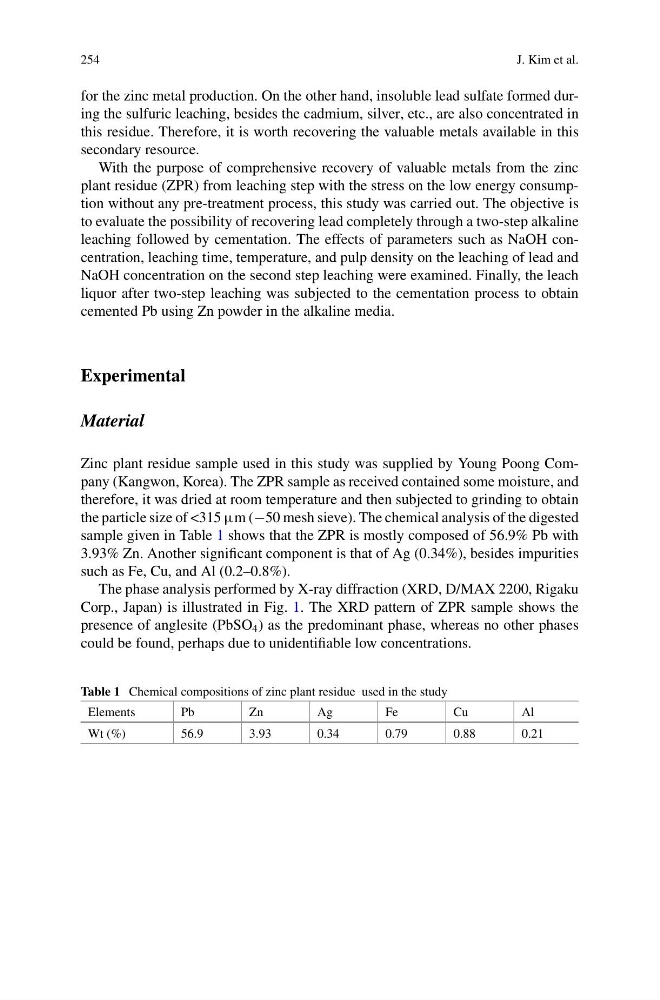
sample given in Table 1 shows that the ZPR is mostly composed of 56.9% Pb with
3.93% Zn. Another significant component is that of Ag (0.34%), besides impurities
such as Fe, Cu, and Al (0.2–0.8%).
The phase analysis performed by X-ray diffraction (XRD, D/MAX 2200, Rigaku
Corp., Japan) is illustrated in Fig. 1. The XRD pattern of ZPR sample shows the
presence of anglesite (PbSO 4 ) as the predominant phase, whereas no other phases
could be found, perhaps due to unidentifiable low concentrations.
Table 1 Chemical compositions of zinc plant residue used in the study
Elements
Pb
Zn
Ag
Fe
Cu
Al
Wt (%)
56.9
3.93
0.34
0.79
0.88
0.21
J. Kim et al.
for the zinc metal production. On the other hand, insoluble lead sulfate formed during the sulfuric leaching, besides the cadmium, silver, etc., are also concentrated in
this residue. Therefore, it is worth recovering the valuable metals available in this
secondary resource.
With the purpose of comprehensive recovery of valuable metals from the zinc
plant residue (ZPR) from leaching step with the stress on the low energy consumption without any pre-treatment process, this study was carried out. The objective is
to evaluate the possibility of recovering lead completely through a two-step alkaline
leaching followed by cementation. The effects of parameters such as NaOH concentration, leaching time, temperature, and pulp density on the leaching of lead and
NaOH concentration on the second step leaching were examined. Finally, the leach
liquor after two-step leaching was subjected to the cementation process to obtain
cemented Pb using Zn powder in the alkaline media.
Experimental
Material
Zinc plant residue sample used in this study was supplied by Young Poong Company (Kangwon, Korea). The ZPR sample as received contained some moisture, and
therefore, it was dried at room temperature and then subjected to grinding to obtain
the particle size of <315 µm (−50 mesh sieve). The chemical analysis of the digested
sample given in Table 1 shows that the ZPR is mostly composed of 56.9% Pb with
3.93% Zn. Another significant component is that of Ag (0.34%), besides impurities
such as Fe, Cu, and Al (0.2–0.8%).
The phase analysis performed by X-ray diffraction (XRD, D/MAX 2200, Rigaku
Corp., Japan) is illustrated in Fig. 1. The XRD pattern of ZPR sample shows the
presence of anglesite (PbSO 4 ) as the predominant phase, whereas no other phases
could be found, perhaps due to unidentifiable low concentrations.
Table 1 Chemical compositions of zinc plant residue used in the study
Elements
Pb
Zn
Ag
Fe
Cu
Al
Wt (%)
56.9
3.93
0.34
0.79
0.88
0.21