

236
F. M. Teixeira et al.
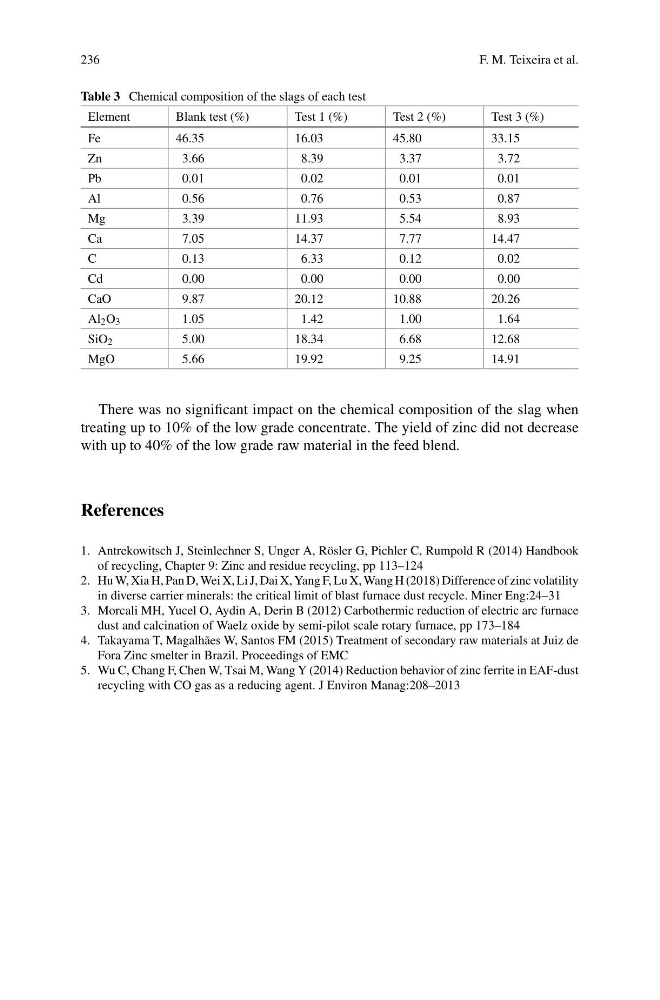
Table 3 Chemical composition of the slags of each test
Element
Blank test (%)
Test 1 (%)
Test 2 (%)
Test 3 (%)
Fe
46.35
16.03
45.80
33.15
Zn
3.66
8.39
3.37
3.72
Pb
0.01
0.02
0.01
0.01
Al
0.56
0.76
0.53
0.87
Mg
3.39
11.93
5.54
8.93
Ca
7.05
14.37
7.77
14.47
C
0.13
6.33
0.12
0.02
Cd
0.00
0.00
0.00
0.00
CaO
9.87
20.12
10.88
20.26
Al 2 O 3
1.05
1.42
1.00
1.64
SiO 2
5.00
18.34
6.68
12.68
MgO
5.66
19.92
9.25
14.91
There was no significant impact on the chemical composition of the slag when
treating up to 10% of the low grade concentrate. The yield of zinc did not decrease
with up to 40% of the low grade raw material in the feed blend.
References
1. Antrekowitsch J, Steinlechner S, Unger A, Rösler G, Pichler C, Rumpold R (2014) Handbook
of recycling, Chapter 9: Zinc and residue recycling, pp 113–124
2. Hu W, Xia H, Pan D, Wei X, Li J, Dai X, Yang F, Lu X, Wang H (2018) Difference of zinc volatility
in diverse carrier minerals: the critical limit of blast furnace dust recycle. Miner Eng:24–31
3. Morcali MH, Yucel O, Aydin A, Derin B (2012) Carbothermic reduction of electric arc furnace
dust and calcination of Waelz oxide by semi-pilot scale rotary furnace, pp 173–184
4. Takayama T, Magalhães W, Santos FM (2015) Treatment of secondary raw materials at Juiz de
Fora Zinc smelter in Brazil. Proceedings of EMC
5. Wu C, Chang F, Chen W, Tsai M, Wang Y (2014) Reduction behavior of zinc ferrite in EAF-dust
recycling with CO gas as a reducing agent. J Environ Manag:208–2013
F. M. Teixeira et al.
Table 3 Chemical composition of the slags of each test
Element
Blank test (%)
Test 1 (%)
Test 2 (%)
Test 3 (%)
Fe
46.35
16.03
45.80
33.15
Zn
3.66
8.39
3.37
3.72
Pb
0.01
0.02
0.01
0.01
Al
0.56
0.76
0.53
0.87
Mg
3.39
11.93
5.54
8.93
Ca
7.05
14.37
7.77
14.47
C
0.13
6.33
0.12
0.02
Cd
0.00
0.00
0.00
0.00
CaO
9.87
20.12
10.88
20.26
Al 2 O 3
1.05
1.42
1.00
1.64
SiO 2
5.00
18.34
6.68
12.68
MgO
5.66
19.92
9.25
14.91
There was no significant impact on the chemical composition of the slag when
treating up to 10% of the low grade concentrate. The yield of zinc did not decrease
with up to 40% of the low grade raw material in the feed blend.
References
1. Antrekowitsch J, Steinlechner S, Unger A, Rösler G, Pichler C, Rumpold R (2014) Handbook
of recycling, Chapter 9: Zinc and residue recycling, pp 113–124
2. Hu W, Xia H, Pan D, Wei X, Li J, Dai X, Yang F, Lu X, Wang H (2018) Difference of zinc volatility
in diverse carrier minerals: the critical limit of blast furnace dust recycle. Miner Eng:24–31
3. Morcali MH, Yucel O, Aydin A, Derin B (2012) Carbothermic reduction of electric arc furnace
dust and calcination of Waelz oxide by semi-pilot scale rotary furnace, pp 173–184
4. Takayama T, Magalhães W, Santos FM (2015) Treatment of secondary raw materials at Juiz de
Fora Zinc smelter in Brazil. Proceedings of EMC
5. Wu C, Chang F, Chen W, Tsai M, Wang Y (2014) Reduction behavior of zinc ferrite in EAF-dust
recycling with CO gas as a reducing agent. J Environ Manag:208–2013