

234
F. M. Teixeira et al.
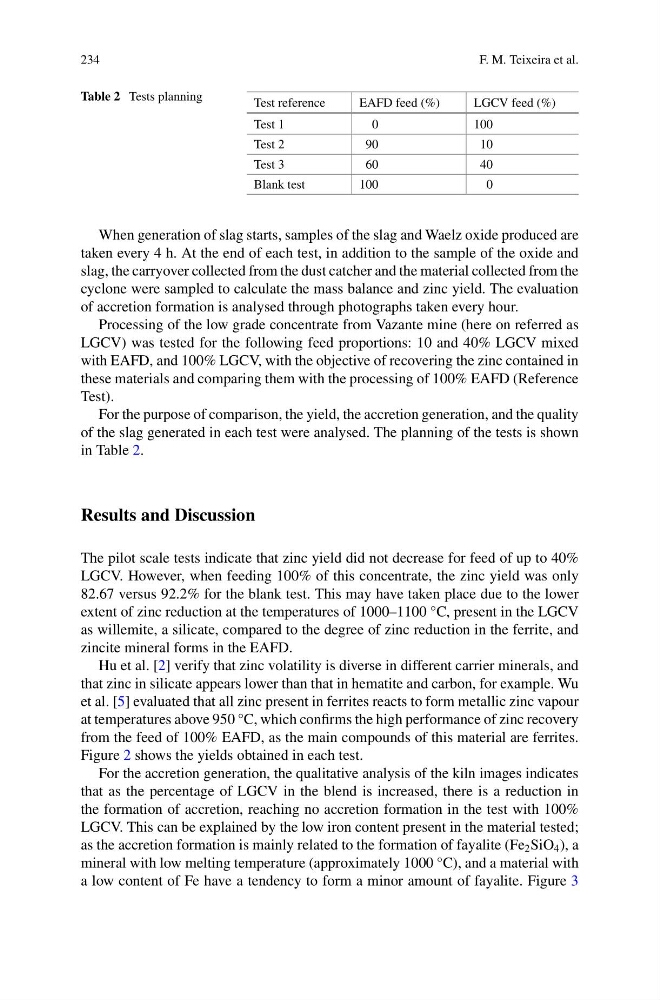
Table 2 Tests planning
Test reference
EAFD feed (%)
LGCV feed (%)
Test 1
0
100
Test 2
90
10
Test 3
60
40
Blank test
100
0
When generation of slag starts, samples of the slag and Waelz oxide produced are
taken every 4 h. At the end of each test, in addition to the sample of the oxide and
slag, the carryover collected from the dust catcher and the material collected from the
cyclone were sampled to calculate the mass balance and zinc yield. The evaluation
of accretion formation is analysed through photographs taken every hour.
Processing of the low grade concentrate from Vazante mine (here on referred as
LGCV) was tested for the following feed proportions: 10 and 40% LGCV mixed
with EAFD, and 100% LGCV, with the objective of recovering the zinc contained in
these materials and comparing them with the processing of 100% EAFD (Reference
Test).
For the purpose of comparison, the yield, the accretion generation, and the quality
of the slag generated in each test were analysed. The planning of the tests is shown
in Table 2.
Results and Discussion
The pilot scale tests indicate that zinc yield did not decrease for feed of up to 40%
LGCV. However, when feeding 100% of this concentrate, the zinc yield was only
82.67 versus 92.2% for the blank test. This may have taken place due to the lower
extent of zinc reduction at the temperatures of 1000–1100 °C, present in the LGCV
as willemite, a silicate, compared to the degree of zinc reduction in the ferrite, and
zincite mineral forms in the EAFD.
Hu et al. [2] verify that zinc volatility is diverse in different carrier minerals, and
that zinc in silicate appears lower than that in hematite and carbon, for example. Wu
et al. [5] evaluated that all zinc present in ferrites reacts to form metallic zinc vapour
at temperatures above 950 °C, which confirms the high performance of zinc recovery
from the feed of 100% EAFD, as the main compounds of this material are ferrites.
Figure 2 shows the yields obtained in each test.
For the accretion generation, the qualitative analysis of the kiln images indicates
that as the percentage of LGCV in the blend is increased, there is a reduction in
the formation of accretion, reaching no accretion formation in the test with 100%
LGCV. This can be explained by the low iron content present in the material tested;
as the accretion formation is mainly related to the formation of fayalite (Fe 2 SiO 4 ), a
mineral with low melting temperature (approximately 1000 °C), and a material with
a low content of Fe have a tendency to form a minor amount of fayalite. Figure 3
F. M. Teixeira et al.
Table 2 Tests planning
Test reference
EAFD feed (%)
LGCV feed (%)
Test 1
0
100
Test 2
90
10
Test 3
60
40
Blank test
100
0
When generation of slag starts, samples of the slag and Waelz oxide produced are
taken every 4 h. At the end of each test, in addition to the sample of the oxide and
slag, the carryover collected from the dust catcher and the material collected from the
cyclone were sampled to calculate the mass balance and zinc yield. The evaluation
of accretion formation is analysed through photographs taken every hour.
Processing of the low grade concentrate from Vazante mine (here on referred as
LGCV) was tested for the following feed proportions: 10 and 40% LGCV mixed
with EAFD, and 100% LGCV, with the objective of recovering the zinc contained in
these materials and comparing them with the processing of 100% EAFD (Reference
Test).
For the purpose of comparison, the yield, the accretion generation, and the quality
of the slag generated in each test were analysed. The planning of the tests is shown
in Table 2.
Results and Discussion
The pilot scale tests indicate that zinc yield did not decrease for feed of up to 40%
LGCV. However, when feeding 100% of this concentrate, the zinc yield was only
82.67 versus 92.2% for the blank test. This may have taken place due to the lower
extent of zinc reduction at the temperatures of 1000–1100 °C, present in the LGCV
as willemite, a silicate, compared to the degree of zinc reduction in the ferrite, and
zincite mineral forms in the EAFD.
Hu et al. [2] verify that zinc volatility is diverse in different carrier minerals, and
that zinc in silicate appears lower than that in hematite and carbon, for example. Wu
et al. [5] evaluated that all zinc present in ferrites reacts to form metallic zinc vapour
at temperatures above 950 °C, which confirms the high performance of zinc recovery
from the feed of 100% EAFD, as the main compounds of this material are ferrites.
Figure 2 shows the yields obtained in each test.
For the accretion generation, the qualitative analysis of the kiln images indicates
that as the percentage of LGCV in the blend is increased, there is a reduction in
the formation of accretion, reaching no accretion formation in the test with 100%
LGCV. This can be explained by the low iron content present in the material tested;
as the accretion formation is mainly related to the formation of fayalite (Fe 2 SiO 4 ), a
mineral with low melting temperature (approximately 1000 °C), and a material with
a low content of Fe have a tendency to form a minor amount of fayalite. Figure 3