

228
T. Yamaguchi
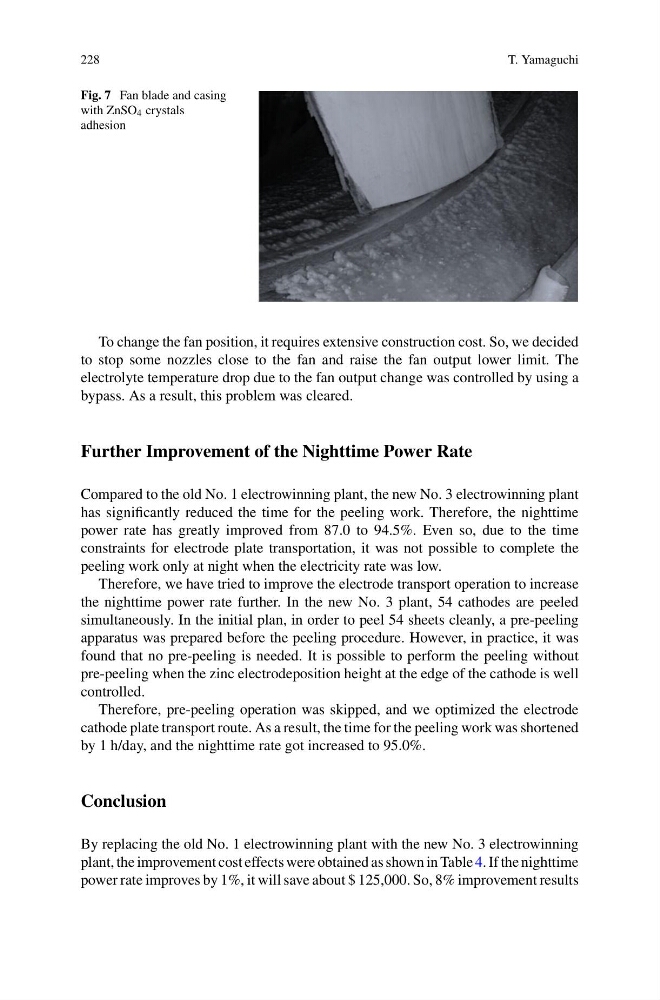
Fig. 7 Fan blade and casing
with ZnSO 4 crystals
adhesion
To change the fan position, it requires extensive construction cost. So, we decided
to stop some nozzles close to the fan and raise the fan output lower limit. The
electrolyte temperature drop due to the fan output change was controlled by using a
bypass. As a result, this problem was cleared.
Further Improvement of the Nighttime Power Rate
Compared to the old No. 1 electrowinning plant, the new No. 3 electrowinning plant
has significantly reduced the time for the peeling work. Therefore, the nighttime
power rate has greatly improved from 87.0 to 94.5%. Even so, due to the time
constraints for electrode plate transportation, it was not possible to complete the
peeling work only at night when the electricity rate was low.
Therefore, we have tried to improve the electrode transport operation to increase
the nighttime power rate further. In the new No. 3 plant, 54 cathodes are peeled
simultaneously. In the initial plan, in order to peel 54 sheets cleanly, a pre-peeling
apparatus was prepared before the peeling procedure. However, in practice, it was
found that no pre-peeling is needed. It is possible to perform the peeling without
pre-peeling when the zinc electrodeposition height at the edge of the cathode is well
controlled.
Therefore, pre-peeling operation was skipped, and we optimized the electrode
cathode plate transport route. As a result, the time for the peeling work was shortened
by 1 h/day, and the nighttime rate got increased to 95.0%.
Conclusion
By replacing the old No. 1 electrowinning plant with the new No. 3 electrowinning
plant, the improvement cost effects were obtained as shown in Table 4. If the nighttime
power rate improves by 1%, it will save about $ 125,000. So, 8% improvement results
T. Yamaguchi
Fig. 7 Fan blade and casing
with ZnSO 4 crystals
adhesion
To change the fan position, it requires extensive construction cost. So, we decided
to stop some nozzles close to the fan and raise the fan output lower limit. The
electrolyte temperature drop due to the fan output change was controlled by using a
bypass. As a result, this problem was cleared.
Further Improvement of the Nighttime Power Rate
Compared to the old No. 1 electrowinning plant, the new No. 3 electrowinning plant
has significantly reduced the time for the peeling work. Therefore, the nighttime
power rate has greatly improved from 87.0 to 94.5%. Even so, due to the time
constraints for electrode plate transportation, it was not possible to complete the
peeling work only at night when the electricity rate was low.
Therefore, we have tried to improve the electrode transport operation to increase
the nighttime power rate further. In the new No. 3 plant, 54 cathodes are peeled
simultaneously. In the initial plan, in order to peel 54 sheets cleanly, a pre-peeling
apparatus was prepared before the peeling procedure. However, in practice, it was
found that no pre-peeling is needed. It is possible to perform the peeling without
pre-peeling when the zinc electrodeposition height at the edge of the cathode is well
controlled.
Therefore, pre-peeling operation was skipped, and we optimized the electrode
cathode plate transport route. As a result, the time for the peeling work was shortened
by 1 h/day, and the nighttime rate got increased to 95.0%.
Conclusion
By replacing the old No. 1 electrowinning plant with the new No. 3 electrowinning
plant, the improvement cost effects were obtained as shown in Table 4. If the nighttime
power rate improves by 1%, it will save about $ 125,000. So, 8% improvement results