

224
T. Yamaguchi
Power Usage Pattern of Electrowinning Plant in Annaka
Refinery
In Japan, the electric price of holiday and nighttime of weekdays is significantly
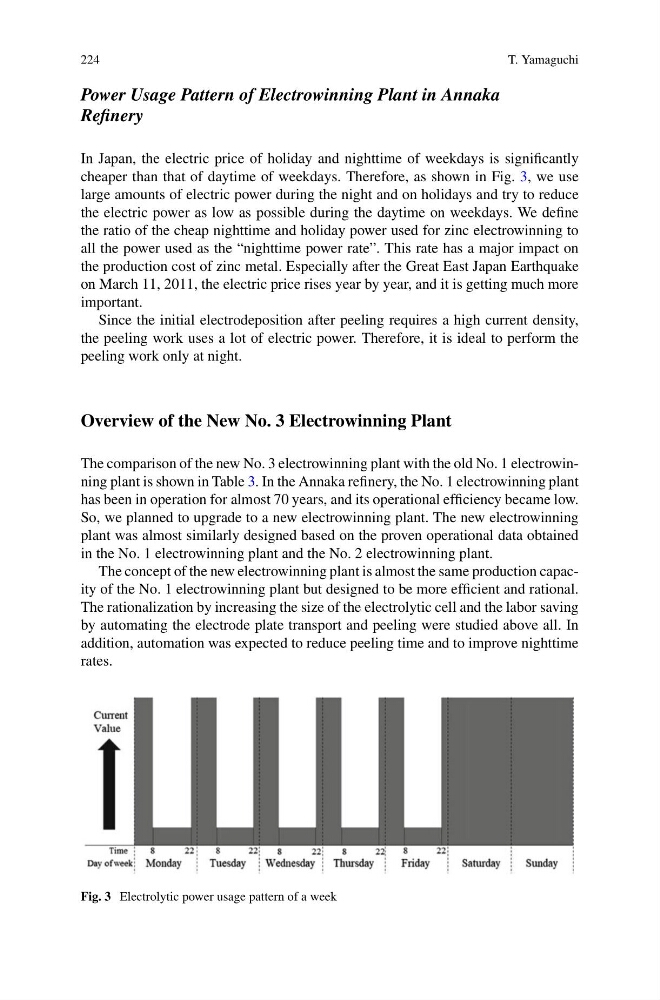
cheaper than that of daytime of weekdays. Therefore, as shown in Fig. 3, we use
large amounts of electric power during the night and on holidays and try to reduce
the electric power as low as possible during the daytime on weekdays. We define
the ratio of the cheap nighttime and holiday power used for zinc electrowinning to
all the power used as the “nighttime power rate”. This rate has a major impact on
the production cost of zinc metal. Especially after the Great East Japan Earthquake
on March 11, 2011, the electric price rises year by year, and it is getting much more
important.
Since the initial electrodeposition after peeling requires a high current density,
the peeling work uses a lot of electric power. Therefore, it is ideal to perform the
peeling work only at night.
Overview of the New No. 3 Electrowinning Plant
The comparison of the new No. 3 electrowinning plant with the old No. 1 electrowinning plant is shown in Table 3. In the Annaka refinery, the No. 1 electrowinning plant
has been in operation for almost 70 years, and its operational efficiency became low.
So, we planned to upgrade to a new electrowinning plant. The new electrowinning
plant was almost similarly designed based on the proven operational data obtained
in the No. 1 electrowinning plant and the No. 2 electrowinning plant.
The concept of the new electrowinning plant is almost the same production capacity of the No. 1 electrowinning plant but designed to be more efficient and rational.
The rationalization by increasing the size of the electrolytic cell and the labor saving
by automating the electrode plate transport and peeling were studied above all. In
addition, automation was expected to reduce peeling time and to improve nighttime
rates.
Fig. 3 Electrolytic power usage pattern of a week
T. Yamaguchi
Power Usage Pattern of Electrowinning Plant in Annaka
Refinery
In Japan, the electric price of holiday and nighttime of weekdays is significantly
cheaper than that of daytime of weekdays. Therefore, as shown in Fig. 3, we use
large amounts of electric power during the night and on holidays and try to reduce
the electric power as low as possible during the daytime on weekdays. We define
the ratio of the cheap nighttime and holiday power used for zinc electrowinning to
all the power used as the “nighttime power rate”. This rate has a major impact on
the production cost of zinc metal. Especially after the Great East Japan Earthquake
on March 11, 2011, the electric price rises year by year, and it is getting much more
important.
Since the initial electrodeposition after peeling requires a high current density,
the peeling work uses a lot of electric power. Therefore, it is ideal to perform the
peeling work only at night.
Overview of the New No. 3 Electrowinning Plant
The comparison of the new No. 3 electrowinning plant with the old No. 1 electrowinning plant is shown in Table 3. In the Annaka refinery, the No. 1 electrowinning plant
has been in operation for almost 70 years, and its operational efficiency became low.
So, we planned to upgrade to a new electrowinning plant. The new electrowinning
plant was almost similarly designed based on the proven operational data obtained
in the No. 1 electrowinning plant and the No. 2 electrowinning plant.
The concept of the new electrowinning plant is almost the same production capacity of the No. 1 electrowinning plant but designed to be more efficient and rational.
The rationalization by increasing the size of the electrolytic cell and the labor saving
by automating the electrode plate transport and peeling were studied above all. In
addition, automation was expected to reduce peeling time and to improve nighttime
rates.
Fig. 3 Electrolytic power usage pattern of a week