

Application of CSC Technology in Nonferrous Metallurgy
213
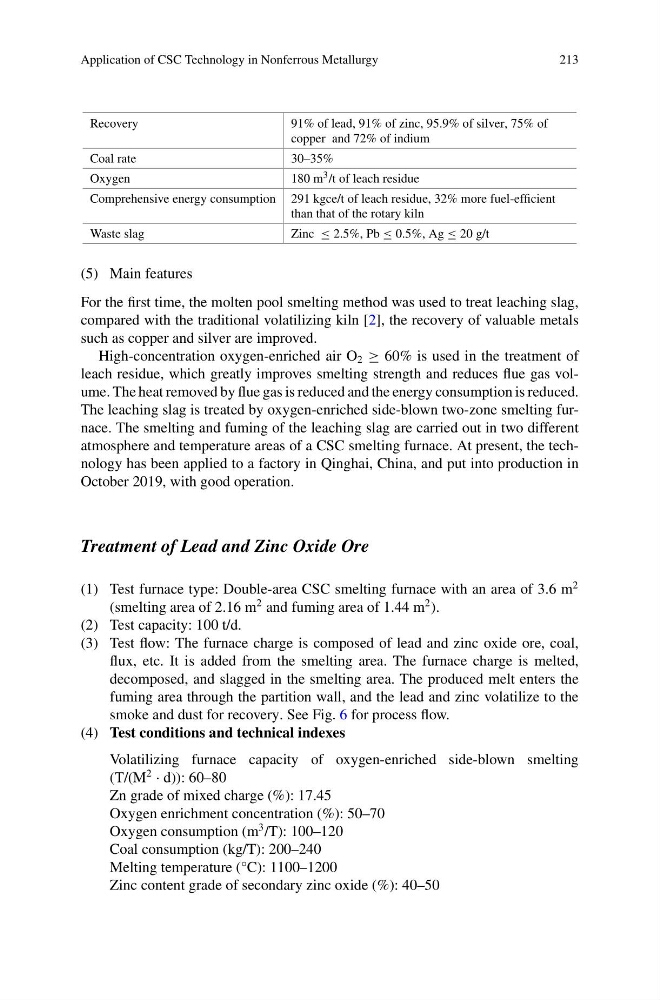
Recovery
91% of lead, 91% of zinc, 95.9% of silver, 75% of
copper and 72% of indium
Coal rate
30–35%
Oxygen
180 m 3 /t of leach residue
Comprehensive energy consumption 291 kgce/t of leach residue, 32% more fuel-efficient
than that of the rotary kiln
Waste slag
Zinc ≤ 2.5%, Pb ≤ 0.5%, Ag ≤ 20 g/t
(5) Main features
For the first time, the molten pool smelting method was used to treat leaching slag,
compared with the traditional volatilizing kiln [2], the recovery of valuable metals
such as copper and silver are improved.
High-concentration oxygen-enriched air O 2 ≥ 60% is used in the treatment of
leach residue, which greatly improves smelting strength and reduces flue gas volume. The heat removed by flue gas is reduced and the energy consumption is reduced.
The leaching slag is treated by oxygen-enriched side-blown two-zone smelting furnace. The smelting and fuming of the leaching slag are carried out in two different
atmosphere and temperature areas of a CSC smelting furnace. At present, the technology has been applied to a factory in Qinghai, China, and put into production in
October 2019, with good operation.
Treatment of Lead and Zinc Oxide Ore
(1) Test furnace type: Double-area CSC smelting furnace with an area of 3.6 m
2
(smelting area of 2.16 m
2 and fuming area of 1.44 m
2 ).
(2) Test capacity: 100 t/d.
(3) Test flow: The furnace charge is composed of lead and zinc oxide ore, coal,
flux, etc. It is added from the smelting area. The furnace charge is melted,
decomposed, and slagged in the smelting area. The produced melt enters the
fuming area through the partition wall, and the lead and zinc volatilize to the
smoke and dust for recovery. See Fig. 6 for process flow.
(4) Test conditions and technical indexes
Volatilizing furnace capacity of oxygen-enriched side-blown smelting
(T/(M
2 · d)): 60–80
Zn grade of mixed charge (%): 17.45
Oxygen enrichment concentration (%): 50–70
Oxygen consumption (m
3 /T): 100–120
Coal consumption (kg/T): 200–240
Melting temperature (°C): 1100–1200
Zinc content grade of secondary zinc oxide (%): 40–50
213
Recovery
91% of lead, 91% of zinc, 95.9% of silver, 75% of
copper and 72% of indium
Coal rate
30–35%
Oxygen
180 m 3 /t of leach residue
Comprehensive energy consumption 291 kgce/t of leach residue, 32% more fuel-efficient
than that of the rotary kiln
Waste slag
Zinc ≤ 2.5%, Pb ≤ 0.5%, Ag ≤ 20 g/t
(5) Main features
For the first time, the molten pool smelting method was used to treat leaching slag,
compared with the traditional volatilizing kiln [2], the recovery of valuable metals
such as copper and silver are improved.
High-concentration oxygen-enriched air O 2 ≥ 60% is used in the treatment of
leach residue, which greatly improves smelting strength and reduces flue gas volume. The heat removed by flue gas is reduced and the energy consumption is reduced.
The leaching slag is treated by oxygen-enriched side-blown two-zone smelting furnace. The smelting and fuming of the leaching slag are carried out in two different
atmosphere and temperature areas of a CSC smelting furnace. At present, the technology has been applied to a factory in Qinghai, China, and put into production in
October 2019, with good operation.
Treatment of Lead and Zinc Oxide Ore
(1) Test furnace type: Double-area CSC smelting furnace with an area of 3.6 m
2
(smelting area of 2.16 m
2 and fuming area of 1.44 m
2 ).
(2) Test capacity: 100 t/d.
(3) Test flow: The furnace charge is composed of lead and zinc oxide ore, coal,
flux, etc. It is added from the smelting area. The furnace charge is melted,
decomposed, and slagged in the smelting area. The produced melt enters the
fuming area through the partition wall, and the lead and zinc volatilize to the
smoke and dust for recovery. See Fig. 6 for process flow.
(4) Test conditions and technical indexes
Volatilizing furnace capacity of oxygen-enriched side-blown smelting
(T/(M
2 · d)): 60–80
Zn grade of mixed charge (%): 17.45
Oxygen enrichment concentration (%): 50–70
Oxygen consumption (m
3 /T): 100–120
Coal consumption (kg/T): 200–240
Melting temperature (°C): 1100–1200
Zinc content grade of secondary zinc oxide (%): 40–50