

188
P. Weber et al.
In the TSL process lead bullion, slag and waste gas are produced. The lead bullion
is treated in a refining plant to produce lead alloys and crude silver. However, the
product slag from the TSL still contains 36–63% Pb. Before the new plant was built,
this slag was sold abroad for treatment to recover lead.
With the goal of recovering valuable lead metal from the TSL slag, WMG wanted
to expand the site with a lead recovery plant based on the so-called side-blowing
furnace (SBF) technology. The furnace shell was sourced by WMG themselves from
China, while the rest of the plant equipment supply, the adaptation of the Chinese
technology to European standards, and the integration into the existing production
site was accomplished by German company Kuettner as an EPC project.
Due to environmental requirements, this expansion of the lead operations had to
ensure a decrease of the existing emission footprint of the entire plant. Therefore, a
state of the art off-gas system had to be designed to meet most stringent standards
not only with respect to dust emissions but even more so when it comes to limit the
SO 2 emission to a maximum of 250 mg/Nm
3 . This is achieved without using a wet
scrubbing system with its inherent cost for effluent treatment. In addition, the new
off-gas system integrates several existing emission sources from TSL operations to
facilitate the reduction of overall plant emissions.
Process Description
The raw materials to be treated in the SBF are liquid primary slag from the existing
TSL, as well as some solid TSL or other furnace slag from stockpile. The function
of the SBF reduction furnace is to reduce the lead content in the slag and to recover
lead as metal bullion.
The operation of the reduction furnace is in batch mode. Batch duration is 120 min,
which means that the reduction furnace requires fresh slag from the TSL furnace
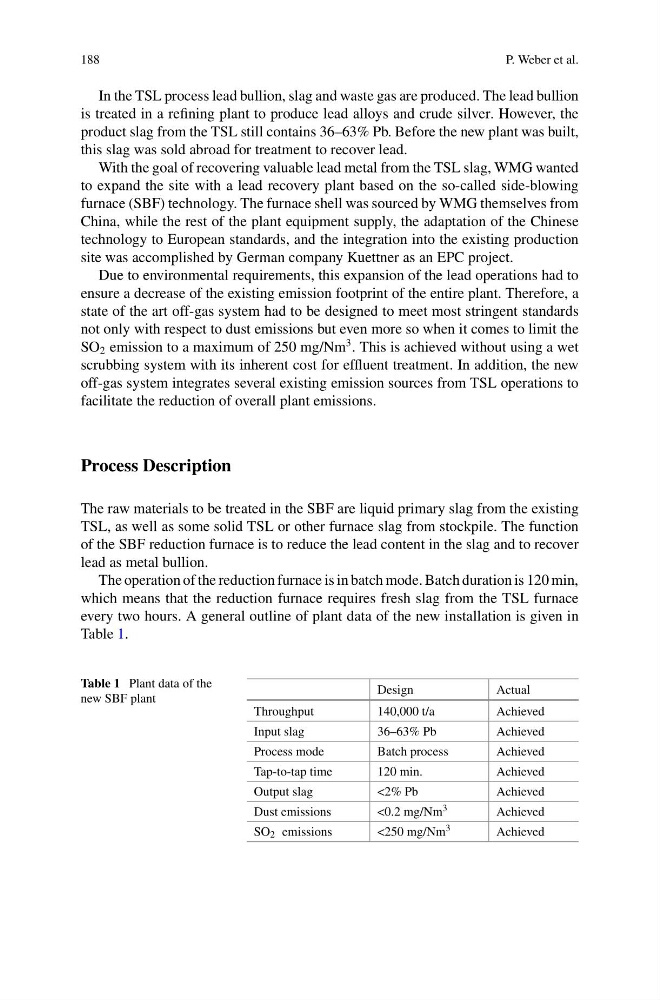
every two hours. A general outline of plant data of the new installation is given in
Table 1.
Table 1 Plant data of the
new SBF plant
Design
Actual
Throughput
140,000 t/a
Achieved
Input slag
36–63% Pb
Achieved
Process mode
Batch process
Achieved
Tap-to-tap time
120 min.
Achieved
Output slag
<2% Pb
Achieved
Dust emissions
<0.2 mg/Nm 3
Achieved
SO 2 emissions
<250 mg/Nm 3
Achieved
P. Weber et al.
In the TSL process lead bullion, slag and waste gas are produced. The lead bullion
is treated in a refining plant to produce lead alloys and crude silver. However, the
product slag from the TSL still contains 36–63% Pb. Before the new plant was built,
this slag was sold abroad for treatment to recover lead.
With the goal of recovering valuable lead metal from the TSL slag, WMG wanted
to expand the site with a lead recovery plant based on the so-called side-blowing
furnace (SBF) technology. The furnace shell was sourced by WMG themselves from
China, while the rest of the plant equipment supply, the adaptation of the Chinese
technology to European standards, and the integration into the existing production
site was accomplished by German company Kuettner as an EPC project.
Due to environmental requirements, this expansion of the lead operations had to
ensure a decrease of the existing emission footprint of the entire plant. Therefore, a
state of the art off-gas system had to be designed to meet most stringent standards
not only with respect to dust emissions but even more so when it comes to limit the
SO 2 emission to a maximum of 250 mg/Nm
3 . This is achieved without using a wet
scrubbing system with its inherent cost for effluent treatment. In addition, the new
off-gas system integrates several existing emission sources from TSL operations to
facilitate the reduction of overall plant emissions.
Process Description
The raw materials to be treated in the SBF are liquid primary slag from the existing
TSL, as well as some solid TSL or other furnace slag from stockpile. The function
of the SBF reduction furnace is to reduce the lead content in the slag and to recover
lead as metal bullion.
The operation of the reduction furnace is in batch mode. Batch duration is 120 min,
which means that the reduction furnace requires fresh slag from the TSL furnace
every two hours. A general outline of plant data of the new installation is given in
Table 1.
Table 1 Plant data of the
new SBF plant
Design
Actual
Throughput
140,000 t/a
Achieved
Input slag
36–63% Pb
Achieved
Process mode
Batch process
Achieved
Tap-to-tap time
120 min.
Achieved
Output slag
<2% Pb
Achieved
Dust emissions
<0.2 mg/Nm 3
Achieved
SO 2 emissions
<250 mg/Nm 3
Achieved