

182
R. Vanparys et al.
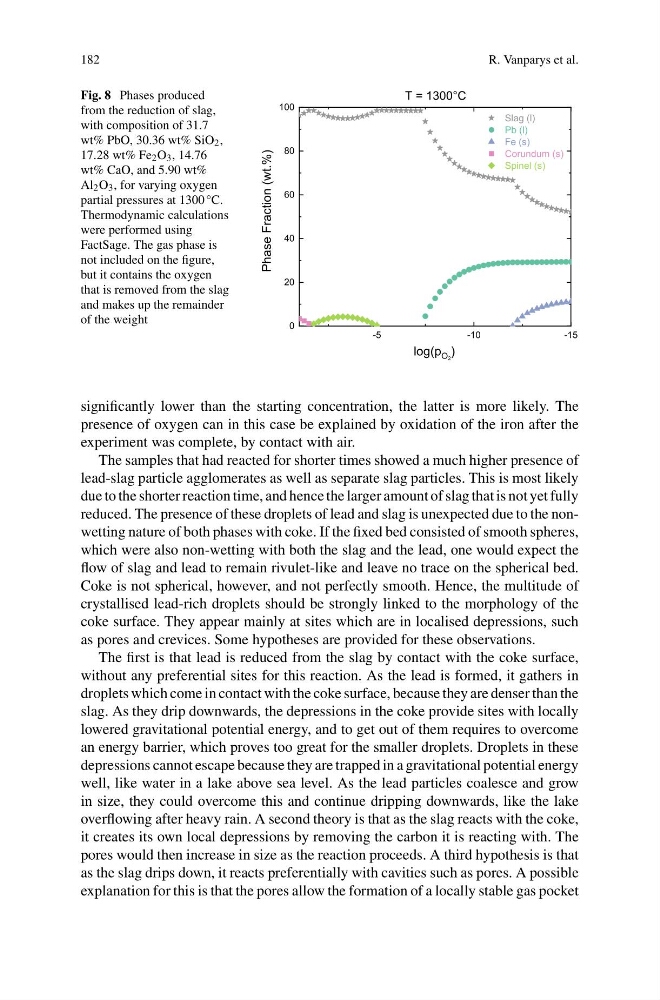
Fig. 8 Phases produced
from the reduction of slag,
with composition of 31.7
wt% PbO, 30.36 wt% SiO 2 ,
17.28 wt% Fe 2 O 3 , 14.76
wt% CaO, and 5.90 wt%
Al 2 O 3 , for varying oxygen
partial pressures at 1300 °C.
Thermodynamic calculations
were performed using
FactSage. The gas phase is
not included on the figure,
but it contains the oxygen
that is removed from the slag
and makes up the remainder
of the weight
significantly lower than the starting concentration, the latter is more likely. The
presence of oxygen can in this case be explained by oxidation of the iron after the
experiment was complete, by contact with air.
The samples that had reacted for shorter times showed a much higher presence of
lead-slag particle agglomerates as well as separate slag particles. This is most likely
due to the shorter reaction time, and hence the larger amount of slag that is not yet fully
reduced. The presence of these droplets of lead and slag is unexpected due to the nonwetting nature of both phases with coke. If the fixed bed consisted of smooth spheres,
which were also non-wetting with both the slag and the lead, one would expect the
flow of slag and lead to remain rivulet-like and leave no trace on the spherical bed.
Coke is not spherical, however, and not perfectly smooth. Hence, the multitude of
crystallised lead-rich droplets should be strongly linked to the morphology of the
coke surface. They appear mainly at sites which are in localised depressions, such
as pores and crevices. Some hypotheses are provided for these observations.
The first is that lead is reduced from the slag by contact with the coke surface,
without any preferential sites for this reaction. As the lead is formed, it gathers in
droplets which come in contact with the coke surface, because they are denser than the
slag. As they drip downwards, the depressions in the coke provide sites with locally
lowered gravitational potential energy, and to get out of them requires to overcome
an energy barrier, which proves too great for the smaller droplets. Droplets in these
depressions cannot escape because they are trapped in a gravitational potential energy
well, like water in a lake above sea level. As the lead particles coalesce and grow
in size, they could overcome this and continue dripping downwards, like the lake
overflowing after heavy rain. A second theory is that as the slag reacts with the coke,
it creates its own local depressions by removing the carbon it is reacting with. The
pores would then increase in size as the reaction proceeds. A third hypothesis is that
as the slag drips down, it reacts preferentially with cavities such as pores. A possible
explanation for this is that the pores allow the formation of a locally stable gas pocket
R. Vanparys et al.
Fig. 8 Phases produced
from the reduction of slag,
with composition of 31.7
wt% PbO, 30.36 wt% SiO 2 ,
17.28 wt% Fe 2 O 3 , 14.76
wt% CaO, and 5.90 wt%
Al 2 O 3 , for varying oxygen
partial pressures at 1300 °C.
Thermodynamic calculations
were performed using
FactSage. The gas phase is
not included on the figure,
but it contains the oxygen
that is removed from the slag
and makes up the remainder
of the weight
significantly lower than the starting concentration, the latter is more likely. The
presence of oxygen can in this case be explained by oxidation of the iron after the
experiment was complete, by contact with air.
The samples that had reacted for shorter times showed a much higher presence of
lead-slag particle agglomerates as well as separate slag particles. This is most likely
due to the shorter reaction time, and hence the larger amount of slag that is not yet fully
reduced. The presence of these droplets of lead and slag is unexpected due to the nonwetting nature of both phases with coke. If the fixed bed consisted of smooth spheres,
which were also non-wetting with both the slag and the lead, one would expect the
flow of slag and lead to remain rivulet-like and leave no trace on the spherical bed.
Coke is not spherical, however, and not perfectly smooth. Hence, the multitude of
crystallised lead-rich droplets should be strongly linked to the morphology of the
coke surface. They appear mainly at sites which are in localised depressions, such
as pores and crevices. Some hypotheses are provided for these observations.
The first is that lead is reduced from the slag by contact with the coke surface,
without any preferential sites for this reaction. As the lead is formed, it gathers in
droplets which come in contact with the coke surface, because they are denser than the
slag. As they drip downwards, the depressions in the coke provide sites with locally
lowered gravitational potential energy, and to get out of them requires to overcome
an energy barrier, which proves too great for the smaller droplets. Droplets in these
depressions cannot escape because they are trapped in a gravitational potential energy
well, like water in a lake above sea level. As the lead particles coalesce and grow
in size, they could overcome this and continue dripping downwards, like the lake
overflowing after heavy rain. A second theory is that as the slag reacts with the coke,
it creates its own local depressions by removing the carbon it is reacting with. The
pores would then increase in size as the reaction proceeds. A third hypothesis is that
as the slag drips down, it reacts preferentially with cavities such as pores. A possible
explanation for this is that the pores allow the formation of a locally stable gas pocket