

154
D. Dreisinger et al.
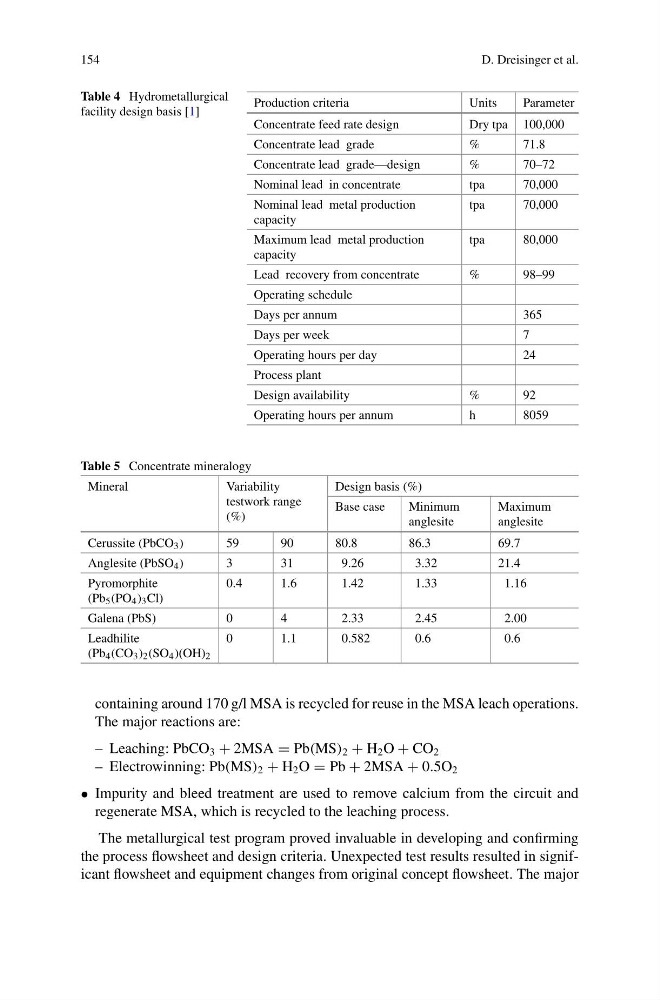
Table 4 Hydrometallurgical
facility design basis [1]
Production criteria
Units
Parameter
Concentrate feed rate design
Dry tpa 100,000
Concentrate lead grade
%
71.8
Concentrate lead grade—design
%
70–72
Nominal lead in concentrate
tpa
70,000
Nominal lead metal production
capacity
tpa
70,000
Maximum lead metal production
capacity
tpa
80,000
Lead recovery from concentrate
%
98–99
Operating schedule
Days per annum
365
Days per week
7
Operating hours per day
24
Process plant
Design availability
%
92
Operating hours per annum
h
8059
Table 5 Concentrate mineralogy
Mineral
Variability
testwork range
(%)
Design basis (%)
Base case
Minimum
anglesite
Maximum
anglesite
Cerussite (PbCO 3 )
59
90
80.8
86.3
69.7
Anglesite (PbSO 4 )
3
31
9.26
3.32
21.4
Pyromorphite
(Pb 5 (PO 4 ) 3 Cl)
0.4
1.6
1.42
1.33
1.16
Galena (PbS)
0
4
2.33
2.45
2.00
Leadhilite
(Pb 4 (CO 3 ) 2 (SO 4 )(OH) 2
0
1.1
0.582
0.6
0.6
containing around 170 g/l MSA is recycled for reuse in the MSA leach operations.
The major reactions are:
– Leaching: PbCO 3 + 2MSA = Pb(MS) 2 + H 2 O + CO 2
– Electrowinning: Pb(MS) 2 + H 2 O = Pb + 2MSA + 0.5O 2
• Impurity and bleed treatment are used to remove calcium from the circuit and
regenerate MSA, which is recycled to the leaching process.
The metallurgical test program proved invaluable in developing and confirming
the process flowsheet and design criteria. Unexpected test results resulted in significant flowsheet and equipment changes from original concept flowsheet. The major
D. Dreisinger et al.
Table 4 Hydrometallurgical
facility design basis [1]
Production criteria
Units
Parameter
Concentrate feed rate design
Dry tpa 100,000
Concentrate lead grade
%
71.8
Concentrate lead grade—design
%
70–72
Nominal lead in concentrate
tpa
70,000
Nominal lead metal production
capacity
tpa
70,000
Maximum lead metal production
capacity
tpa
80,000
Lead recovery from concentrate
%
98–99
Operating schedule
Days per annum
365
Days per week
7
Operating hours per day
24
Process plant
Design availability
%
92
Operating hours per annum
h
8059
Table 5 Concentrate mineralogy
Mineral
Variability
testwork range
(%)
Design basis (%)
Base case
Minimum
anglesite
Maximum
anglesite
Cerussite (PbCO 3 )
59
90
80.8
86.3
69.7
Anglesite (PbSO 4 )
3
31
9.26
3.32
21.4
Pyromorphite
(Pb 5 (PO 4 ) 3 Cl)
0.4
1.6
1.42
1.33
1.16
Galena (PbS)
0
4
2.33
2.45
2.00
Leadhilite
(Pb 4 (CO 3 ) 2 (SO 4 )(OH) 2
0
1.1
0.582
0.6
0.6
containing around 170 g/l MSA is recycled for reuse in the MSA leach operations.
The major reactions are:
– Leaching: PbCO 3 + 2MSA = Pb(MS) 2 + H 2 O + CO 2
– Electrowinning: Pb(MS) 2 + H 2 O = Pb + 2MSA + 0.5O 2
• Impurity and bleed treatment are used to remove calcium from the circuit and
regenerate MSA, which is recycled to the leaching process.
The metallurgical test program proved invaluable in developing and confirming
the process flowsheet and design criteria. Unexpected test results resulted in significant flowsheet and equipment changes from original concept flowsheet. The major