

Lead Metal Production at Paroo Station Mine Using …
141
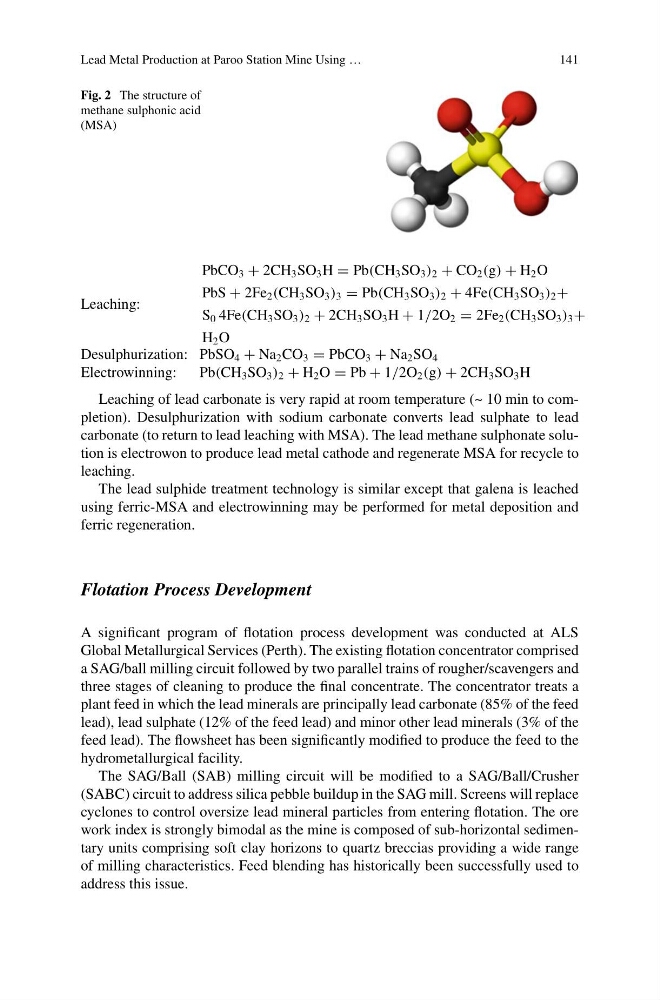
Fig. 2 The structure of
methane sulphonic acid
(MSA)
Leaching:
PbCO 3 + 2CH 3 SO 3 H = Pb(CH 3 SO 3 ) 2 + CO 2 (g) + H 2 O
PbS + 2Fe 2 (CH 3 SO 3 ) 3 = Pb(CH 3 SO 3 ) 2 + 4Fe(CH 3 SO 3 ) 2 +
S 0 4Fe(CH 3 SO 3 ) 2 + 2CH 3 SO 3 H + 1/2O 2 = 2Fe 2 (CH 3 SO 3 ) 3 +
H 2 O
Desulphurization: PbSO 4 + Na 2 CO 3 = PbCO 3 + Na 2 SO 4
Electrowinning:
Pb(CH 3 SO 3 ) 2 + H 2 O = Pb + 1/2O 2 (g) + 2CH 3 SO 3 H
Leaching of lead carbonate is very rapid at room temperature (~ 10 min to completion). Desulphurization with sodium carbonate converts lead sulphate to lead
carbonate (to return to lead leaching with MSA). The lead methane sulphonate solution is electrowon to produce lead metal cathode and regenerate MSA for recycle to
leaching.
The lead sulphide treatment technology is similar except that galena is leached
using ferric-MSA and electrowinning may be performed for metal deposition and
ferric regeneration.
Flotation Process Development
A significant program of flotation process development was conducted at ALS
Global Metallurgical Services (Perth). The existing flotation concentrator comprised
a SAG/ball milling circuit followed by two parallel trains of rougher/scavengers and
three stages of cleaning to produce the final concentrate. The concentrator treats a
plant feed in which the lead minerals are principally lead carbonate (85% of the feed
lead), lead sulphate (12% of the feed lead) and minor other lead minerals (3% of the
feed lead). The flowsheet has been significantly modified to produce the feed to the
hydrometallurgical facility.
The SAG/Ball (SAB) milling circuit will be modified to a SAG/Ball/Crusher
(SABC) circuit to address silica pebble buildup in the SAG mill. Screens will replace
cyclones to control oversize lead mineral particles from entering flotation. The ore
work index is strongly bimodal as the mine is composed of sub-horizontal sedimentary units comprising soft clay horizons to quartz breccias providing a wide range
of milling characteristics. Feed blending has historically been successfully used to
address this issue.
141
Fig. 2 The structure of
methane sulphonic acid
(MSA)
Leaching:
PbCO 3 + 2CH 3 SO 3 H = Pb(CH 3 SO 3 ) 2 + CO 2 (g) + H 2 O
PbS + 2Fe 2 (CH 3 SO 3 ) 3 = Pb(CH 3 SO 3 ) 2 + 4Fe(CH 3 SO 3 ) 2 +
S 0 4Fe(CH 3 SO 3 ) 2 + 2CH 3 SO 3 H + 1/2O 2 = 2Fe 2 (CH 3 SO 3 ) 3 +
H 2 O
Desulphurization: PbSO 4 + Na 2 CO 3 = PbCO 3 + Na 2 SO 4
Electrowinning:
Pb(CH 3 SO 3 ) 2 + H 2 O = Pb + 1/2O 2 (g) + 2CH 3 SO 3 H
Leaching of lead carbonate is very rapid at room temperature (~ 10 min to completion). Desulphurization with sodium carbonate converts lead sulphate to lead
carbonate (to return to lead leaching with MSA). The lead methane sulphonate solution is electrowon to produce lead metal cathode and regenerate MSA for recycle to
leaching.
The lead sulphide treatment technology is similar except that galena is leached
using ferric-MSA and electrowinning may be performed for metal deposition and
ferric regeneration.
Flotation Process Development
A significant program of flotation process development was conducted at ALS
Global Metallurgical Services (Perth). The existing flotation concentrator comprised
a SAG/ball milling circuit followed by two parallel trains of rougher/scavengers and
three stages of cleaning to produce the final concentrate. The concentrator treats a
plant feed in which the lead minerals are principally lead carbonate (85% of the feed
lead), lead sulphate (12% of the feed lead) and minor other lead minerals (3% of the
feed lead). The flowsheet has been significantly modified to produce the feed to the
hydrometallurgical facility.
The SAG/Ball (SAB) milling circuit will be modified to a SAG/Ball/Crusher
(SABC) circuit to address silica pebble buildup in the SAG mill. Screens will replace
cyclones to control oversize lead mineral particles from entering flotation. The ore
work index is strongly bimodal as the mine is composed of sub-horizontal sedimentary units comprising soft clay horizons to quartz breccias providing a wide range
of milling characteristics. Feed blending has historically been successfully used to
address this issue.