

124
M. Scott and M. Moats
Table 1 Composition of
alkaline non-cyanide zinc
baths [6]
Component
Low Zinc
High Zinc
Zn (g/L)
6–9
13.5–22.5
NaOH (g/L)
75–105
120–150
Proprietary additives
1–3%
1–3%
coatings with significant throwing power and can tolerate impurities. In more modern
times, the presence of cyanide has resulted in significant disposal costs for spent
plating baths [2]. The toxicity of the cyanide baths prompted research into low
cyanide containing baths as well as cyanide-free baths. The resulting cyanide-free
baths (acid zinc and alkaline zincate) can produce acceptable coatings, but are not
able to achieve the throwing power or brightness of the cyanide containing baths [3].
Alkaline zincate solutions offer the potential of lower operating costs due to
reduced corrosion of steel supports and structures and lower waste disposal costs than
acid baths [4]. Zincate baths also exhibit better throwing power than acid baths [5].
The major drawback with zincate baths is inferior plating appearance and properties
leading to the need for smaller variations in zinc concentration, temperature, and current density during operation than the other zinc plating baths [4]. The compositions
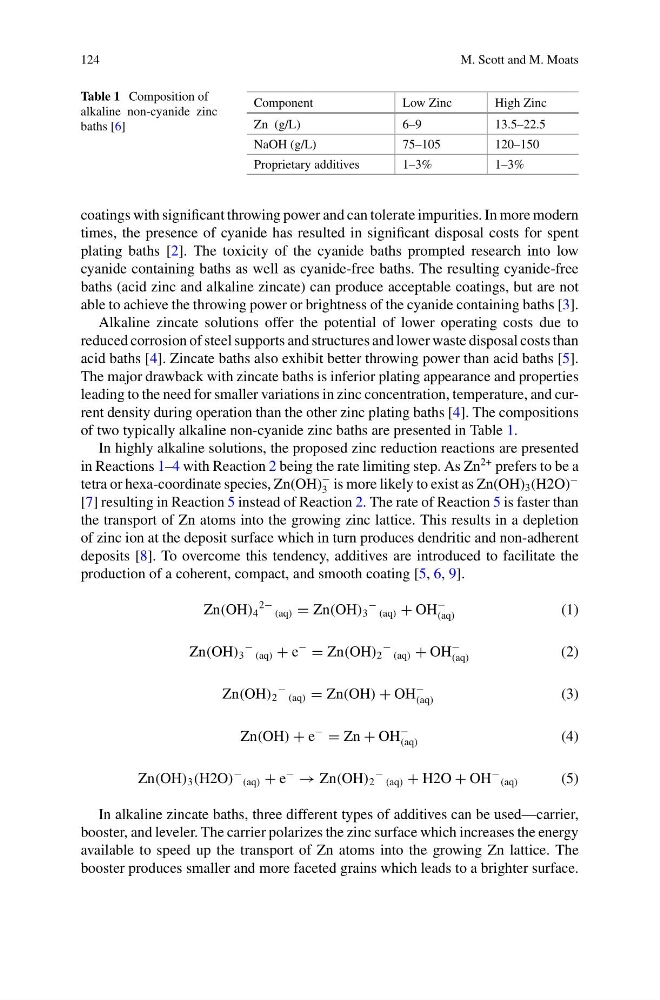
of two typically alkaline non-cyanide zinc baths are presented in Table 1.
In highly alkaline solutions, the proposed zinc reduction reactions are presented
in Reactions 1–4 with Reaction 2 being the rate limiting step. As Zn
2+ prefers to be a
tetra or hexa-coordinate species, Zn(OH)
−
3 is more likely to exist as Zn(OH) 3 (H2O)
−
[7] resulting in Reaction 5 instead of Reaction 2. The rate of Reaction 5 is faster than
the transport of Zn atoms into the growing zinc lattice. This results in a depletion
of zinc ion at the deposit surface which in turn produces dendritic and non-adherent
deposits [8]. To overcome this tendency, additives are introduced to facilitate the
production of a coherent, compact, and smooth coating [5, 6, 9].
Zn(OH) 4
2− (aq) = Zn(OH) 3
− (aq) + OH
−
(aq)
(1)
Zn(OH) 3
− (aq) + e
−
= Zn(OH) 2
− (aq) + OH
−
(aq)
(2)
Zn(OH) 2
− (aq) = Zn(OH) + OH
−
(aq)
(3)
Zn(OH) + e
−
= Zn + OH
−
(aq)
(4)
Zn(OH) 3 (H2O)
− (aq) + e
−
→ Zn(OH) 2
− (aq) + H2O + OH
− (aq)
(5)
In alkaline zincate baths, three different types of additives can be used—carrier,
booster, and leveler. The carrier polarizes the zinc surface which increases the energy
available to speed up the transport of Zn atoms into the growing Zn lattice. The
booster produces smaller and more faceted grains which leads to a brighter surface.
M. Scott and M. Moats
Table 1 Composition of
alkaline non-cyanide zinc
baths [6]
Component
Low Zinc
High Zinc
Zn (g/L)
6–9
13.5–22.5
NaOH (g/L)
75–105
120–150
Proprietary additives
1–3%
1–3%
coatings with significant throwing power and can tolerate impurities. In more modern
times, the presence of cyanide has resulted in significant disposal costs for spent
plating baths [2]. The toxicity of the cyanide baths prompted research into low
cyanide containing baths as well as cyanide-free baths. The resulting cyanide-free
baths (acid zinc and alkaline zincate) can produce acceptable coatings, but are not
able to achieve the throwing power or brightness of the cyanide containing baths [3].
Alkaline zincate solutions offer the potential of lower operating costs due to
reduced corrosion of steel supports and structures and lower waste disposal costs than
acid baths [4]. Zincate baths also exhibit better throwing power than acid baths [5].
The major drawback with zincate baths is inferior plating appearance and properties
leading to the need for smaller variations in zinc concentration, temperature, and current density during operation than the other zinc plating baths [4]. The compositions
of two typically alkaline non-cyanide zinc baths are presented in Table 1.
In highly alkaline solutions, the proposed zinc reduction reactions are presented
in Reactions 1–4 with Reaction 2 being the rate limiting step. As Zn
2+ prefers to be a
tetra or hexa-coordinate species, Zn(OH)
−
3 is more likely to exist as Zn(OH) 3 (H2O)
−
[7] resulting in Reaction 5 instead of Reaction 2. The rate of Reaction 5 is faster than
the transport of Zn atoms into the growing zinc lattice. This results in a depletion
of zinc ion at the deposit surface which in turn produces dendritic and non-adherent
deposits [8]. To overcome this tendency, additives are introduced to facilitate the
production of a coherent, compact, and smooth coating [5, 6, 9].
Zn(OH) 4
2− (aq) = Zn(OH) 3
− (aq) + OH
−
(aq)
(1)
Zn(OH) 3
− (aq) + e
−
= Zn(OH) 2
− (aq) + OH
−
(aq)
(2)
Zn(OH) 2
− (aq) = Zn(OH) + OH
−
(aq)
(3)
Zn(OH) + e
−
= Zn + OH
−
(aq)
(4)
Zn(OH) 3 (H2O)
− (aq) + e
−
→ Zn(OH) 2
− (aq) + H2O + OH
− (aq)
(5)
In alkaline zincate baths, three different types of additives can be used—carrier,
booster, and leveler. The carrier polarizes the zinc surface which increases the energy
available to speed up the transport of Zn atoms into the growing Zn lattice. The
booster produces smaller and more faceted grains which leads to a brighter surface.