

104
J. A. de Lima et al.
Table 1 Effect of some
metal ions on the loss of zinc
current efficiency
Element
Concentration (mg/L)
Ge
0.002
Sb
0.002
Cu
0.12
Tl
0.5
Co
1.0
Ni
1.0
Cd
Without effect
Pb
Minimum
Adapted from [1]
EC =
m
m f
=
m nF
(i t M )
(5)
where m represents the mass of deposited metal, in g; m f the mass calculated from
Faraday’s law, in g; the current, in A; t is the deposition time, in s; M the atomic
mass of the metal, in g/mol; n the number of electrons involved in the reaction; and
F the Faraday constant, 96500 °C/mol.
Current efficiency is an indicator of productivity in electrolysis. The main reasons
for loss of current efficiency are related to the rate of hydrogen formation and codeposition of metal impurities in the cathode. In a high purity zinc sulfate solution,
the hydrogen ion reduction is very slow and this impact is minimized. However,
several metal ions can catalyze the reduction of that ion [1]. With respect to the
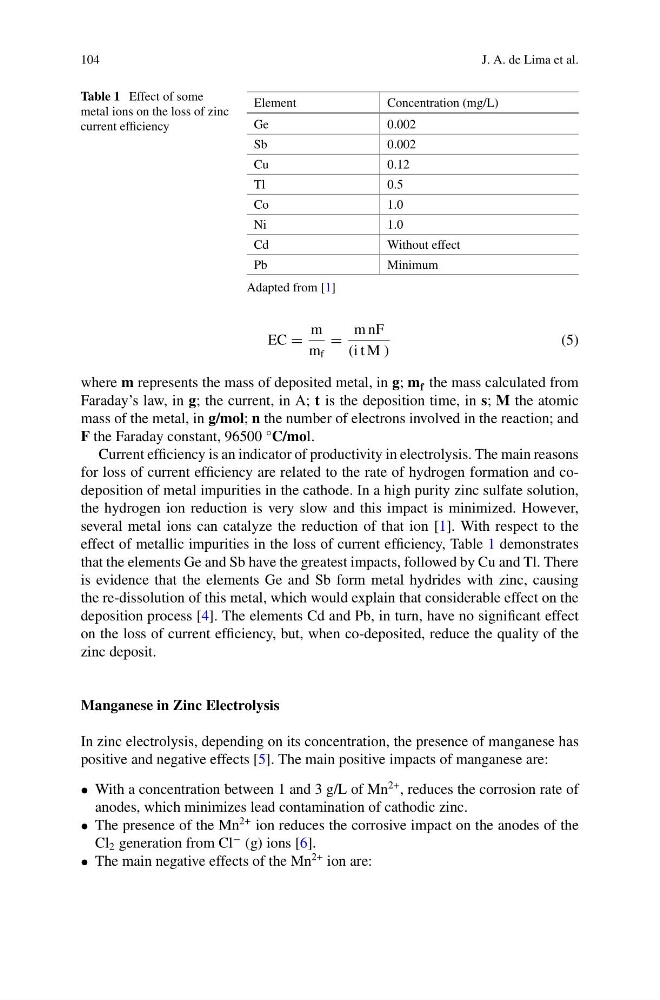
effect of metallic impurities in the loss of current efficiency, Table 1 demonstrates
that the elements Ge and Sb have the greatest impacts, followed by Cu and Tl. There
is evidence that the elements Ge and Sb form metal hydrides with zinc, causing
the re-dissolution of this metal, which would explain that considerable effect on the
deposition process [4]. The elements Cd and Pb, in turn, have no significant effect
on the loss of current efficiency, but, when co-deposited, reduce the quality of the
zinc deposit.
Manganese in Zinc Electrolysis
In zinc electrolysis, depending on its concentration, the presence of manganese has
positive and negative effects [5]. The main positive impacts of manganese are:
• With a concentration between 1 and 3 g/L of Mn
2+ , reduces the corrosion rate of
anodes, which minimizes lead contamination of cathodic zinc.
• The presence of the Mn
2+ ion reduces the corrosive impact on the anodes of the
Cl 2 generation from Cl
− (g) ions [6].
• The main negative effects of the Mn
2+ ion are:
J. A. de Lima et al.
Table 1 Effect of some
metal ions on the loss of zinc
current efficiency
Element
Concentration (mg/L)
Ge
0.002
Sb
0.002
Cu
0.12
Tl
0.5
Co
1.0
Ni
1.0
Cd
Without effect
Pb
Minimum
Adapted from [1]
EC =
m
m f
=
m nF
(i t M )
(5)
where m represents the mass of deposited metal, in g; m f the mass calculated from
Faraday’s law, in g; the current, in A; t is the deposition time, in s; M the atomic
mass of the metal, in g/mol; n the number of electrons involved in the reaction; and
F the Faraday constant, 96500 °C/mol.
Current efficiency is an indicator of productivity in electrolysis. The main reasons
for loss of current efficiency are related to the rate of hydrogen formation and codeposition of metal impurities in the cathode. In a high purity zinc sulfate solution,
the hydrogen ion reduction is very slow and this impact is minimized. However,
several metal ions can catalyze the reduction of that ion [1]. With respect to the
effect of metallic impurities in the loss of current efficiency, Table 1 demonstrates
that the elements Ge and Sb have the greatest impacts, followed by Cu and Tl. There
is evidence that the elements Ge and Sb form metal hydrides with zinc, causing
the re-dissolution of this metal, which would explain that considerable effect on the
deposition process [4]. The elements Cd and Pb, in turn, have no significant effect
on the loss of current efficiency, but, when co-deposited, reduce the quality of the
zinc deposit.
Manganese in Zinc Electrolysis
In zinc electrolysis, depending on its concentration, the presence of manganese has
positive and negative effects [5]. The main positive impacts of manganese are:
• With a concentration between 1 and 3 g/L of Mn
2+ , reduces the corrosion rate of
anodes, which minimizes lead contamination of cathodic zinc.
• The presence of the Mn
2+ ion reduces the corrosive impact on the anodes of the
Cl 2 generation from Cl
− (g) ions [6].
• The main negative effects of the Mn
2+ ion are: