

102
J. A. de Lima et al.
the route known as RLE (Roasting–Leaching–Electrowinning). The Electrowinning
stage is of fundamental importance because it consumes 80% of all electrical energy
and this represents 31% of the entire conversion cost. It also restricts the production
capacity of the plant.
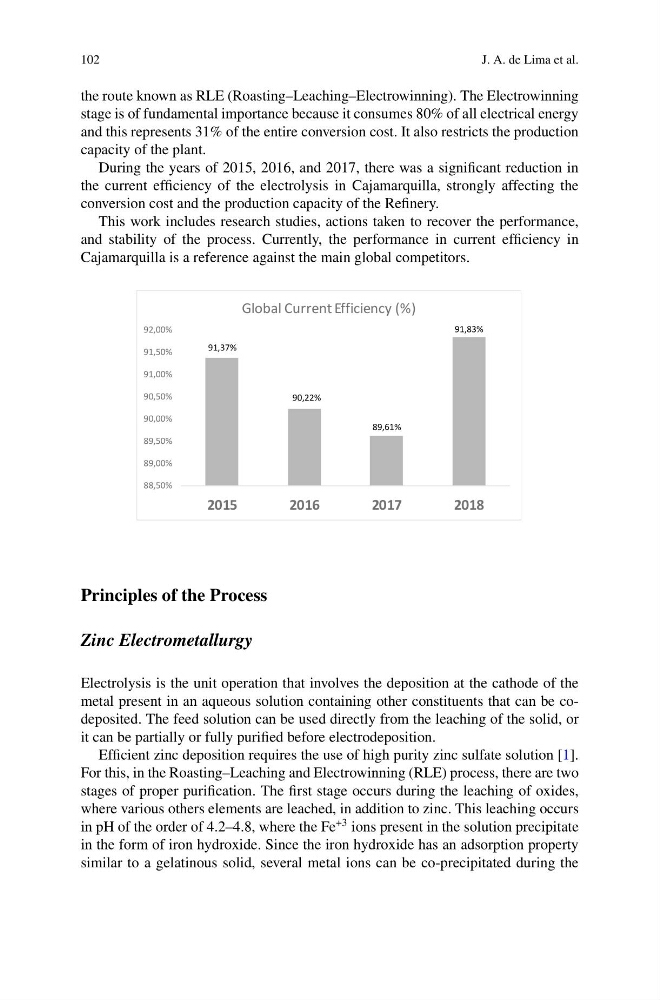
During the years of 2015, 2016, and 2017, there was a significant reduction in
the current efficiency of the electrolysis in Cajamarquilla, strongly affecting the
conversion cost and the production capacity of the Refinery.
This work includes research studies, actions taken to recover the performance,
and stability of the process. Currently, the performance in current efficiency in
Cajamarquilla is a reference against the main global competitors.
91,37%
90,22%
89,61%
91,83%
88,50%
89,00%
89,50%
90,00%
90,50%
91,00%
91,50%
92,00%
2015
2016
2017
2018
Global Current Efficiency (%)
Principles of the Process
Zinc Electrometallurgy
Electrolysis is the unit operation that involves the deposition at the cathode of the
metal present in an aqueous solution containing other constituents that can be codeposited. The feed solution can be used directly from the leaching of the solid, or
it can be partially or fully purified before electrodeposition.
Efficient zinc deposition requires the use of high purity zinc sulfate solution [1].
For this, in the Roasting–Leaching and Electrowinning (RLE) process, there are two
stages of proper purification. The first stage occurs during the leaching of oxides,
where various others elements are leached, in addition to zinc. This leaching occurs
in pH of the order of 4.2–4.8, where the Fe
+3 ions present in the solution precipitate
in the form of iron hydroxide. Since the iron hydroxide has an adsorption property
similar to a gelatinous solid, several metal ions can be co-precipitated during the
J. A. de Lima et al.
the route known as RLE (Roasting–Leaching–Electrowinning). The Electrowinning
stage is of fundamental importance because it consumes 80% of all electrical energy
and this represents 31% of the entire conversion cost. It also restricts the production
capacity of the plant.
During the years of 2015, 2016, and 2017, there was a significant reduction in
the current efficiency of the electrolysis in Cajamarquilla, strongly affecting the
conversion cost and the production capacity of the Refinery.
This work includes research studies, actions taken to recover the performance,
and stability of the process. Currently, the performance in current efficiency in
Cajamarquilla is a reference against the main global competitors.
91,37%
90,22%
89,61%
91,83%
88,50%
89,00%
89,50%
90,00%
90,50%
91,00%
91,50%
92,00%
2015
2016
2017
2018
Global Current Efficiency (%)
Principles of the Process
Zinc Electrometallurgy
Electrolysis is the unit operation that involves the deposition at the cathode of the
metal present in an aqueous solution containing other constituents that can be codeposited. The feed solution can be used directly from the leaching of the solid, or
it can be partially or fully purified before electrodeposition.
Efficient zinc deposition requires the use of high purity zinc sulfate solution [1].
For this, in the Roasting–Leaching and Electrowinning (RLE) process, there are two
stages of proper purification. The first stage occurs during the leaching of oxides,
where various others elements are leached, in addition to zinc. This leaching occurs
in pH of the order of 4.2–4.8, where the Fe
+3 ions present in the solution precipitate
in the form of iron hydroxide. Since the iron hydroxide has an adsorption property
similar to a gelatinous solid, several metal ions can be co-precipitated during the