

96
S. Takaya et al.
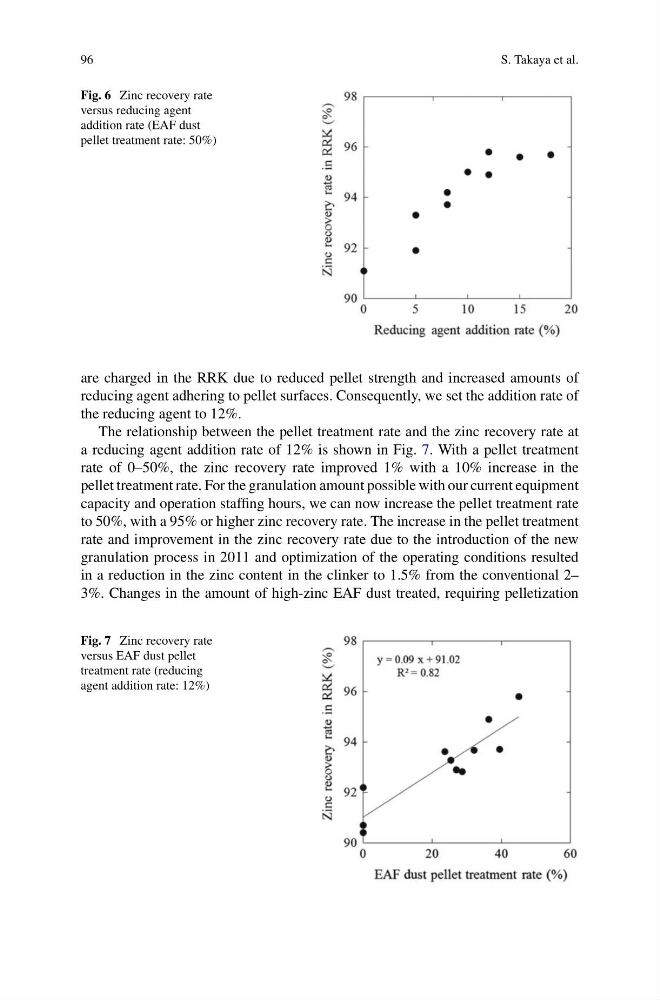
Fig. 6 Zinc recovery rate
versus reducing agent
addition rate (EAF dust
pellet treatment rate: 50%)
are charged in the RRK due to reduced pellet strength and increased amounts of
reducing agent adhering to pellet surfaces. Consequently, we set the addition rate of
the reducing agent to 12%.
The relationship between the pellet treatment rate and the zinc recovery rate at
a reducing agent addition rate of 12% is shown in Fig. 7. With a pellet treatment
rate of 0–50%, the zinc recovery rate improved 1% with a 10% increase in the
pellet treatment rate. For the granulation amount possible with our current equipment
capacity and operation staffing hours, we can now increase the pellet treatment rate
to 50%, with a 95% or higher zinc recovery rate. The increase in the pellet treatment
rate and improvement in the zinc recovery rate due to the introduction of the new
granulation process in 2011 and optimization of the operating conditions resulted
in a reduction in the zinc content in the clinker to 1.5% from the conventional 2–
3%. Changes in the amount of high-zinc EAF dust treated, requiring pelletization
Fig. 7 Zinc recovery rate
versus EAF dust pellet
treatment rate (reducing
agent addition rate: 12%)
S. Takaya et al.
Fig. 6 Zinc recovery rate
versus reducing agent
addition rate (EAF dust
pellet treatment rate: 50%)
are charged in the RRK due to reduced pellet strength and increased amounts of
reducing agent adhering to pellet surfaces. Consequently, we set the addition rate of
the reducing agent to 12%.
The relationship between the pellet treatment rate and the zinc recovery rate at
a reducing agent addition rate of 12% is shown in Fig. 7. With a pellet treatment
rate of 0–50%, the zinc recovery rate improved 1% with a 10% increase in the
pellet treatment rate. For the granulation amount possible with our current equipment
capacity and operation staffing hours, we can now increase the pellet treatment rate
to 50%, with a 95% or higher zinc recovery rate. The increase in the pellet treatment
rate and improvement in the zinc recovery rate due to the introduction of the new
granulation process in 2011 and optimization of the operating conditions resulted
in a reduction in the zinc content in the clinker to 1.5% from the conventional 2–
3%. Changes in the amount of high-zinc EAF dust treated, requiring pelletization
Fig. 7 Zinc recovery rate
versus EAF dust pellet
treatment rate (reducing
agent addition rate: 12%)