

Production of SHG Zinc From 100% Recycled Materials
83
Based on the Beaumont plant operating experience, several improvements have
been engineered into the second-generation AZR process. The primary goals are to
(a) decrease plant downtime and maintenance costs, (b) improve the quality of the
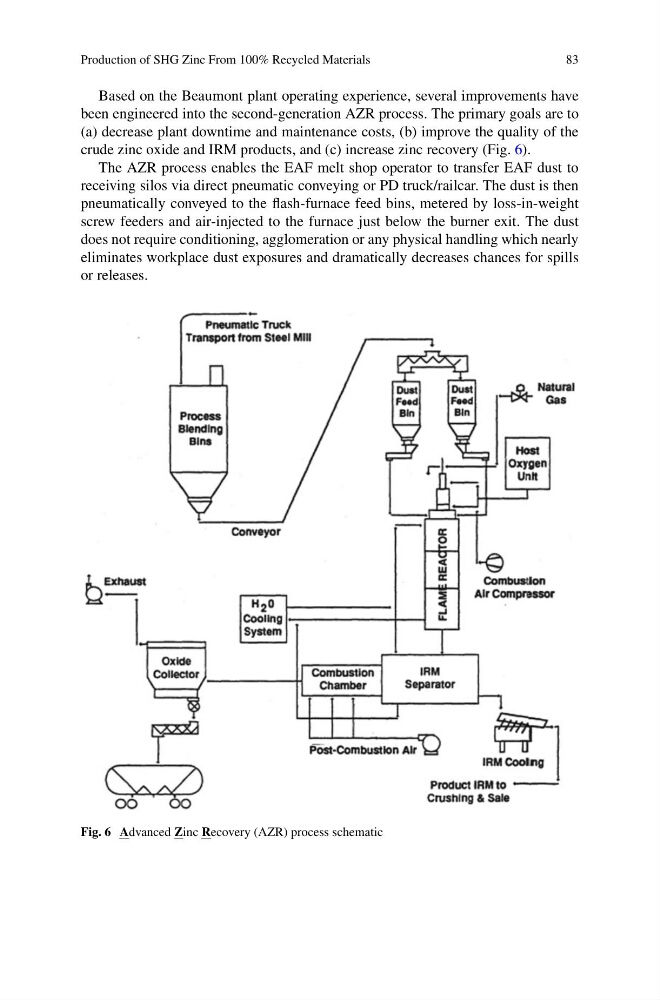
crude zinc oxide and IRM products, and (c) increase zinc recovery (Fig. 6).
The AZR process enables the EAF melt shop operator to transfer EAF dust to
receiving silos via direct pneumatic conveying or PD truck/railcar. The dust is then
pneumatically conveyed to the flash-furnace feed bins, metered by loss-in-weight
screw feeders and air-injected to the furnace just below the burner exit. The dust
does not require conditioning, agglomeration or any physical handling which nearly
eliminates workplace dust exposures and dramatically decreases chances for spills
or releases.
Fig. 6 Advanced Zinc Recovery (AZR) process schematic
83
Based on the Beaumont plant operating experience, several improvements have
been engineered into the second-generation AZR process. The primary goals are to
(a) decrease plant downtime and maintenance costs, (b) improve the quality of the
crude zinc oxide and IRM products, and (c) increase zinc recovery (Fig. 6).
The AZR process enables the EAF melt shop operator to transfer EAF dust to
receiving silos via direct pneumatic conveying or PD truck/railcar. The dust is then
pneumatically conveyed to the flash-furnace feed bins, metered by loss-in-weight
screw feeders and air-injected to the furnace just below the burner exit. The dust
does not require conditioning, agglomeration or any physical handling which nearly
eliminates workplace dust exposures and dramatically decreases chances for spills
or releases.
Fig. 6 Advanced Zinc Recovery (AZR) process schematic