

82
6 Applications of Carbon Nanostructures Produced in Molten Salts
(a)
(b)
(c)
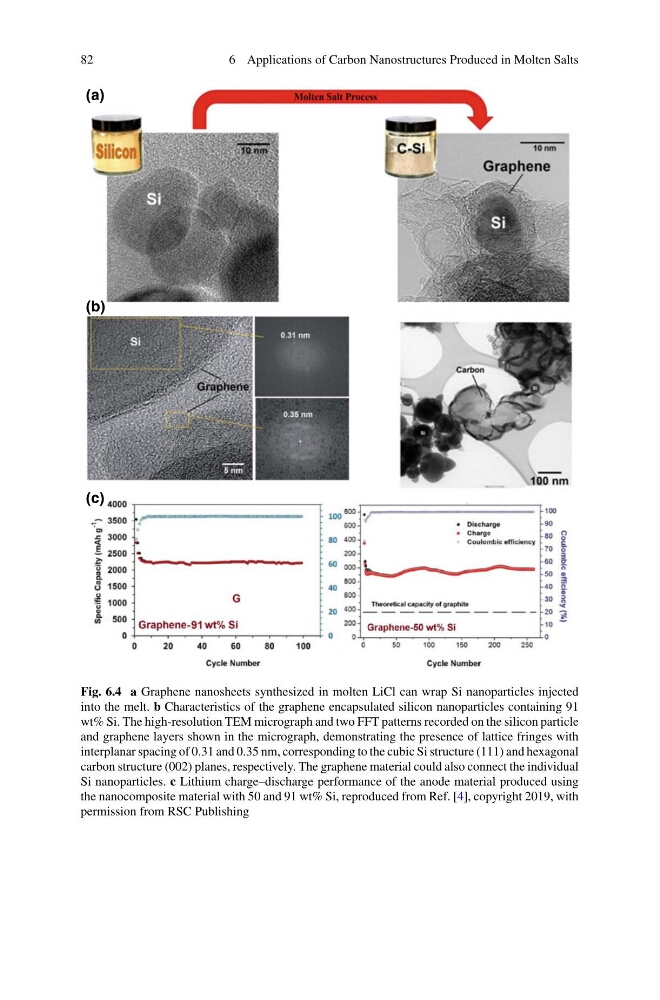
Fig. 6.4 a Graphene nanosheets synthesized in molten LiCl can wrap Si nanoparticles injected
into the melt. b Characteristics of the graphene encapsulated silicon nanoparticles containing 91
wt% Si. The high-resolution TEM micrograph and two FFT patterns recorded on the silicon particle
and graphene layers shown in the micrograph, demonstrating the presence of lattice fringes with
interplanar spacing of 0.31 and 0.35 nm, corresponding to the cubic Si structure (111) and hexagonal
carbon structure (002) planes, respectively. The graphene material could also connect the individual
Si nanoparticles. c Lithium charge–discharge performance of the anode material produced using
the nanocomposite material with 50 and 91 wt% Si, reproduced from Ref. [4], copyright 2019, with
permission from RSC Publishing
6 Applications of Carbon Nanostructures Produced in Molten Salts
(a)
(b)
(c)
Fig. 6.4 a Graphene nanosheets synthesized in molten LiCl can wrap Si nanoparticles injected
into the melt. b Characteristics of the graphene encapsulated silicon nanoparticles containing 91
wt% Si. The high-resolution TEM micrograph and two FFT patterns recorded on the silicon particle
and graphene layers shown in the micrograph, demonstrating the presence of lattice fringes with
interplanar spacing of 0.31 and 0.35 nm, corresponding to the cubic Si structure (111) and hexagonal
carbon structure (002) planes, respectively. The graphene material could also connect the individual
Si nanoparticles. c Lithium charge–discharge performance of the anode material produced using
the nanocomposite material with 50 and 91 wt% Si, reproduced from Ref. [4], copyright 2019, with
permission from RSC Publishing