

6.2 Metal–Carbon Nanocomposites as Anode Materials …
79
6.2.1 Sn-Filled Carbon Nanostructures
Sn-filled carbon nanostructures were produced by the electrolysis of LiCl + SnCl 2 at
a temperature greater than 700 °C using graphite electrodes. The reactions occurred
on the graphite cathodes during the electrolysis process can be described as follows:
(a) Sn
2+ ions are first reduced to metallic Sn on the graphite cathode’s surface; (b)
Li
+ is then reduced at the graphite cathode to form a carbon intercalation compound
or carbon–Li intermediate phases; and (c) sheets of graphite are extruded from the
cathode which consequently encapsulate Sn to form Sn-encapsulated carbon nanostructures [21]. On the other hand, the continuous injection of SnCl 2 into molten LiCl
during the electrolysis process was found to be able to provide a continuous way for
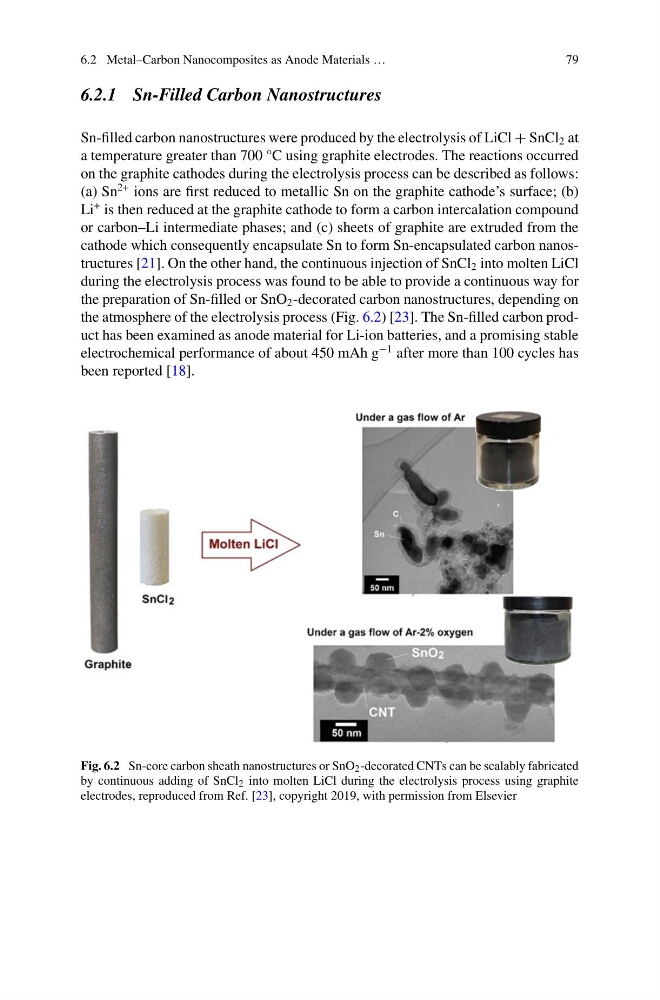
the preparation of Sn-filled or SnO 2 -decorated carbon nanostructures, depending on
the atmosphere of the electrolysis process (Fig. 6.2) [23]. The Sn-filled carbon product has been examined as anode material for Li-ion batteries, and a promising stable
electrochemical performance of about 450 mAh g
−1 after more than 100 cycles has
been reported [18].
Fig. 6.2 Sn-core carbon sheath nanostructures or SnO 2 -decorated CNTs can be scalably fabricated
by continuous adding of SnCl 2 into molten LiCl during the electrolysis process using graphite
electrodes, reproduced from Ref. [23], copyright 2019, with permission from Elsevier
79
6.2.1 Sn-Filled Carbon Nanostructures
Sn-filled carbon nanostructures were produced by the electrolysis of LiCl + SnCl 2 at
a temperature greater than 700 °C using graphite electrodes. The reactions occurred
on the graphite cathodes during the electrolysis process can be described as follows:
(a) Sn
2+ ions are first reduced to metallic Sn on the graphite cathode’s surface; (b)
Li
+ is then reduced at the graphite cathode to form a carbon intercalation compound
or carbon–Li intermediate phases; and (c) sheets of graphite are extruded from the
cathode which consequently encapsulate Sn to form Sn-encapsulated carbon nanostructures [21]. On the other hand, the continuous injection of SnCl 2 into molten LiCl
during the electrolysis process was found to be able to provide a continuous way for
the preparation of Sn-filled or SnO 2 -decorated carbon nanostructures, depending on
the atmosphere of the electrolysis process (Fig. 6.2) [23]. The Sn-filled carbon product has been examined as anode material for Li-ion batteries, and a promising stable
electrochemical performance of about 450 mAh g
−1 after more than 100 cycles has
been reported [18].
Fig. 6.2 Sn-core carbon sheath nanostructures or SnO 2 -decorated CNTs can be scalably fabricated
by continuous adding of SnCl 2 into molten LiCl during the electrolysis process using graphite
electrodes, reproduced from Ref. [23], copyright 2019, with permission from Elsevier