

6.1 SnO 2 -Graphene Anode Materials for Li-Ion Batteries
77
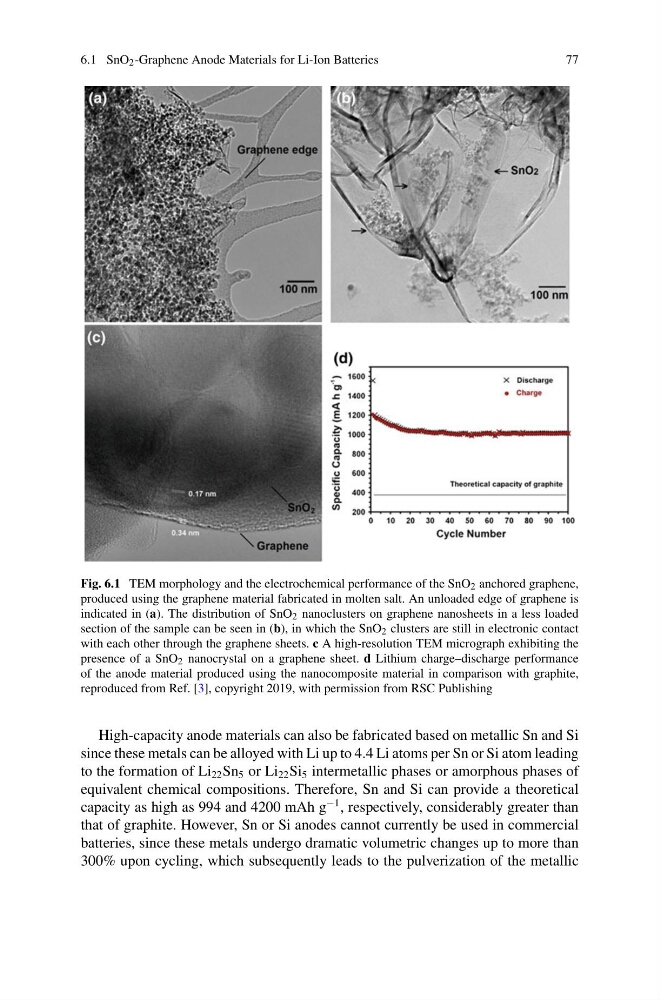
Fig. 6.1 TEM morphology and the electrochemical performance of the SnO 2 anchored graphene,
produced using the graphene material fabricated in molten salt. An unloaded edge of graphene is
indicated in (a). The distribution of SnO 2 nanoclusters on graphene nanosheets in a less loaded
section of the sample can be seen in (b), in which the SnO 2 clusters are still in electronic contact
with each other through the graphene sheets. c A high-resolution TEM micrograph exhibiting the
presence of a SnO 2 nanocrystal on a graphene sheet. d Lithium charge–discharge performance
of the anode material produced using the nanocomposite material in comparison with graphite,
reproduced from Ref. [3], copyright 2019, with permission from RSC Publishing
High-capacity anode materials can also be fabricated based on metallic Sn and Si
since these metals can be alloyed with Li up to 4.4 Li atoms per Sn or Si atom leading
to the formation of Li 22 Sn 5 or Li 22 Si 5 intermetallic phases or amorphous phases of
equivalent chemical compositions. Therefore, Sn and Si can provide a theoretical
capacity as high as 994 and 4200 mAh g
−1 , respectively, considerably greater than
that of graphite. However, Sn or Si anodes cannot currently be used in commercial
batteries, since these metals undergo dramatic volumetric changes up to more than
300% upon cycling, which subsequently leads to the pulverization of the metallic
77
Fig. 6.1 TEM morphology and the electrochemical performance of the SnO 2 anchored graphene,
produced using the graphene material fabricated in molten salt. An unloaded edge of graphene is
indicated in (a). The distribution of SnO 2 nanoclusters on graphene nanosheets in a less loaded
section of the sample can be seen in (b), in which the SnO 2 clusters are still in electronic contact
with each other through the graphene sheets. c A high-resolution TEM micrograph exhibiting the
presence of a SnO 2 nanocrystal on a graphene sheet. d Lithium charge–discharge performance
of the anode material produced using the nanocomposite material in comparison with graphite,
reproduced from Ref. [3], copyright 2019, with permission from RSC Publishing
High-capacity anode materials can also be fabricated based on metallic Sn and Si
since these metals can be alloyed with Li up to 4.4 Li atoms per Sn or Si atom leading
to the formation of Li 22 Sn 5 or Li 22 Si 5 intermetallic phases or amorphous phases of
equivalent chemical compositions. Therefore, Sn and Si can provide a theoretical
capacity as high as 994 and 4200 mAh g
−1 , respectively, considerably greater than
that of graphite. However, Sn or Si anodes cannot currently be used in commercial
batteries, since these metals undergo dramatic volumetric changes up to more than
300% upon cycling, which subsequently leads to the pulverization of the metallic