

4.6 Molten Salt Conversion of CO 2 into Li 2 CO 3 Nanocrystals
55
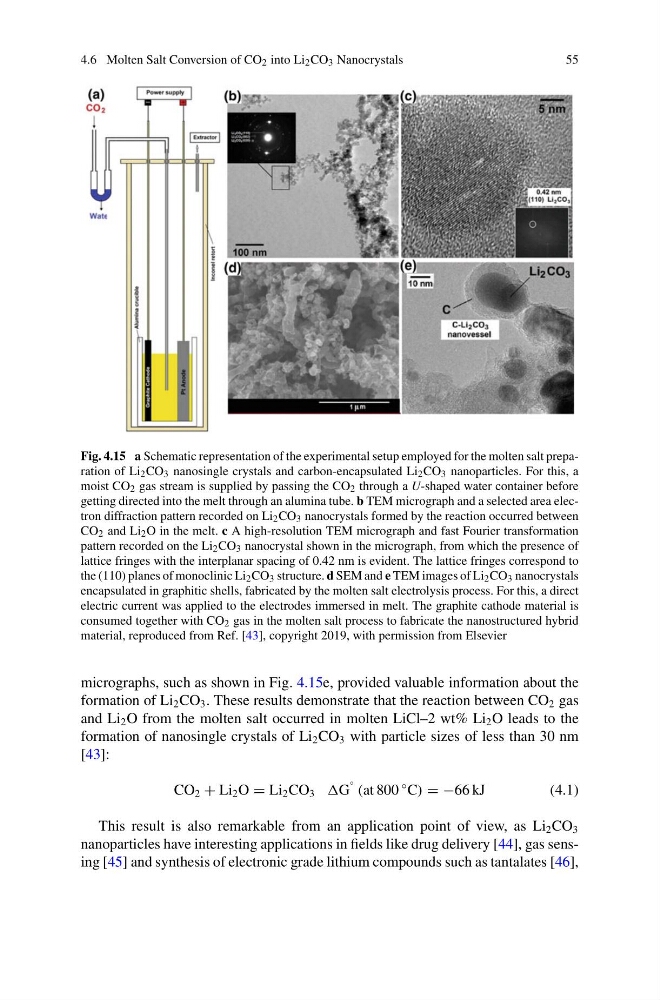
Fig. 4.15 a Schematic representation of the experimental setup employed for the molten salt preparation of Li 2 CO 3 nanosingle crystals and carbon-encapsulated Li 2 CO 3 nanoparticles. For this, a
moist CO 2 gas stream is supplied by passing the CO 2 through a U-shaped water container before
getting directed into the melt through an alumina tube. b TEM micrograph and a selected area electron diffraction pattern recorded on Li 2 CO 3 nanocrystals formed by the reaction occurred between
CO 2 and Li 2 O in the melt. c A high-resolution TEM micrograph and fast Fourier transformation
pattern recorded on the Li 2 CO 3 nanocrystal shown in the micrograph, from which the presence of
lattice fringes with the interplanar spacing of 0.42 nm is evident. The lattice fringes correspond to
the (110) planes of monoclinic Li 2 CO 3 structure. d SEM and e TEM images of Li 2 CO 3 nanocrystals
encapsulated in graphitic shells, fabricated by the molten salt electrolysis process. For this, a direct
electric current was applied to the electrodes immersed in melt. The graphite cathode material is
consumed together with CO 2 gas in the molten salt process to fabricate the nanostructured hybrid
material, reproduced from Ref. [43], copyright 2019, with permission from Elsevier
micrographs, such as shown in Fig. 4.15e, provided valuable information about the
formation of Li 2 CO 3 . These results demonstrate that the reaction between CO 2 gas
and Li 2 O from the molten salt occurred in molten LiCl–2 wt% Li 2 O leads to the
formation of nanosingle crystals of Li 2 CO 3 with particle sizes of less than 30 nm
[43]:
CO 2 + Li 2 O = Li 2 CO 3 G
◦ (at 800
◦ C) = −66 kJ
(4.1)
This result is also remarkable from an application point of view, as Li 2 CO 3
nanoparticles have interesting applications in fields like drug delivery [44], gas sensing [45] and synthesis of electronic grade lithium compounds such as tantalates [46],
55
Fig. 4.15 a Schematic representation of the experimental setup employed for the molten salt preparation of Li 2 CO 3 nanosingle crystals and carbon-encapsulated Li 2 CO 3 nanoparticles. For this, a
moist CO 2 gas stream is supplied by passing the CO 2 through a U-shaped water container before
getting directed into the melt through an alumina tube. b TEM micrograph and a selected area electron diffraction pattern recorded on Li 2 CO 3 nanocrystals formed by the reaction occurred between
CO 2 and Li 2 O in the melt. c A high-resolution TEM micrograph and fast Fourier transformation
pattern recorded on the Li 2 CO 3 nanocrystal shown in the micrograph, from which the presence of
lattice fringes with the interplanar spacing of 0.42 nm is evident. The lattice fringes correspond to
the (110) planes of monoclinic Li 2 CO 3 structure. d SEM and e TEM images of Li 2 CO 3 nanocrystals
encapsulated in graphitic shells, fabricated by the molten salt electrolysis process. For this, a direct
electric current was applied to the electrodes immersed in melt. The graphite cathode material is
consumed together with CO 2 gas in the molten salt process to fabricate the nanostructured hybrid
material, reproduced from Ref. [43], copyright 2019, with permission from Elsevier
micrographs, such as shown in Fig. 4.15e, provided valuable information about the
formation of Li 2 CO 3 . These results demonstrate that the reaction between CO 2 gas
and Li 2 O from the molten salt occurred in molten LiCl–2 wt% Li 2 O leads to the
formation of nanosingle crystals of Li 2 CO 3 with particle sizes of less than 30 nm
[43]:
CO 2 + Li 2 O = Li 2 CO 3 G
◦ (at 800
◦ C) = −66 kJ
(4.1)
This result is also remarkable from an application point of view, as Li 2 CO 3
nanoparticles have interesting applications in fields like drug delivery [44], gas sensing [45] and synthesis of electronic grade lithium compounds such as tantalates [46],