

4.5 Molten Salt Preparation of Interconnected Graphene—Carbon …
53
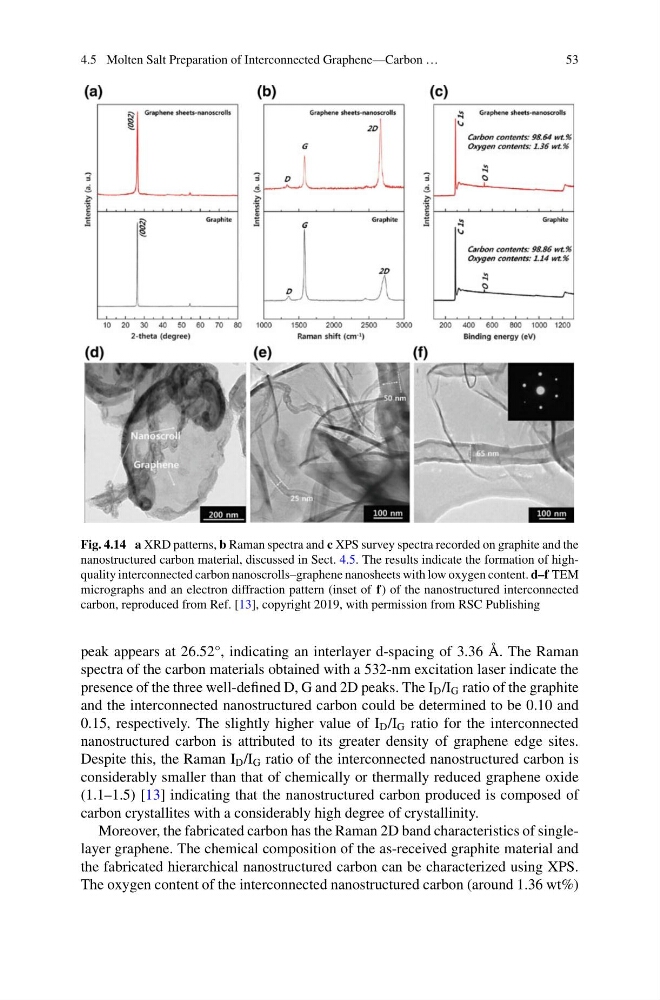
Fig. 4.14 a XRD patterns, b Raman spectra and c XPS survey spectra recorded on graphite and the
nanostructured carbon material, discussed in Sect. 4.5. The results indicate the formation of highquality interconnected carbon nanoscrolls–graphene nanosheets with low oxygen content. d–f TEM
micrographs and an electron diffraction pattern (inset of f) of the nanostructured interconnected
carbon, reproduced from Ref. [13], copyright 2019, with permission from RSC Publishing
peak appears at 26.52°, indicating an interlayer d-spacing of 3.36 Å. The Raman
spectra of the carbon materials obtained with a 532-nm excitation laser indicate the
presence of the three well-defined D, G and 2D peaks. The I D /I G ratio of the graphite
and the interconnected nanostructured carbon could be determined to be 0.10 and
0.15, respectively. The slightly higher value of I D /I G ratio for the interconnected
nanostructured carbon is attributed to its greater density of graphene edge sites.
Despite this, the Raman I D /I G ratio of the interconnected nanostructured carbon is
considerably smaller than that of chemically or thermally reduced graphene oxide
(1.1–1.5) [13] indicating that the nanostructured carbon produced is composed of
carbon crystallites with a considerably high degree of crystallinity.
Moreover, the fabricated carbon has the Raman 2D band characteristics of singlelayer graphene. The chemical composition of the as-received graphite material and
the fabricated hierarchical nanostructured carbon can be characterized using XPS.
The oxygen content of the interconnected nanostructured carbon (around 1.36 wt%)
53
Fig. 4.14 a XRD patterns, b Raman spectra and c XPS survey spectra recorded on graphite and the
nanostructured carbon material, discussed in Sect. 4.5. The results indicate the formation of highquality interconnected carbon nanoscrolls–graphene nanosheets with low oxygen content. d–f TEM
micrographs and an electron diffraction pattern (inset of f) of the nanostructured interconnected
carbon, reproduced from Ref. [13], copyright 2019, with permission from RSC Publishing
peak appears at 26.52°, indicating an interlayer d-spacing of 3.36 Å. The Raman
spectra of the carbon materials obtained with a 532-nm excitation laser indicate the
presence of the three well-defined D, G and 2D peaks. The I D /I G ratio of the graphite
and the interconnected nanostructured carbon could be determined to be 0.10 and
0.15, respectively. The slightly higher value of I D /I G ratio for the interconnected
nanostructured carbon is attributed to its greater density of graphene edge sites.
Despite this, the Raman I D /I G ratio of the interconnected nanostructured carbon is
considerably smaller than that of chemically or thermally reduced graphene oxide
(1.1–1.5) [13] indicating that the nanostructured carbon produced is composed of
carbon crystallites with a considerably high degree of crystallinity.
Moreover, the fabricated carbon has the Raman 2D band characteristics of singlelayer graphene. The chemical composition of the as-received graphite material and
the fabricated hierarchical nanostructured carbon can be characterized using XPS.
The oxygen content of the interconnected nanostructured carbon (around 1.36 wt%)