

46
4 Cathodic Exfoliation of Graphite in Molten Salt Electrolytes
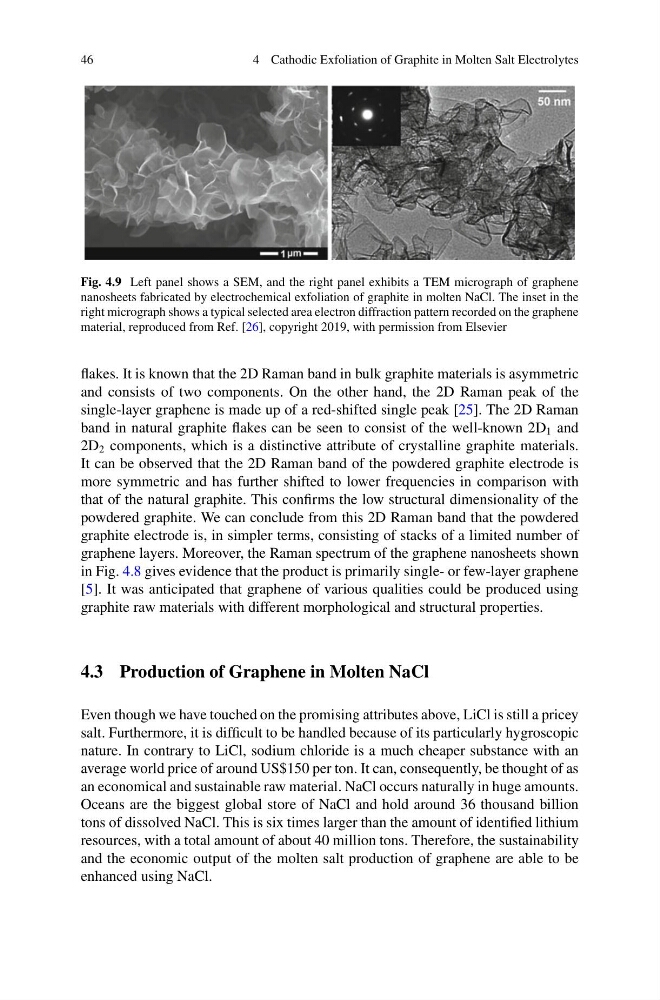
Fig. 4.9 Left panel shows a SEM, and the right panel exhibits a TEM micrograph of graphene
nanosheets fabricated by electrochemical exfoliation of graphite in molten NaCl. The inset in the
right micrograph shows a typical selected area electron diffraction pattern recorded on the graphene
material, reproduced from Ref. [26], copyright 2019, with permission from Elsevier
flakes. It is known that the 2D Raman band in bulk graphite materials is asymmetric
and consists of two components. On the other hand, the 2D Raman peak of the
single-layer graphene is made up of a red-shifted single peak [25]. The 2D Raman
band in natural graphite flakes can be seen to consist of the well-known 2D 1 and
2D 2 components, which is a distinctive attribute of crystalline graphite materials.
It can be observed that the 2D Raman band of the powdered graphite electrode is
more symmetric and has further shifted to lower frequencies in comparison with
that of the natural graphite. This confirms the low structural dimensionality of the
powdered graphite. We can conclude from this 2D Raman band that the powdered
graphite electrode is, in simpler terms, consisting of stacks of a limited number of
graphene layers. Moreover, the Raman spectrum of the graphene nanosheets shown
in Fig. 4.8 gives evidence that the product is primarily single- or few-layer graphene
[5]. It was anticipated that graphene of various qualities could be produced using
graphite raw materials with different morphological and structural properties.
4.3 Production of Graphene in Molten NaCl
Even though we have touched on the promising attributes above, LiCl is still a pricey
salt. Furthermore, it is difficult to be handled because of its particularly hygroscopic
nature. In contrary to LiCl, sodium chloride is a much cheaper substance with an
average world price of around US$150 per ton. It can, consequently, be thought of as
an economical and sustainable raw material. NaCl occurs naturally in huge amounts.
Oceans are the biggest global store of NaCl and hold around 36 thousand billion
tons of dissolved NaCl. This is six times larger than the amount of identified lithium
resources, with a total amount of about 40 million tons. Therefore, the sustainability
and the economic output of the molten salt production of graphene are able to be
enhanced using NaCl.
4 Cathodic Exfoliation of Graphite in Molten Salt Electrolytes
Fig. 4.9 Left panel shows a SEM, and the right panel exhibits a TEM micrograph of graphene
nanosheets fabricated by electrochemical exfoliation of graphite in molten NaCl. The inset in the
right micrograph shows a typical selected area electron diffraction pattern recorded on the graphene
material, reproduced from Ref. [26], copyright 2019, with permission from Elsevier
flakes. It is known that the 2D Raman band in bulk graphite materials is asymmetric
and consists of two components. On the other hand, the 2D Raman peak of the
single-layer graphene is made up of a red-shifted single peak [25]. The 2D Raman
band in natural graphite flakes can be seen to consist of the well-known 2D 1 and
2D 2 components, which is a distinctive attribute of crystalline graphite materials.
It can be observed that the 2D Raman band of the powdered graphite electrode is
more symmetric and has further shifted to lower frequencies in comparison with
that of the natural graphite. This confirms the low structural dimensionality of the
powdered graphite. We can conclude from this 2D Raman band that the powdered
graphite electrode is, in simpler terms, consisting of stacks of a limited number of
graphene layers. Moreover, the Raman spectrum of the graphene nanosheets shown
in Fig. 4.8 gives evidence that the product is primarily single- or few-layer graphene
[5]. It was anticipated that graphene of various qualities could be produced using
graphite raw materials with different morphological and structural properties.
4.3 Production of Graphene in Molten NaCl
Even though we have touched on the promising attributes above, LiCl is still a pricey
salt. Furthermore, it is difficult to be handled because of its particularly hygroscopic
nature. In contrary to LiCl, sodium chloride is a much cheaper substance with an
average world price of around US$150 per ton. It can, consequently, be thought of as
an economical and sustainable raw material. NaCl occurs naturally in huge amounts.
Oceans are the biggest global store of NaCl and hold around 36 thousand billion
tons of dissolved NaCl. This is six times larger than the amount of identified lithium
resources, with a total amount of about 40 million tons. Therefore, the sustainability
and the economic output of the molten salt production of graphene are able to be
enhanced using NaCl.