

8
2 Production of Advanced Materials in Molten Salts
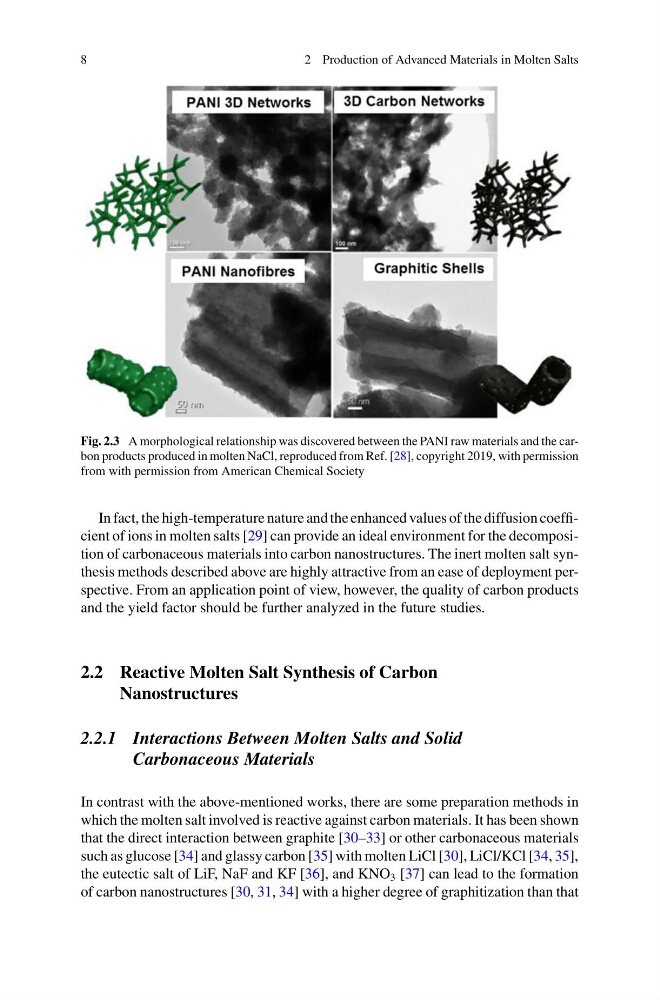
Fig. 2.3 A morphological relationship was discovered between the PANI raw materials and the carbon products produced in molten NaCl, reproduced from Ref. [28], copyright 2019, with permission
from with permission from American Chemical Society
In fact, the high-temperature nature and the enhanced values of the diffusion coefficient of ions in molten salts [29] can provide an ideal environment for the decomposition of carbonaceous materials into carbon nanostructures. The inert molten salt synthesis methods described above are highly attractive from an ease of deployment perspective. From an application point of view, however, the quality of carbon products
and the yield factor should be further analyzed in the future studies.
2.2 Reactive Molten Salt Synthesis of Carbon
Nanostructures
2.2.1 Interactions Between Molten Salts and Solid
Carbonaceous Materials
In contrast with the above-mentioned works, there are some preparation methods in
which the molten salt involved is reactive against carbon materials. It has been shown
that the direct interaction between graphite [30–33] or other carbonaceous materials
such as glucose [34] and glassy carbon [35] with molten LiCl [30], LiCl/KCl [34, 35],
the eutectic salt of LiF, NaF and KF [36], and KNO 3 [37] can lead to the formation
of carbon nanostructures [30, 31, 34] with a higher degree of graphitization than that
2 Production of Advanced Materials in Molten Salts
Fig. 2.3 A morphological relationship was discovered between the PANI raw materials and the carbon products produced in molten NaCl, reproduced from Ref. [28], copyright 2019, with permission
from with permission from American Chemical Society
In fact, the high-temperature nature and the enhanced values of the diffusion coefficient of ions in molten salts [29] can provide an ideal environment for the decomposition of carbonaceous materials into carbon nanostructures. The inert molten salt synthesis methods described above are highly attractive from an ease of deployment perspective. From an application point of view, however, the quality of carbon products
and the yield factor should be further analyzed in the future studies.
2.2 Reactive Molten Salt Synthesis of Carbon
Nanostructures
2.2.1 Interactions Between Molten Salts and Solid
Carbonaceous Materials
In contrast with the above-mentioned works, there are some preparation methods in
which the molten salt involved is reactive against carbon materials. It has been shown
that the direct interaction between graphite [30–33] or other carbonaceous materials
such as glucose [34] and glassy carbon [35] with molten LiCl [30], LiCl/KCl [34, 35],
the eutectic salt of LiF, NaF and KF [36], and KNO 3 [37] can lead to the formation
of carbon nanostructures [30, 31, 34] with a higher degree of graphitization than that