

156
8 Molten Salt-Assisted Preparation of Nanodiamonds at Atmospheric …
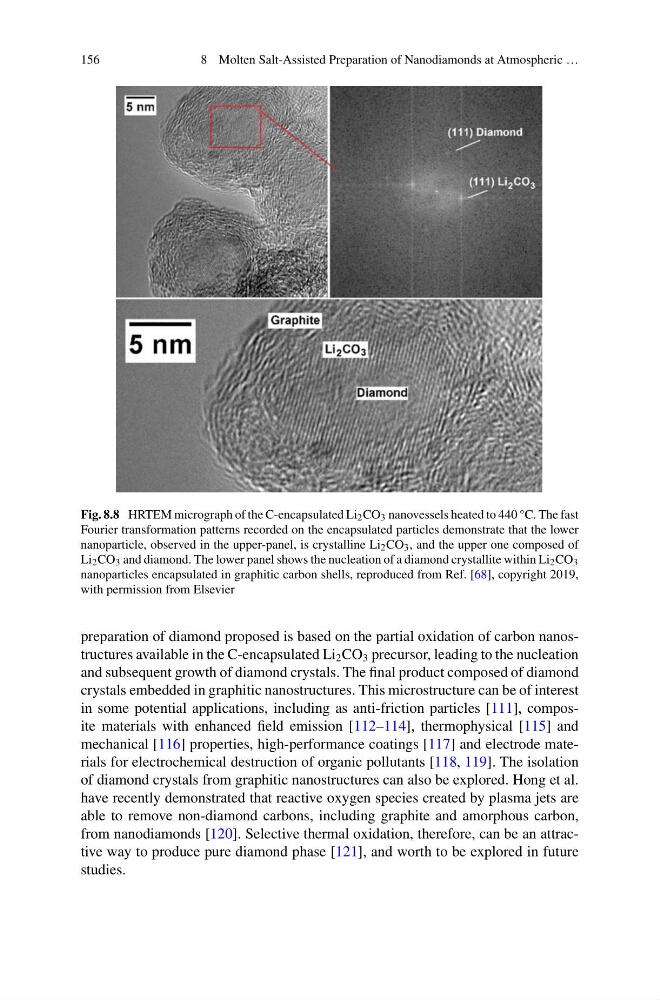
Fig. 8.8 HRTEM micrograph of the C-encapsulated Li 2 CO 3 nanovessels heated to 440 °C. The fast
Fourier transformation patterns recorded on the encapsulated particles demonstrate that the lower
nanoparticle, observed in the upper-panel, is crystalline Li 2 CO 3 , and the upper one composed of
Li 2 CO 3 and diamond. The lower panel shows the nucleation of a diamond crystallite within Li 2 CO 3
nanoparticles encapsulated in graphitic carbon shells, reproduced from Ref. [68], copyright 2019,
with permission from Elsevier
preparation of diamond proposed is based on the partial oxidation of carbon nanostructures available in the C-encapsulated Li 2 CO 3 precursor, leading to the nucleation
and subsequent growth of diamond crystals. The final product composed of diamond
crystals embedded in graphitic nanostructures. This microstructure can be of interest
in some potential applications, including as anti-friction particles [111], composite materials with enhanced field emission [112–114], thermophysical [115] and
mechanical [116] properties, high-performance coatings [117] and electrode materials for electrochemical destruction of organic pollutants [118, 119]. The isolation
of diamond crystals from graphitic nanostructures can also be explored. Hong et al.
have recently demonstrated that reactive oxygen species created by plasma jets are
able to remove non-diamond carbons, including graphite and amorphous carbon,
from nanodiamonds [120]. Selective thermal oxidation, therefore, can be an attractive way to produce pure diamond phase [121], and worth to be explored in future
studies.
8 Molten Salt-Assisted Preparation of Nanodiamonds at Atmospheric …
Fig. 8.8 HRTEM micrograph of the C-encapsulated Li 2 CO 3 nanovessels heated to 440 °C. The fast
Fourier transformation patterns recorded on the encapsulated particles demonstrate that the lower
nanoparticle, observed in the upper-panel, is crystalline Li 2 CO 3 , and the upper one composed of
Li 2 CO 3 and diamond. The lower panel shows the nucleation of a diamond crystallite within Li 2 CO 3
nanoparticles encapsulated in graphitic carbon shells, reproduced from Ref. [68], copyright 2019,
with permission from Elsevier
preparation of diamond proposed is based on the partial oxidation of carbon nanostructures available in the C-encapsulated Li 2 CO 3 precursor, leading to the nucleation
and subsequent growth of diamond crystals. The final product composed of diamond
crystals embedded in graphitic nanostructures. This microstructure can be of interest
in some potential applications, including as anti-friction particles [111], composite materials with enhanced field emission [112–114], thermophysical [115] and
mechanical [116] properties, high-performance coatings [117] and electrode materials for electrochemical destruction of organic pollutants [118, 119]. The isolation
of diamond crystals from graphitic nanostructures can also be explored. Hong et al.
have recently demonstrated that reactive oxygen species created by plasma jets are
able to remove non-diamond carbons, including graphite and amorphous carbon,
from nanodiamonds [120]. Selective thermal oxidation, therefore, can be an attractive way to produce pure diamond phase [121], and worth to be explored in future
studies.