

148
8 Molten Salt-Assisted Preparation of Nanodiamonds at Atmospheric …
lithium-containing materials which are commonly found in electrolytically produced
carbon products.
The presence of a sharp characteristic (002) peak in the XRD pattern shown in
Fig. 8.4a demonstrates that the carbon content of the electrolytic product is mostly
graphite. The crystallite size of the carbon material along the c-axis, L c , was calculated from the XRD information of the hexagonal (002) peak observed at 2θ =
26.50° according to Scherer’s approach and found to be 41 nm. The result shows the
formation of nanocrystalline graphite.
The SEM microstructure of the electrochemically produced carbon materials is
shown in Fig. 8.4b. The inset of the figure shows a higher magnified image from a
selected region. The material comprised of tubes with diameters in the wide range
of 10–500 nm and spherical nanoparticles, typically less than 100 nm. Also, some
graphite sheets can be seen in the microstructure.
Figures 8.4c–e show the HRTEM morphology of the carbon product. These micrographs demonstrate the presence of encapsulated 1–3 nm Li 2 CO 3 nanosingle crystals
with shells of carbon around them. These results suggest that the carbon product
includes Li 2 CO 3 nanocrystals surrounded by graphite layers.
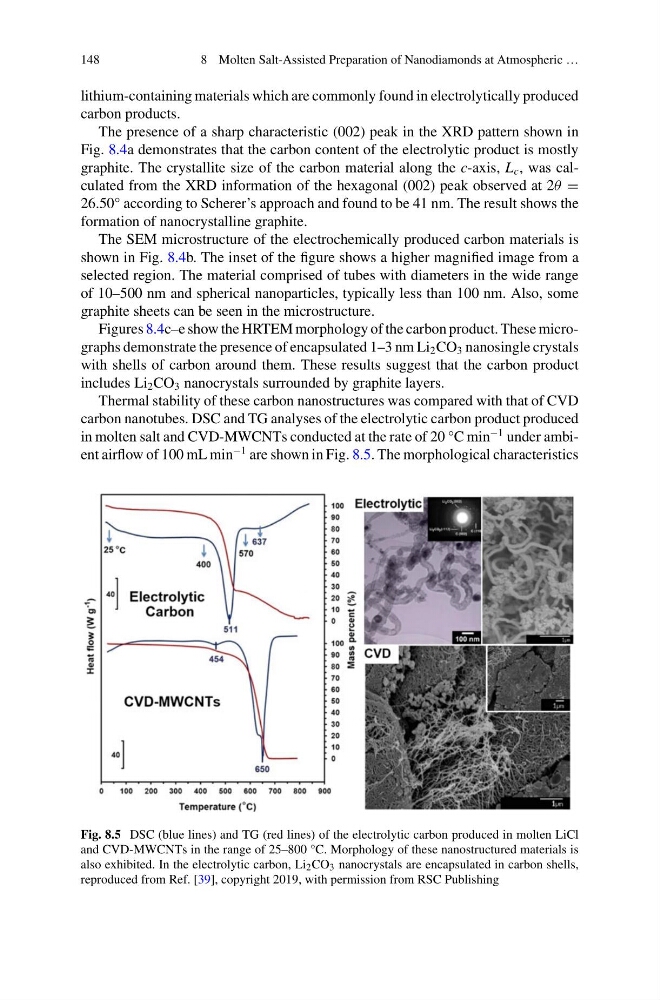
Thermal stability of these carbon nanostructures was compared with that of CVD
carbon nanotubes. DSC and TG analyses of the electrolytic carbon product produced
in molten salt and CVD-MWCNTs conducted at the rate of 20 °C min
−1 under ambient airflow of 100 mL min
−1 are shown in Fig. 8.5. The morphological characteristics
Fig. 8.5 DSC (blue lines) and TG (red lines) of the electrolytic carbon produced in molten LiCl
and CVD-MWCNTs in the range of 25–800 °C. Morphology of these nanostructured materials is
also exhibited. In the electrolytic carbon, Li 2 CO 3 nanocrystals are encapsulated in carbon shells,
reproduced from Ref. [39], copyright 2019, with permission from RSC Publishing
8 Molten Salt-Assisted Preparation of Nanodiamonds at Atmospheric …
lithium-containing materials which are commonly found in electrolytically produced
carbon products.
The presence of a sharp characteristic (002) peak in the XRD pattern shown in
Fig. 8.4a demonstrates that the carbon content of the electrolytic product is mostly
graphite. The crystallite size of the carbon material along the c-axis, L c , was calculated from the XRD information of the hexagonal (002) peak observed at 2θ =
26.50° according to Scherer’s approach and found to be 41 nm. The result shows the
formation of nanocrystalline graphite.
The SEM microstructure of the electrochemically produced carbon materials is
shown in Fig. 8.4b. The inset of the figure shows a higher magnified image from a
selected region. The material comprised of tubes with diameters in the wide range
of 10–500 nm and spherical nanoparticles, typically less than 100 nm. Also, some
graphite sheets can be seen in the microstructure.
Figures 8.4c–e show the HRTEM morphology of the carbon product. These micrographs demonstrate the presence of encapsulated 1–3 nm Li 2 CO 3 nanosingle crystals
with shells of carbon around them. These results suggest that the carbon product
includes Li 2 CO 3 nanocrystals surrounded by graphite layers.
Thermal stability of these carbon nanostructures was compared with that of CVD
carbon nanotubes. DSC and TG analyses of the electrolytic carbon product produced
in molten salt and CVD-MWCNTs conducted at the rate of 20 °C min
−1 under ambient airflow of 100 mL min
−1 are shown in Fig. 8.5. The morphological characteristics
Fig. 8.5 DSC (blue lines) and TG (red lines) of the electrolytic carbon produced in molten LiCl
and CVD-MWCNTs in the range of 25–800 °C. Morphology of these nanostructured materials is
also exhibited. In the electrolytic carbon, Li 2 CO 3 nanocrystals are encapsulated in carbon shells,
reproduced from Ref. [39], copyright 2019, with permission from RSC Publishing