

132
7 Molten Salt Conversion of Plastics into Highly Conductive …
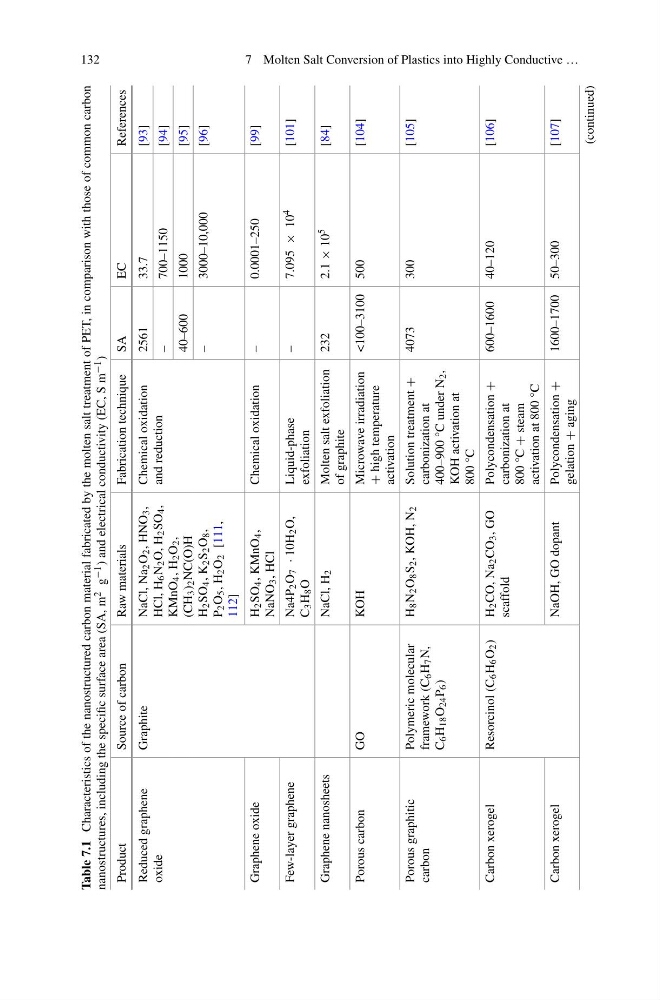
Table 7.1
Characteristics of the nanostructured carbon material fabricated by the molten salt treatment of PET, in comparison with those of common carbon
nanostructures, including the specific surface area (SA, m 2
g −1
) and electrical conductivity (EC, S m −1
)
Product
Source of carbon
Raw materials
Fabrication technique
SA
EC
References
Reduced graphene
oxide
Graphite
NaCl, Na
2 O
2 , HNO
3 ,
HCl, H
6 N
2 O, H
2 SO
4 ,
KMnO
4 , H
2 O
2 ,
(CH
3 )
2 NC(O)H
H
2 SO
4 , K
2 S
2 O
8 ,
P
2 O
5 , H
2 O
2 [111,
112]
Chemical oxidation
and reduction
2561
33.7
[93]
–
700–1150
[94]
40–600
1000
[95]
–
3000–10,000
[96]
Graphene oxide
H
2 SO
4 , KMnO
4 ,
NaNO
3 , HCl
Chemical oxidation
–
0.0001–250
[99]
Few-layer graphene
Na4P
2 O
7 · 10H
2 O,
C
3 H
8 O
Liquid-phase
exfoliation
–
7.095
× 10 4
[101]
Graphene nanosheets
NaCl, H
2
Molten salt exfoliation
of graphite
232
2.1
× 10 5
[84]
Porous carbon
GO
KOH
Microwave irradiation
+ high temperature
activation
<100–3100 500
[104]
Porous graphitic
carbon
Polymeric molecular
framework (C
6 H
7 N,
C
6 H
18 O
24 P
6 )
H
8 N
2 O
8 S
2 , KOH, N
2
Solution treatment
+
carbonization at
400–900 °C under N
2 ,
KOH activation at
800 °C
4073
300
[105]
Carbon xerogel
Resorcinol (C
6 H
6 O
2 )
H
2 CO, Na
2 CO
3 , GO
scaffold
Polycondensation
+
carbonization at
800 °C
+ steam
activation at 800 °C
600–1600
40–120
[106]
Carbon xerogel
NaOH, GO dopant
Polycondensation
+
gelation
+ aging
1600–1700 50–300
[107]
(continued)
7 Molten Salt Conversion of Plastics into Highly Conductive …
Table 7.1
Characteristics of the nanostructured carbon material fabricated by the molten salt treatment of PET, in comparison with those of common carbon
nanostructures, including the specific surface area (SA, m 2
g −1
) and electrical conductivity (EC, S m −1
)
Product
Source of carbon
Raw materials
Fabrication technique
SA
EC
References
Reduced graphene
oxide
Graphite
NaCl, Na
2 O
2 , HNO
3 ,
HCl, H
6 N
2 O, H
2 SO
4 ,
KMnO
4 , H
2 O
2 ,
(CH
3 )
2 NC(O)H
H
2 SO
4 , K
2 S
2 O
8 ,
P
2 O
5 , H
2 O
2 [111,
112]
Chemical oxidation
and reduction
2561
33.7
[93]
–
700–1150
[94]
40–600
1000
[95]
–
3000–10,000
[96]
Graphene oxide
H
2 SO
4 , KMnO
4 ,
NaNO
3 , HCl
Chemical oxidation
–
0.0001–250
[99]
Few-layer graphene
Na4P
2 O
7 · 10H
2 O,
C
3 H
8 O
Liquid-phase
exfoliation
–
7.095
× 10 4
[101]
Graphene nanosheets
NaCl, H
2
Molten salt exfoliation
of graphite
232
2.1
× 10 5
[84]
Porous carbon
GO
KOH
Microwave irradiation
+ high temperature
activation
<100–3100 500
[104]
Porous graphitic
carbon
Polymeric molecular
framework (C
6 H
7 N,
C
6 H
18 O
24 P
6 )
H
8 N
2 O
8 S
2 , KOH, N
2
Solution treatment
+
carbonization at
400–900 °C under N
2 ,
KOH activation at
800 °C
4073
300
[105]
Carbon xerogel
Resorcinol (C
6 H
6 O
2 )
H
2 CO, Na
2 CO
3 , GO
scaffold
Polycondensation
+
carbonization at
800 °C
+ steam
activation at 800 °C
600–1600
40–120
[106]
Carbon xerogel
NaOH, GO dopant
Polycondensation
+
gelation
+ aging
1600–1700 50–300
[107]
(continued)