

124
7 Molten Salt Conversion of Plastics into Highly Conductive …
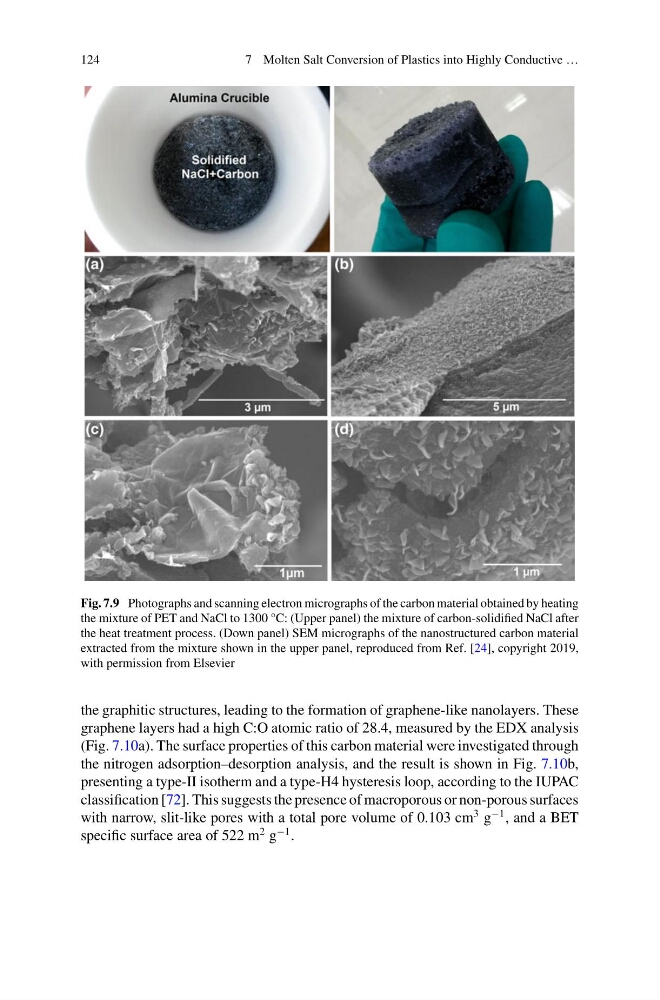
Fig. 7.9 Photographs and scanning electron micrographs of the carbon material obtained by heating
the mixture of PET and NaCl to 1300 °C: (Upper panel) the mixture of carbon-solidified NaCl after
the heat treatment process. (Down panel) SEM micrographs of the nanostructured carbon material
extracted from the mixture shown in the upper panel, reproduced from Ref. [24], copyright 2019,
with permission from Elsevier
the graphitic structures, leading to the formation of graphene-like nanolayers. These
graphene layers had a high C:O atomic ratio of 28.4, measured by the EDX analysis
(Fig. 7.10a). The surface properties of this carbon material were investigated through
the nitrogen adsorption–desorption analysis, and the result is shown in Fig. 7.10b,
presenting a type-II isotherm and a type-H4 hysteresis loop, according to the IUPAC
classification [72]. This suggests the presence of macroporous or non-porous surfaces
with narrow, slit-like pores with a total pore volume of 0.103 cm
3 g
−1 , and a BET
specific surface area of 522 m
2 g
−1 .
7 Molten Salt Conversion of Plastics into Highly Conductive …
Fig. 7.9 Photographs and scanning electron micrographs of the carbon material obtained by heating
the mixture of PET and NaCl to 1300 °C: (Upper panel) the mixture of carbon-solidified NaCl after
the heat treatment process. (Down panel) SEM micrographs of the nanostructured carbon material
extracted from the mixture shown in the upper panel, reproduced from Ref. [24], copyright 2019,
with permission from Elsevier
the graphitic structures, leading to the formation of graphene-like nanolayers. These
graphene layers had a high C:O atomic ratio of 28.4, measured by the EDX analysis
(Fig. 7.10a). The surface properties of this carbon material were investigated through
the nitrogen adsorption–desorption analysis, and the result is shown in Fig. 7.10b,
presenting a type-II isotherm and a type-H4 hysteresis loop, according to the IUPAC
classification [72]. This suggests the presence of macroporous or non-porous surfaces
with narrow, slit-like pores with a total pore volume of 0.103 cm
3 g
−1 , and a BET
specific surface area of 522 m
2 g
−1 .