

116
7 Molten Salt Conversion of Plastics into Highly Conductive …
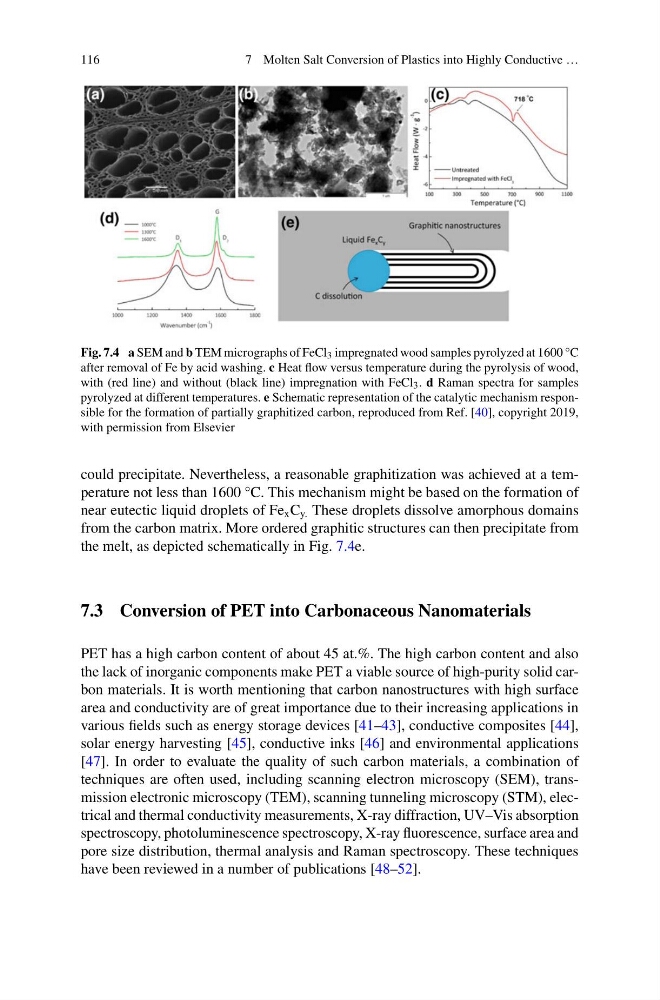
Fig. 7.4 a SEM and b TEM micrographs of FeCl 3 impregnated wood samples pyrolyzed at 1600 °C
after removal of Fe by acid washing. c Heat flow versus temperature during the pyrolysis of wood,
with (red line) and without (black line) impregnation with FeCl 3 . d Raman spectra for samples
pyrolyzed at different temperatures. e Schematic representation of the catalytic mechanism responsible for the formation of partially graphitized carbon, reproduced from Ref. [40], copyright 2019,
with permission from Elsevier
could precipitate. Nevertheless, a reasonable graphitization was achieved at a temperature not less than 1600 °C. This mechanism might be based on the formation of
near eutectic liquid droplets of Fe x C y. These droplets dissolve amorphous domains
from the carbon matrix. More ordered graphitic structures can then precipitate from
the melt, as depicted schematically in Fig. 7.4e.
7.3 Conversion of PET into Carbonaceous Nanomaterials
PET has a high carbon content of about 45 at.%. The high carbon content and also
the lack of inorganic components make PET a viable source of high-purity solid carbon materials. It is worth mentioning that carbon nanostructures with high surface
area and conductivity are of great importance due to their increasing applications in
various fields such as energy storage devices [41–43], conductive composites [44],
solar energy harvesting [45], conductive inks [46] and environmental applications
[47]. In order to evaluate the quality of such carbon materials, a combination of
techniques are often used, including scanning electron microscopy (SEM), transmission electronic microscopy (TEM), scanning tunneling microscopy (STM), electrical and thermal conductivity measurements, X-ray diffraction, UV–Vis absorption
spectroscopy, photoluminescence spectroscopy, X-ray fluorescence, surface area and
pore size distribution, thermal analysis and Raman spectroscopy. These techniques
have been reviewed in a number of publications [48–52].
7 Molten Salt Conversion of Plastics into Highly Conductive …
Fig. 7.4 a SEM and b TEM micrographs of FeCl 3 impregnated wood samples pyrolyzed at 1600 °C
after removal of Fe by acid washing. c Heat flow versus temperature during the pyrolysis of wood,
with (red line) and without (black line) impregnation with FeCl 3 . d Raman spectra for samples
pyrolyzed at different temperatures. e Schematic representation of the catalytic mechanism responsible for the formation of partially graphitized carbon, reproduced from Ref. [40], copyright 2019,
with permission from Elsevier
could precipitate. Nevertheless, a reasonable graphitization was achieved at a temperature not less than 1600 °C. This mechanism might be based on the formation of
near eutectic liquid droplets of Fe x C y. These droplets dissolve amorphous domains
from the carbon matrix. More ordered graphitic structures can then precipitate from
the melt, as depicted schematically in Fig. 7.4e.
7.3 Conversion of PET into Carbonaceous Nanomaterials
PET has a high carbon content of about 45 at.%. The high carbon content and also
the lack of inorganic components make PET a viable source of high-purity solid carbon materials. It is worth mentioning that carbon nanostructures with high surface
area and conductivity are of great importance due to their increasing applications in
various fields such as energy storage devices [41–43], conductive composites [44],
solar energy harvesting [45], conductive inks [46] and environmental applications
[47]. In order to evaluate the quality of such carbon materials, a combination of
techniques are often used, including scanning electron microscopy (SEM), transmission electronic microscopy (TEM), scanning tunneling microscopy (STM), electrical and thermal conductivity measurements, X-ray diffraction, UV–Vis absorption
spectroscopy, photoluminescence spectroscopy, X-ray fluorescence, surface area and
pore size distribution, thermal analysis and Raman spectroscopy. These techniques
have been reviewed in a number of publications [48–52].