

What is an informational environment? 97
produced signals, to the extent that the latter have a bearing on their senders’
and receivers’ ecological environments. That bearing typically – but not always –
consists in serving purposes of coordination and cooperation within a population
of users, that is senders and receivers of such signals. Situations of competition
and deception will constitute a relevant special case. In terms of a definition, my
account will assume the following shape:
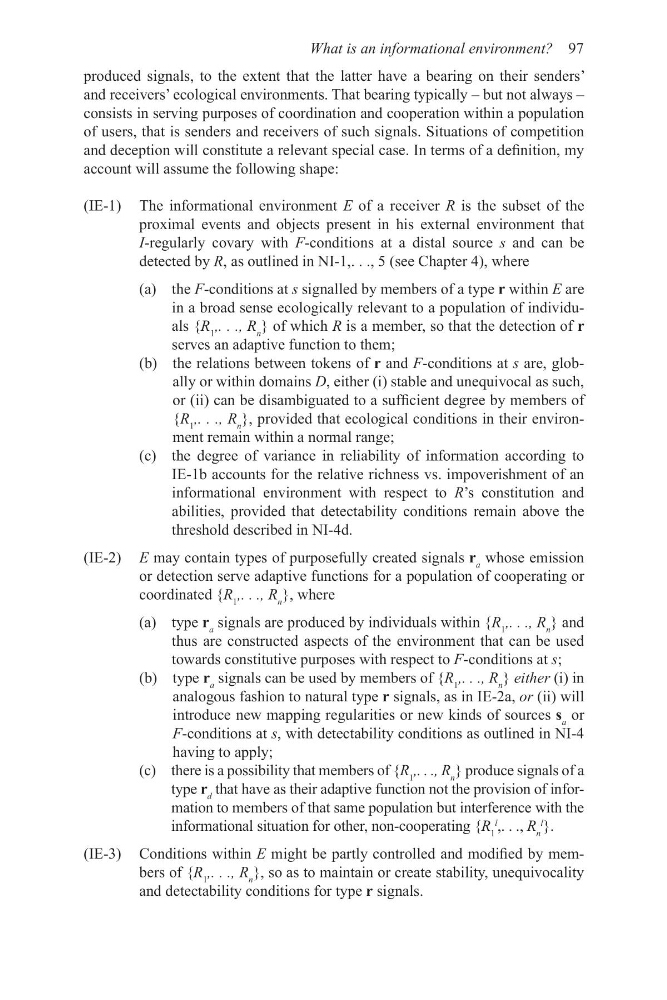
(IE-1) The informational environment E of a receiver R is the subset of the
proximal events and objects present in his external environment that
I-regularly covary with F-conditions at a distal source s and can be
detected by R, as outlined in NI-1,. . ., 5 (see Chapter 4), where
(a) the F-conditions at s signalled by members of a type r within E are
in a broad sense ecologically relevant to a population of individuals {R 1 ,. . ., R n } of which R is a member, so that the detection of r
serves an adaptive function to them;
(b) the relations between tokens of r and F-conditions at s are, globally or within domains D, either (i) stable and unequivocal as such,
or (ii) can be disambiguated to a sufficient degree by members of
{R 1 ,. . ., R n }, provided that ecological conditions in their environment remain within a normal range;
(c) the degree of variance in reliability of information according to
IE-1b accounts for the relative richness vs. impoverishment of an
informational environment with respect to R’s constitution and
abilities, provided that detectability conditions remain above the
threshold described in NI-4d.
(IE-2) E may contain types of purposefully created signals r a whose emission
or detection serve adaptive functions for a population of cooperating or
coordinated {R 1 ,. . ., R n }, where
(a) type r a signals are produced by individuals within {R 1 ,. . ., R n } and
thus are constructed aspects of the environment that can be used
towards constitutive purposes with respect to F-conditions at s;
(b) type r a signals can be used by members of {R 1 ,. . ., R n } either (i) in
analogous fashion to natural type r signals, as in IE-2a, or (ii) will
introduce new mapping regularities or new kinds of sources s a or
F-conditions at s, with detectability conditions as outlined in NI-4
having to apply;
(c) there is a possibility that members of {R 1 ,. . ., R n } produce signals of a
type r d that have as their adaptive function not the provision of information to members of that same population but interference with the
informational situation for other, non-cooperating {R 1
l
,. . ., R n
l
}.
(IE-3) Conditions within E might be partly controlled and modified by members of {R 1 ,. . ., R n }, so as to maintain or create stability, unequivocality
and detectability conditions for type r signals.
produced signals, to the extent that the latter have a bearing on their senders’
and receivers’ ecological environments. That bearing typically – but not always –
consists in serving purposes of coordination and cooperation within a population
of users, that is senders and receivers of such signals. Situations of competition
and deception will constitute a relevant special case. In terms of a definition, my
account will assume the following shape:
(IE-1) The informational environment E of a receiver R is the subset of the
proximal events and objects present in his external environment that
I-regularly covary with F-conditions at a distal source s and can be
detected by R, as outlined in NI-1,. . ., 5 (see Chapter 4), where
(a) the F-conditions at s signalled by members of a type r within E are
in a broad sense ecologically relevant to a population of individuals {R 1 ,. . ., R n } of which R is a member, so that the detection of r
serves an adaptive function to them;
(b) the relations between tokens of r and F-conditions at s are, globally or within domains D, either (i) stable and unequivocal as such,
or (ii) can be disambiguated to a sufficient degree by members of
{R 1 ,. . ., R n }, provided that ecological conditions in their environment remain within a normal range;
(c) the degree of variance in reliability of information according to
IE-1b accounts for the relative richness vs. impoverishment of an
informational environment with respect to R’s constitution and
abilities, provided that detectability conditions remain above the
threshold described in NI-4d.
(IE-2) E may contain types of purposefully created signals r a whose emission
or detection serve adaptive functions for a population of cooperating or
coordinated {R 1 ,. . ., R n }, where
(a) type r a signals are produced by individuals within {R 1 ,. . ., R n } and
thus are constructed aspects of the environment that can be used
towards constitutive purposes with respect to F-conditions at s;
(b) type r a signals can be used by members of {R 1 ,. . ., R n } either (i) in
analogous fashion to natural type r signals, as in IE-2a, or (ii) will
introduce new mapping regularities or new kinds of sources s a or
F-conditions at s, with detectability conditions as outlined in NI-4
having to apply;
(c) there is a possibility that members of {R 1 ,. . ., R n } produce signals of a
type r d that have as their adaptive function not the provision of information to members of that same population but interference with the
informational situation for other, non-cooperating {R 1
l
,. . ., R n
l
}.
(IE-3) Conditions within E might be partly controlled and modified by members of {R 1 ,. . ., R n }, so as to maintain or create stability, unequivocality
and detectability conditions for type r signals.