

15
Interconnection Networks in Network-on-Chip
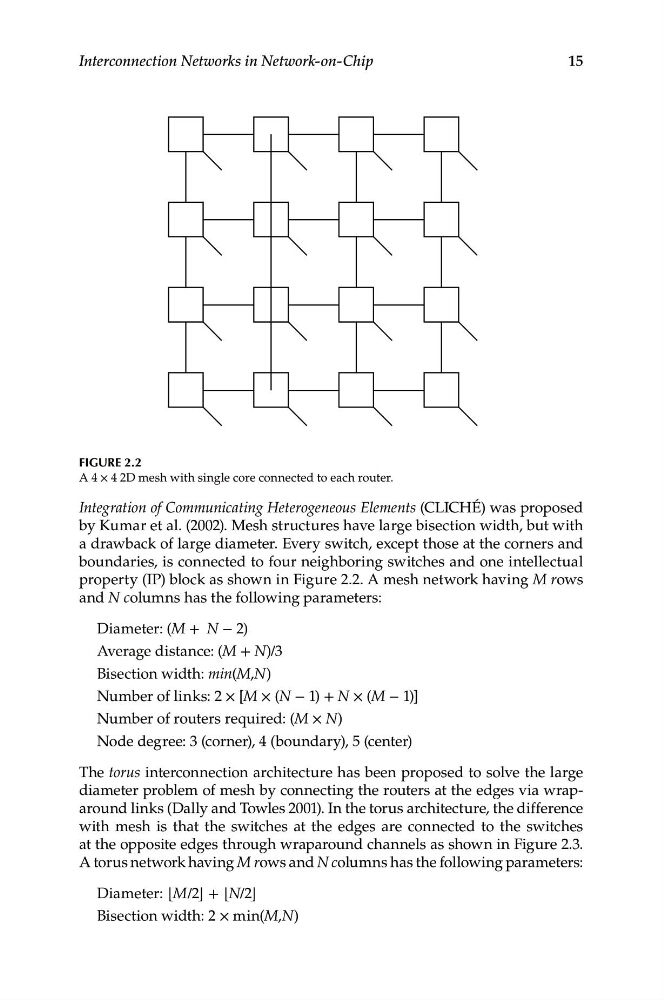
Figure 2.2
A 4 × 4 2D mesh with single core connected to each router.
Integration of Communicating Heterogeneous Elements (CLICHÉ) was proposed
by Kumar et al. (2002). Mesh structures have large bisection width, but with
a drawback of large diameter. Every switch, except those at the corners and
boundaries, is connected to four neighboring switches and one intellectual
property (IP) block as shown in Figure 2.2. A mesh network having M rows
and N columns has the following parameters:
Diameter: (M + N − 2)
Average distance: (M + N)/3
Bisection width: min(M,N)
Number of links: 2 × [M × (N − 1) + N × (M − 1)]
Number of routers required: (M × N)
Node degree: 3 (corner), 4 (boundary), 5 (center)
The torus interconnection architecture has been proposed to solve the large
diameter problem of mesh by connecting the routers at the edges via wraparound links (Dally and Towles 2001). In the torus architecture, the difference
with mesh is that the switches at the edges are connected to the switches
at the opposite edges through wraparound channels as shown in Figure 2.3.
A torus network having M rows and N columns has the following parameters:
Diameter: ⌊M/2⌋ + ⌊N/2⌋
Bisection width: 2 × min(M,N)