

274
Network-on-Chip
⎛
⎞
⎜
∑
ω (i, j) ×
RD k , m ×
Z i , j k l, m, n ⎟
⎜
, ,
⎟
⎜
i , j, k ,l, m, n
⎟ ⎟
⎜
⎟
P L =
Ψ
L ⎜ +
∑ ND i , k ×
ω (i, j) ×
NR i i , k ,l ⎟
⎜ i , j, k ,l
⎟
⎜
⎟
⎜
⎟
+
∑
ND
j, k ×
ω (i, j) ×
NR
⎜
j, k ,l
⎟
⎝
i , j, k ,l
⎠
where:
Ψ i and Ψ o are the weights that denote power consumed per megabytes per
second of traffic flowing through a router port in input and output
directions, respectively
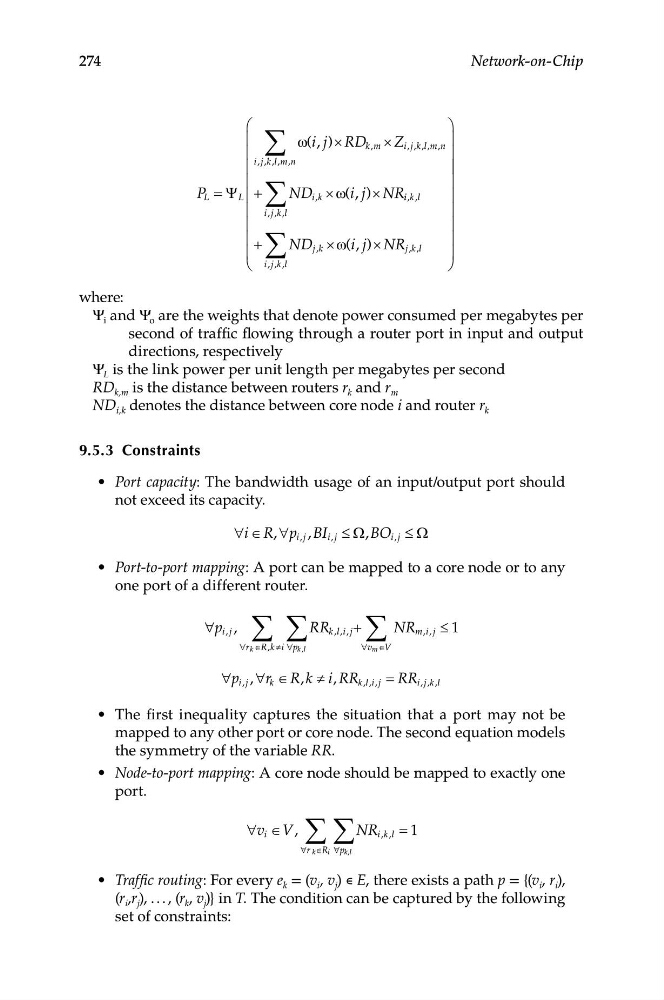
Ψ L is the link power per unit length per megabytes per second
RD k,m is the distance between routers r k and r m
ND i,k denotes the distance between core node i and router r k
9.5.3 Constraints
• Port capacity: The bandwidth usage of an input/output port should
not exceed its capacity.
∀i ∈ R,∀p i , j , BI i , j ≤ Ω, BO i , j ≤ Ω
• Port-to-port mapping: A port can be mapped to a core node or to any
one port of a different router.
∀p i , j , ∑ RR k ,l,i , j + NR m ,i , j ≤ 1
∀r k ∈R, k ≠i
∑
∀ p
∑
k ,l
∀vm∈V
∀ p i, j ,∀r k ∈ R, k ≠ i , RR k ,l,i, j = RR i , j,k , l
• The first inequality captures the situation that a port may not be
mapped to any other port or core node. The second equation models
the symmetry of the variable RR.
• Node-to-port mapping: A core node should be mapped to exactly one
port.
∀v i ∈ V, ∑ ∑
NR i , k ,l = 1
∀r k ∈ Ri ∀pk, l
• Traffic routing: For every e k = (v i , v j ) ∊ E, there exists a path p = {(v i , r i ),
(r i ,r j ), . . . , (r k , v j )} in T. The condition can be captured by the following
set of constraints:
Network-on-Chip
⎛
⎞
⎜
∑
ω (i, j) ×
RD k , m ×
Z i , j k l, m, n ⎟
⎜
, ,
⎟
⎜
i , j, k ,l, m, n
⎟ ⎟
⎜
⎟
P L =
Ψ
L ⎜ +
∑ ND i , k ×
ω (i, j) ×
NR i i , k ,l ⎟
⎜ i , j, k ,l
⎟
⎜
⎟
⎜
⎟
+
∑
ND
j, k ×
ω (i, j) ×
NR
⎜
j, k ,l
⎟
⎝
i , j, k ,l
⎠
where:
Ψ i and Ψ o are the weights that denote power consumed per megabytes per
second of traffic flowing through a router port in input and output
directions, respectively
Ψ L is the link power per unit length per megabytes per second
RD k,m is the distance between routers r k and r m
ND i,k denotes the distance between core node i and router r k
9.5.3 Constraints
• Port capacity: The bandwidth usage of an input/output port should
not exceed its capacity.
∀i ∈ R,∀p i , j , BI i , j ≤ Ω, BO i , j ≤ Ω
• Port-to-port mapping: A port can be mapped to a core node or to any
one port of a different router.
∀p i , j , ∑ RR k ,l,i , j + NR m ,i , j ≤ 1
∀r k ∈R, k ≠i
∑
∀ p
∑
k ,l
∀vm∈V
∀ p i, j ,∀r k ∈ R, k ≠ i , RR k ,l,i, j = RR i , j,k , l
• The first inequality captures the situation that a port may not be
mapped to any other port or core node. The second equation models
the symmetry of the variable RR.
• Node-to-port mapping: A core node should be mapped to exactly one
port.
∀v i ∈ V, ∑ ∑
NR i , k ,l = 1
∀r k ∈ Ri ∀pk, l
• Traffic routing: For every e k = (v i , v j ) ∊ E, there exists a path p = {(v i , r i ),
(r i ,r j ), . . . , (r k , v j )} in T. The condition can be captured by the following
set of constraints: