

Combinatorial network
S 0
S 1
+
+
S 2
S 0
S 1
S 3
u(x)
State register
+
+
(a)
u(x)
(b)
Combinatorial network
+
+
+
+
+
+
+
+
i 3
i 2
S 2
i 1
S 1
i 0
S 0
State register
219
Signal Integrity and Reliability of Network-on-Chip
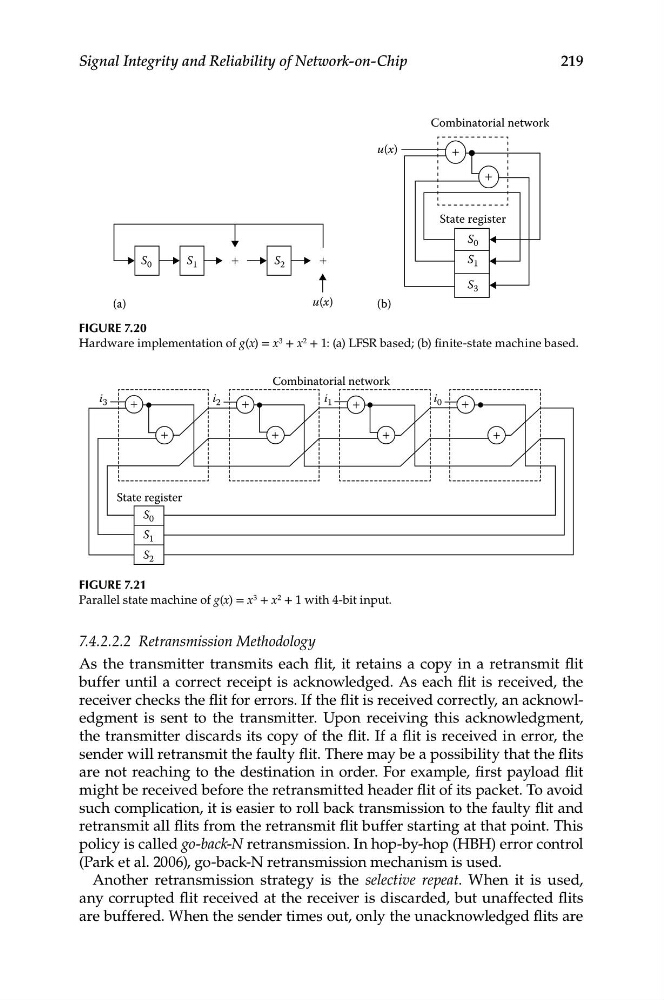
Figure 7.20
Hardware implementation of g(x) = x 3 + x 2 + 1: (a) LFSR based; (b) finite-state machine based.
Figure 7.21
Parallel state machine of g(x) = x 3 + x 2 + 1 with 4-bit input.
7.4.2.2.2 Retransmission Methodology
As the transmitter transmits each flit, it retains a copy in a retransmit flit
buffer until a correct receipt is acknowledged. As each flit is received, the
receiver checks the flit for errors. If the flit is received correctly, an acknowledgment is sent to the transmitter. Upon receiving this acknowledgment,
the transmitter discards its copy of the flit. If a flit is received in error, the
sender will retransmit the faulty flit. There may be a possibility that the flits
are not reaching to the destination in order. For example, first payload flit
might be received before the retransmitted header flit of its packet. To avoid
such complication, it is easier to roll back transmission to the faulty flit and
retransmit all flits from the retransmit flit buffer starting at that point. This
policy is called go-back-N retransmission. In hop-by-hop (HBH) error control
(Park et al. 2006), go-back-N retransmission mechanism is used.
Another retransmission strategy is the selective repeat. When it is used,
any corrupted flit received at the receiver is discarded, but unaffected flits
are buffered. When the sender times out, only the unacknowledged flits are
S 0
S 1
+
+
S 2
S 0
S 1
S 3
u(x)
State register
+
+
(a)
u(x)
(b)
Combinatorial network
+
+
+
+
+
+
+
+
i 3
i 2
S 2
i 1
S 1
i 0
S 0
State register
219
Signal Integrity and Reliability of Network-on-Chip
Figure 7.20
Hardware implementation of g(x) = x 3 + x 2 + 1: (a) LFSR based; (b) finite-state machine based.
Figure 7.21
Parallel state machine of g(x) = x 3 + x 2 + 1 with 4-bit input.
7.4.2.2.2 Retransmission Methodology
As the transmitter transmits each flit, it retains a copy in a retransmit flit
buffer until a correct receipt is acknowledged. As each flit is received, the
receiver checks the flit for errors. If the flit is received correctly, an acknowledgment is sent to the transmitter. Upon receiving this acknowledgment,
the transmitter discards its copy of the flit. If a flit is received in error, the
sender will retransmit the faulty flit. There may be a possibility that the flits
are not reaching to the destination in order. For example, first payload flit
might be received before the retransmitted header flit of its packet. To avoid
such complication, it is easier to roll back transmission to the faulty flit and
retransmit all flits from the retransmit flit buffer starting at that point. This
policy is called go-back-N retransmission. In hop-by-hop (HBH) error control
(Park et al. 2006), go-back-N retransmission mechanism is used.
Another retransmission strategy is the selective repeat. When it is used,
any corrupted flit received at the receiver is discarded, but unaffected flits
are buffered. When the sender times out, only the unacknowledged flits are