

144
Network-on-Chip
5.6.4 Overall PSO Algorithm
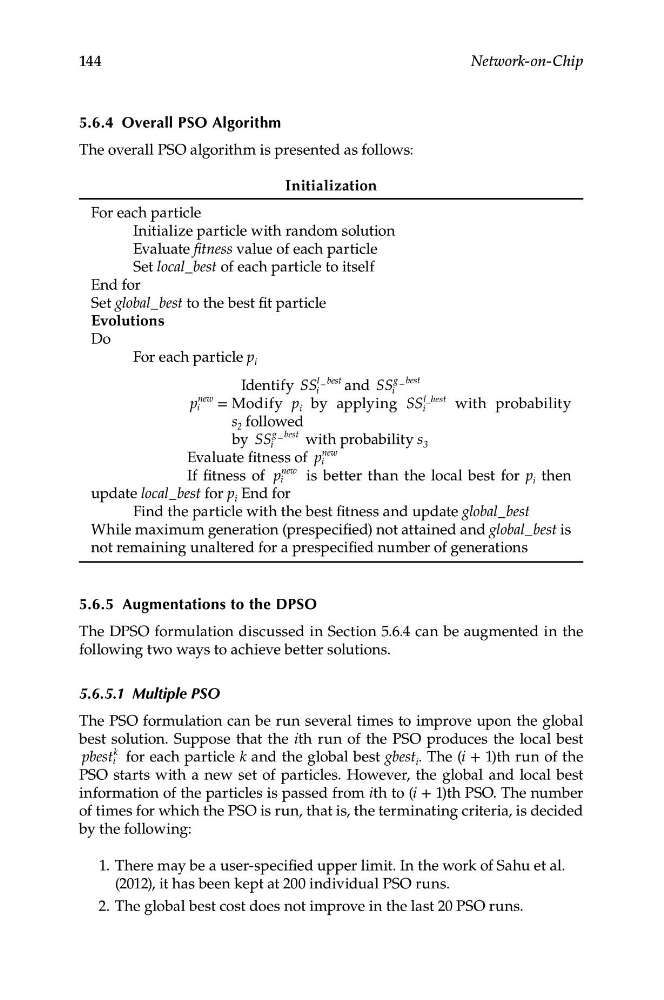
The overall PSO algorithm is presented as follows:
Initialization
For e ach particle
Initialize particle with random solution
Evaluate fitness value of each particle
Set local_best of each particle to itself
End for
Set global_best to the best fit particle
Evolutions
Do
For e ach particle p i
Identify SS
l _ best an S
g _ best
i
d S i
p
new
l_best
i
= Modify p i by applying SS i
with probability
s 2 followed
by SS
g _ best
i
with probability s 3
Evaluate fitness of p
new
i
If fitness of p
new
i
is better than the local best for p i then
update local_best for p i End for
Find the particle with t he best fitness and update global_best
While maximum generation (prespecified) not attained and global_best is
not remaining unaltered for a prespecified number of generations
5.6.5 Augmentations to the DPSO
The DPSO formulation discussed in Section 5.6.4 can be augmented in the
following two ways to achieve better solutions.
5.6.5.1 Multiple PSO
The PSO formulation can be run several times to improve upon the global
best solution. Suppose that the ith run of the PSO produces the local best
pbest i
k for each particle k and the global best gbest i . The (i + 1)th run of the
PSO starts with a new set of particles. However, the global and local best
information of the particles is passed from ith to (i + 1)th PSO. The number
of times for which the PSO is run, that is, the terminating criteria, is decided
by the following:
1. There may be a user-specified upper limit. In the work of Sahu et al.
(2012), it has been kept at 200 individual PSO runs.
2. The global best cost does not improve in the last 20 PSO runs.