

131
Application Mapping on Network-on-Chip
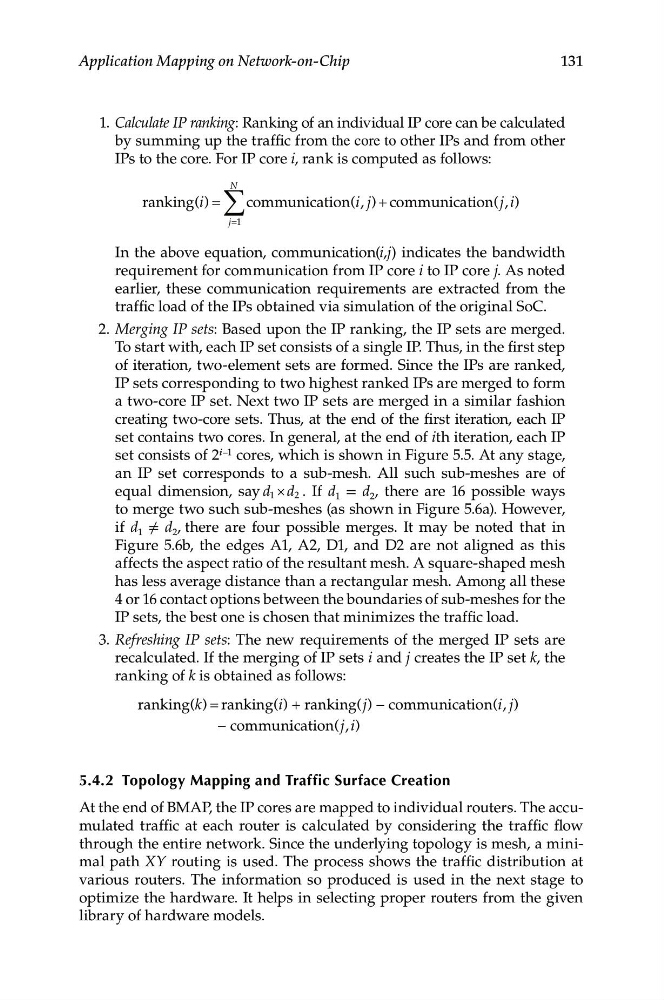
1. Calculate IP ranking: Ranking of an individual IP core can be calculated
by summing up the traffic from the core to other IPs and from other
IPs to the core. For IP core i, rank is computed as follows:
N
ing( i ) = ∑
rank
communication (i, j ) + communication( j, i )
j=1
In the above equation, communication(i,j) indicates the bandwidth
requirement for communication from IP core i to IP core j. As noted
earlier, these communication requirements are extracted from the
traffic load of the IPs obtained via simulation of the original SoC.
2. Merging IP sets: Based upon the IP ranking, the IP sets are merged.
To start with, each IP set consists of a single IP. Thus, in the first step
of iteration, two-element sets are formed. Since the IPs are ranked,
IP sets corresponding to two highest ranked IPs are merged to form
a two-core IP set. Next two IP sets are merged in a similar fashion
creating two-core sets. Thus, at the end of the first iteration, each IP
set contains two cores. In general, at the end of ith iteration, each IP
set consists of 2 i–1 cores, which is shown in Figure 5.5. At any stage,
an IP set corresponds to a sub-mesh. All such sub-meshes are of
equal dimension, say d 1 × d 2 . If d 1 = d 2 , there are 16 possible ways
to merge two such sub-meshes (as shown in Figure 5.6a). However,
if d 1 ≠ d 2 , there are four possible merges. It may be noted that in
Figure 5.6b, the edges A1, A2, D1, and D2 are not aligned as this
affects the aspect ratio of the resultant mesh. A square-shaped mesh
has less average distance than a rectangular mesh. Among all these
4 or 16 contact options between the boundaries of sub-meshes for the
IP sets, the best one is chosen that minimizes the traffic load.
3. Refreshing IP sets: The new requirements of the merged IP sets are
recalculated. If the merging of IP sets i and j creates the IP set k, the
ranking of k is obtained as follows:
ranking( k ) = ranking( i ) + ranking( j ) − communication( i, j )
− communi ication(j, i)
5.4.2 Topology Mapping and Traffic Surface Creation
At the end of BMAP, the IP cores are mapped to individual routers. The accumulated traffic at each router is calculated by considering the traffic flow
through the entire network. Since the underlying topology is mesh, a minimal path XY routing is used. The process shows the traffic distribution at
various routers. The information so produced is used in the next stage to
optimize the hardware. It helps in selecting proper routers from the given
library of hardware models.
Application Mapping on Network-on-Chip
1. Calculate IP ranking: Ranking of an individual IP core can be calculated
by summing up the traffic from the core to other IPs and from other
IPs to the core. For IP core i, rank is computed as follows:
N
ing( i ) = ∑
rank
communication (i, j ) + communication( j, i )
j=1
In the above equation, communication(i,j) indicates the bandwidth
requirement for communication from IP core i to IP core j. As noted
earlier, these communication requirements are extracted from the
traffic load of the IPs obtained via simulation of the original SoC.
2. Merging IP sets: Based upon the IP ranking, the IP sets are merged.
To start with, each IP set consists of a single IP. Thus, in the first step
of iteration, two-element sets are formed. Since the IPs are ranked,
IP sets corresponding to two highest ranked IPs are merged to form
a two-core IP set. Next two IP sets are merged in a similar fashion
creating two-core sets. Thus, at the end of the first iteration, each IP
set contains two cores. In general, at the end of ith iteration, each IP
set consists of 2 i–1 cores, which is shown in Figure 5.5. At any stage,
an IP set corresponds to a sub-mesh. All such sub-meshes are of
equal dimension, say d 1 × d 2 . If d 1 = d 2 , there are 16 possible ways
to merge two such sub-meshes (as shown in Figure 5.6a). However,
if d 1 ≠ d 2 , there are four possible merges. It may be noted that in
Figure 5.6b, the edges A1, A2, D1, and D2 are not aligned as this
affects the aspect ratio of the resultant mesh. A square-shaped mesh
has less average distance than a rectangular mesh. Among all these
4 or 16 contact options between the boundaries of sub-meshes for the
IP sets, the best one is chosen that minimizes the traffic load.
3. Refreshing IP sets: The new requirements of the merged IP sets are
recalculated. If the merging of IP sets i and j creates the IP set k, the
ranking of k is obtained as follows:
ranking( k ) = ranking( i ) + ranking( j ) − communication( i, j )
− communi ication(j, i)
5.4.2 Topology Mapping and Traffic Surface Creation
At the end of BMAP, the IP cores are mapped to individual routers. The accumulated traffic at each router is calculated by considering the traffic flow
through the entire network. Since the underlying topology is mesh, a minimal path XY routing is used. The process shows the traffic distribution at
various routers. The information so produced is used in the next stage to
optimize the hardware. It helps in selecting proper routers from the given
library of hardware models.