

102
Network-on-Chip
4.6.4 Comparison of energy Consumption
This section reports the comparison of energy consumption of all the networks at saturation. A network with more number of channels will definitely
have higher network throughput but at the cost of more link energy consumption. Therefore, the average energy consumption per packet reception
is a meaningful metric while comparing the energy consumption of various network structures. The number of FIFOs required to build a network
is a topology-dependent parameter. Table 4.8 contains information about the
number of links along with their lengths and the number of FIFOs required
to implement the networks under consideration. It can be observed from
Table 4.8 that for connecting 32 IP cores, 64 unidirectional local links of
length 1.25 mm are required. There are also some very short links (of the
order of few micrometers) that exist in the proposed MoT and both type of
mesh networks. They consume very small energy. It has been observed that
Mesh-1 and MoT-based networks require 80 links of length 2.5 mm, whereas
for BFT and Mesh-2, the number of 2.5-mm links is 96 and 64, respectively.
Table 4.8 shows that the number of FIFOs required to implement the BFT
and Mesh-2 networks connecting 32 cores is less compared to the other two
networks under consideration. As the throughput of the BFT network is the
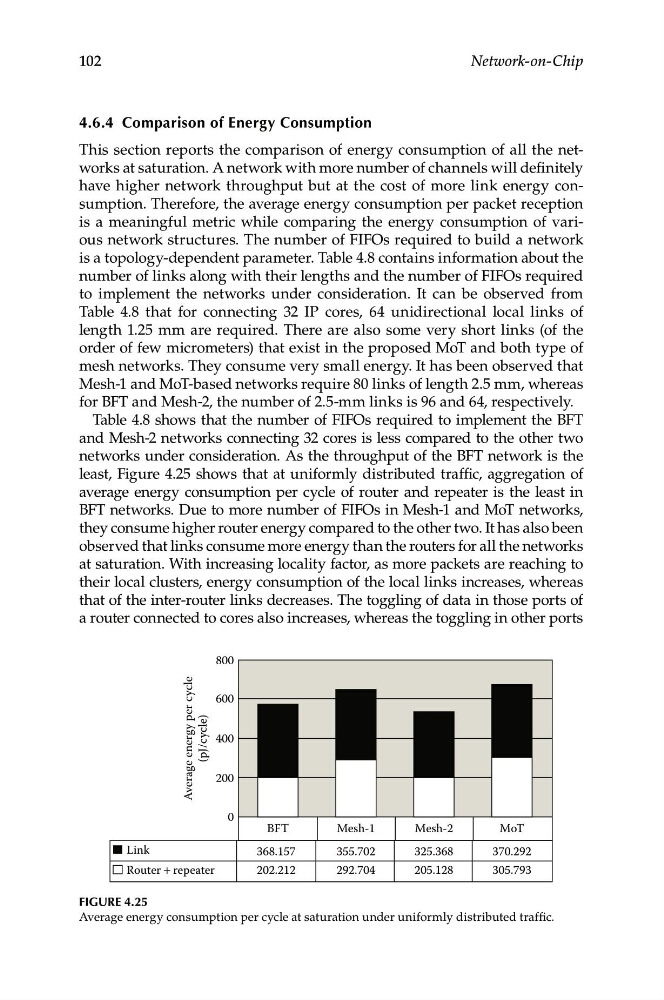
least, Figure 4.25 shows that at uniformly distributed traffic, aggregation of
average energy consumption per cycle of router and repeater is the least in
BFT networks. Due to more number of FIFOs in Mesh-1 and MoT networks,
they consume higher router energy compared to the other two. It has also been
observed that links consume more energy than the routers for all the networks
at saturation. With increasing locality factor, as more packets are reaching to
their local clusters, energy consumption of the local links increases, whereas
that of the inter-router links decreases. The toggling of data in those ports of
a router connected to cores also increases, whereas the toggling in other ports
Link
Mesh-1
BFT
0
200
400
600
800
Average energy per cycle
(pJ/cycle)
368.157
202.212
355.702
292.704
325.368
205.128
370.292
305.793
Mesh-2
MoT
Router + repeater
Figure 4.25
Average energy consumption per cycle at saturation under uniformly distributed traffic.