

40
D. P. Barai et al.
5.3.1 Thermal Properties
Polydispersity of the nanofluids has a significant impact on the nanofluid thermal
conductivity (Karthikeyan et al. 2008). It has been found out by Feng et al. (2008)
that the thermal conductivity of the nanofluids is better when they exhibit uniform
size distribution and that it is less when the size distribution is non-uniform.
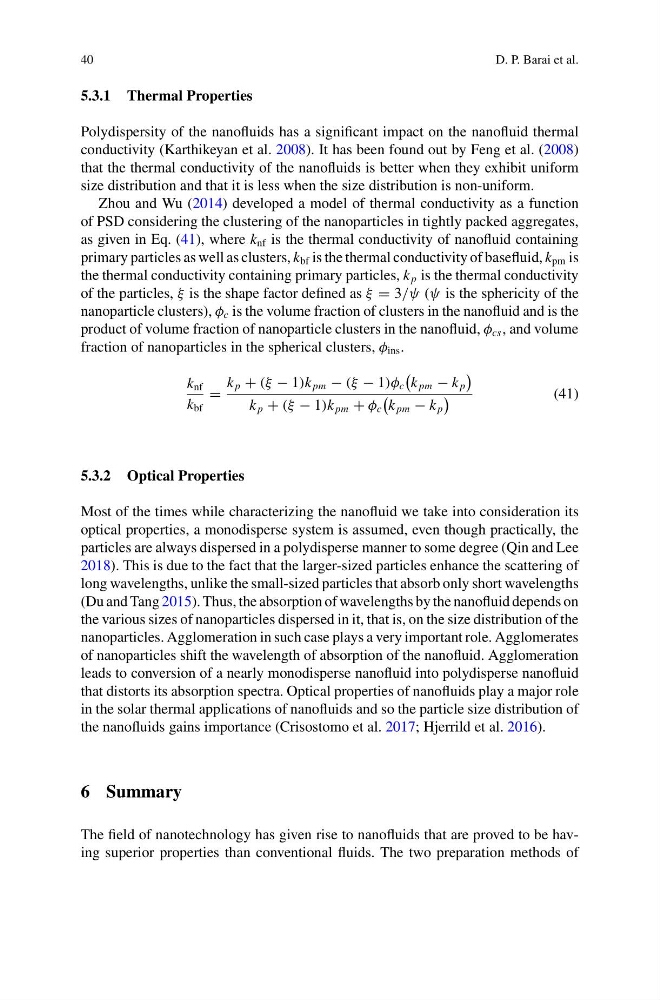
Zhou and Wu (2014) developed a model of thermal conductivity as a function
of PSD considering the clustering of the nanoparticles in tightly packed aggregates,
as given in Eq. (41), where k nf is the thermal conductivity of nanofluid containing
primary particles as well as clusters, k bf is the thermal conductivity of basefluid, k pm is
the thermal conductivity containing primary particles, k p is the thermal conductivity
of the particles, ξ is the shape factor defined as ξ = 3/ψ (ψ is the sphericity of the
nanoparticle clusters), φ c is the volume fraction of clusters in the nanofluid and is the
product of volume fraction of nanoparticle clusters in the nanofluid, φ cs , and volume
fraction of nanoparticles in the spherical clusters, φ ins .
k nf
k bf
=
k p + (ξ − 1)k pm − (ξ − 1)φ c
k pm − k p
k p + (ξ − 1)k pm + φ c
k pm − k p
(41)
5.3.2 Optical Properties
Most of the times while characterizing the nanofluid we take into consideration its
optical properties, a monodisperse system is assumed, even though practically, the
particles are always dispersed in a polydisperse manner to some degree (Qin and Lee
2018). This is due to the fact that the larger-sized particles enhance the scattering of
long wavelengths, unlike the small-sized particles that absorb only short wavelengths
(Du and Tang 2015). Thus, the absorption of wavelengths by the nanofluid depends on
the various sizes of nanoparticles dispersed in it, that is, on the size distribution of the
nanoparticles. Agglomeration in such case plays a very important role. Agglomerates
of nanoparticles shift the wavelength of absorption of the nanofluid. Agglomeration
leads to conversion of a nearly monodisperse nanofluid into polydisperse nanofluid
that distorts its absorption spectra. Optical properties of nanofluids play a major role
in the solar thermal applications of nanofluids and so the particle size distribution of
the nanofluids gains importance (Crisostomo et al. 2017; Hjerrild et al. 2016).
6 Summary
The field of nanotechnology has given rise to nanofluids that are proved to be having superior properties than conventional fluids. The two preparation methods of
D. P. Barai et al.
5.3.1 Thermal Properties
Polydispersity of the nanofluids has a significant impact on the nanofluid thermal
conductivity (Karthikeyan et al. 2008). It has been found out by Feng et al. (2008)
that the thermal conductivity of the nanofluids is better when they exhibit uniform
size distribution and that it is less when the size distribution is non-uniform.
Zhou and Wu (2014) developed a model of thermal conductivity as a function
of PSD considering the clustering of the nanoparticles in tightly packed aggregates,
as given in Eq. (41), where k nf is the thermal conductivity of nanofluid containing
primary particles as well as clusters, k bf is the thermal conductivity of basefluid, k pm is
the thermal conductivity containing primary particles, k p is the thermal conductivity
of the particles, ξ is the shape factor defined as ξ = 3/ψ (ψ is the sphericity of the
nanoparticle clusters), φ c is the volume fraction of clusters in the nanofluid and is the
product of volume fraction of nanoparticle clusters in the nanofluid, φ cs , and volume
fraction of nanoparticles in the spherical clusters, φ ins .
k nf
k bf
=
k p + (ξ − 1)k pm − (ξ − 1)φ c
k pm − k p
k p + (ξ − 1)k pm + φ c
k pm − k p
(41)
5.3.2 Optical Properties
Most of the times while characterizing the nanofluid we take into consideration its
optical properties, a monodisperse system is assumed, even though practically, the
particles are always dispersed in a polydisperse manner to some degree (Qin and Lee
2018). This is due to the fact that the larger-sized particles enhance the scattering of
long wavelengths, unlike the small-sized particles that absorb only short wavelengths
(Du and Tang 2015). Thus, the absorption of wavelengths by the nanofluid depends on
the various sizes of nanoparticles dispersed in it, that is, on the size distribution of the
nanoparticles. Agglomeration in such case plays a very important role. Agglomerates
of nanoparticles shift the wavelength of absorption of the nanofluid. Agglomeration
leads to conversion of a nearly monodisperse nanofluid into polydisperse nanofluid
that distorts its absorption spectra. Optical properties of nanofluids play a major role
in the solar thermal applications of nanofluids and so the particle size distribution of
the nanofluids gains importance (Crisostomo et al. 2017; Hjerrild et al. 2016).
6 Summary
The field of nanotechnology has given rise to nanofluids that are proved to be having superior properties than conventional fluids. The two preparation methods of