

578
A. Singhal et al.
1 Introduction
Two main types of biomolecular receptors have been used for environmental analysis:
antibodies and enzymes. The use of enzymes in biosensor applications predates the
use of antibodies. Sophistication in analytical techniques has enabled the production
of many enzymes at suitable purity for research and biotechnological applications
(Homaei et al. 2013). Traditional industrial application of enzymes has involved
food processing such as cheese making, beer brewing, and wine making (Gurung
et al. 2013). This emphasis is not surprising considering the critical role of enzymes
in metabolic processes. Modern advances in protein engineering have led to the
establishment of customized enzymes for novel applications. Certain characteristics
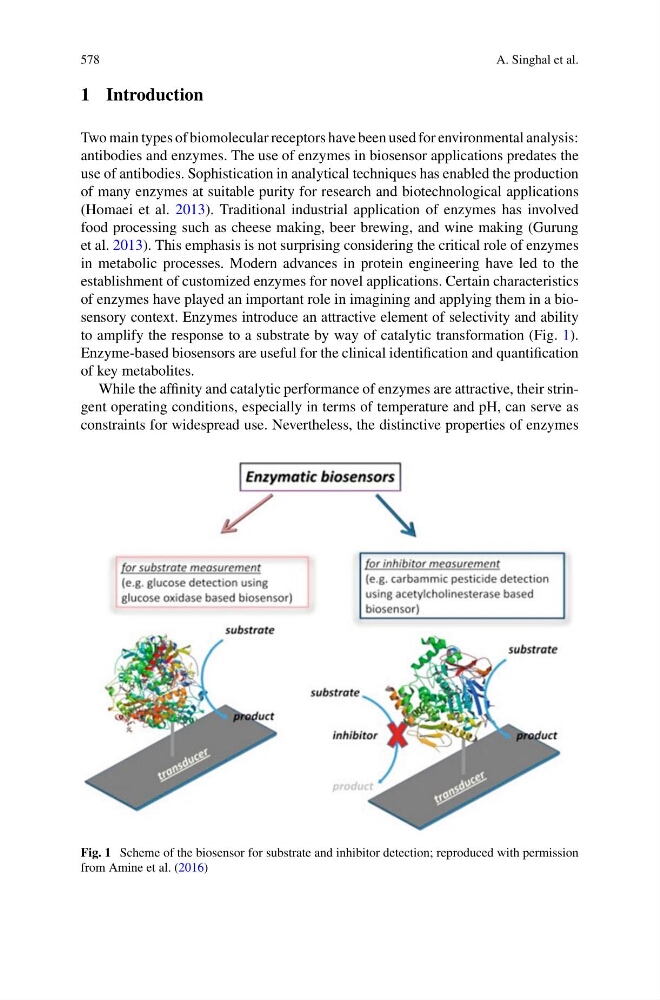
of enzymes have played an important role in imagining and applying them in a biosensory context. Enzymes introduce an attractive element of selectivity and ability
to amplify the response to a substrate by way of catalytic transformation (Fig. 1).
Enzyme-based biosensors are useful for the clinical identification and quantification
of key metabolites.
While the affinity and catalytic performance of enzymes are attractive, their stringent operating conditions, especially in terms of temperature and pH, can serve as
constraints for widespread use. Nevertheless, the distinctive properties of enzymes
Fig. 1 Scheme of the biosensor for substrate and inhibitor detection; reproduced with permission
from Amine et al. (2016)