

Removal of Ni(II) and Zn(II) from Aqueous Media …
569
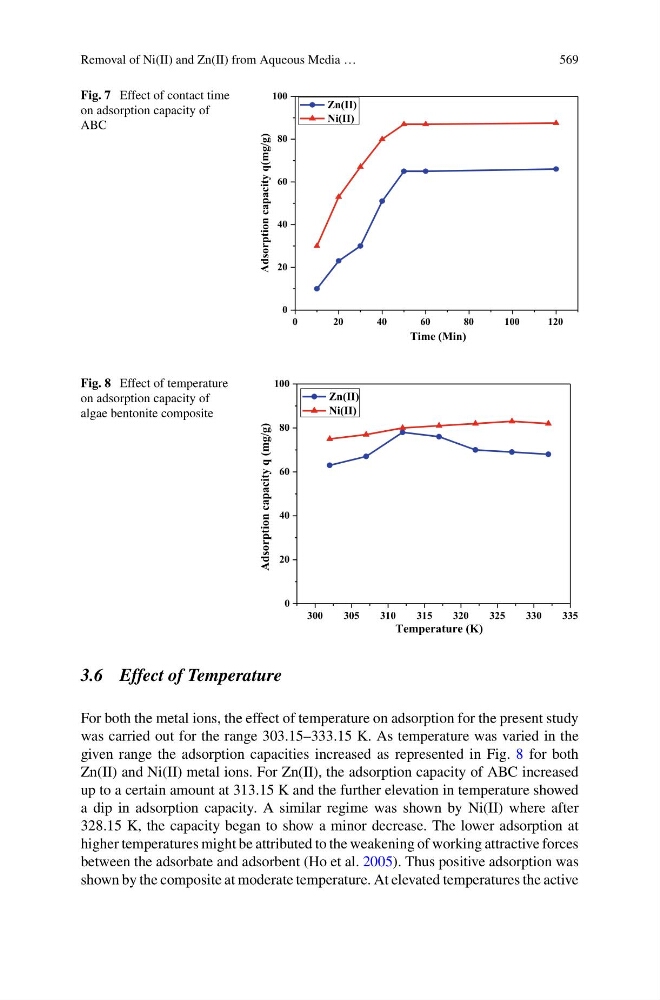
Fig. 7 Effect of contact time
on adsorption capacity of
ABC
0
2 0
4 0
6 0
8 0
1 0 0
1 2 0
0
20
40
60
80
100
Adsorption capacity q(mg/g)
Time (Min)
Zn(II)
Ni(II)
Fig. 8 Effect of temperature
on adsorption capacity of
algae bentonite composite
300
305
310
315
320
325
330
335
0
20
40
60
80
100
Adsorption capacity q (mg/g)
Temperature (K)
Zn(II)
Ni(II)
3.6 Effect of Temperature
For both the metal ions, the effect of temperature on adsorption for the present study
was carried out for the range 303.15–333.15 K. As temperature was varied in the
given range the adsorption capacities increased as represented in Fig. 8 for both
Zn(II) and Ni(II) metal ions. For Zn(II), the adsorption capacity of ABC increased
up to a certain amount at 313.15 K and the further elevation in temperature showed
a dip in adsorption capacity. A similar regime was shown by Ni(II) where after
328.15 K, the capacity began to show a minor decrease. The lower adsorption at
higher temperatures might be attributed to the weakening of working attractive forces
between the adsorbate and adsorbent (Ho et al. 2005). Thus positive adsorption was
shown by the composite at moderate temperature. At elevated temperatures the active