

564
T. Rasool and W. Baba
were performed in 250 ml Erlenmeyer flasks and shaking was done in an orbital shaking incubator at 125 rpm. The pH, contact time, dosage of adsorbent, initial concentration of metal ions, and temperature were studied in the range of 2–6, 10–120 min
100–300 mg, 50–200 mg/L, and 303.15–333.15° K, respectively. The adsorption
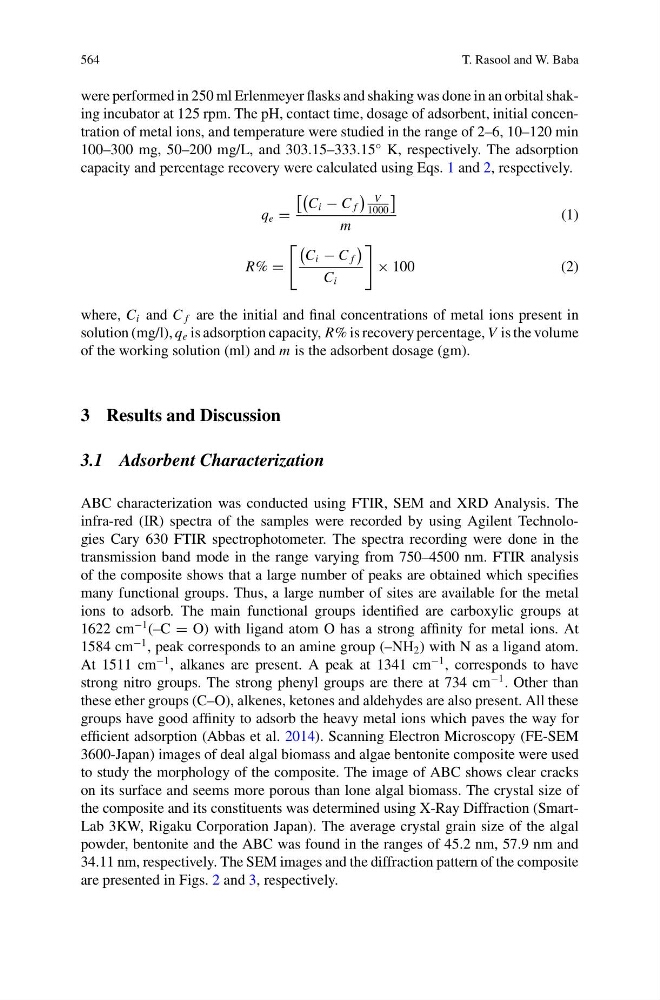
capacity and percentage recovery were calculated using Eqs. 1 and 2, respectively.
q e =
C i − C f
V
1000
m
(1)
R% =
C i − C f
C i
× 100
(2)
where, C i and C f are the initial and final concentrations of metal ions present in
solution (mg/l), q e is adsorption capacity, R% is recovery percentage, V is the volume
of the working solution (ml) and m is the adsorbent dosage (gm).
3 Results and Discussion
3.1 Adsorbent Characterization
ABC characterization was conducted using FTIR, SEM and XRD Analysis. The
infra-red (IR) spectra of the samples were recorded by using Agilent Technologies Cary 630 FTIR spectrophotometer. The spectra recording were done in the
transmission band mode in the range varying from 750–4500 nm. FTIR analysis
of the composite shows that a large number of peaks are obtained which specifies
many functional groups. Thus, a large number of sites are available for the metal
ions to adsorb. The main functional groups identified are carboxylic groups at
1622 cm
−1 (–C = O) with ligand atom O has a strong affinity for metal ions. At
1584 cm
−1 , peak corresponds to an amine group (–NH 2 ) with N as a ligand atom.
At 1511 cm
−1 , alkanes are present. A peak at 1341 cm
−1 , corresponds to have
strong nitro groups. The strong phenyl groups are there at 734 cm
−1 . Other than
these ether groups (C–O), alkenes, ketones and aldehydes are also present. All these
groups have good affinity to adsorb the heavy metal ions which paves the way for
efficient adsorption (Abbas et al. 2014). Scanning Electron Microscopy (FE-SEM
3600-Japan) images of deal algal biomass and algae bentonite composite were used
to study the morphology of the composite. The image of ABC shows clear cracks
on its surface and seems more porous than lone algal biomass. The crystal size of
the composite and its constituents was determined using X-Ray Diffraction (SmartLab 3KW, Rigaku Corporation Japan). The average crystal grain size of the algal
powder, bentonite and the ABC was found in the ranges of 45.2 nm, 57.9 nm and
34.11 nm, respectively. The SEM images and the diffraction pattern of the composite
are presented in Figs. 2 and 3, respectively.
T. Rasool and W. Baba
were performed in 250 ml Erlenmeyer flasks and shaking was done in an orbital shaking incubator at 125 rpm. The pH, contact time, dosage of adsorbent, initial concentration of metal ions, and temperature were studied in the range of 2–6, 10–120 min
100–300 mg, 50–200 mg/L, and 303.15–333.15° K, respectively. The adsorption
capacity and percentage recovery were calculated using Eqs. 1 and 2, respectively.
q e =
C i − C f
V
1000
m
(1)
R% =
C i − C f
C i
× 100
(2)
where, C i and C f are the initial and final concentrations of metal ions present in
solution (mg/l), q e is adsorption capacity, R% is recovery percentage, V is the volume
of the working solution (ml) and m is the adsorbent dosage (gm).
3 Results and Discussion
3.1 Adsorbent Characterization
ABC characterization was conducted using FTIR, SEM and XRD Analysis. The
infra-red (IR) spectra of the samples were recorded by using Agilent Technologies Cary 630 FTIR spectrophotometer. The spectra recording were done in the
transmission band mode in the range varying from 750–4500 nm. FTIR analysis
of the composite shows that a large number of peaks are obtained which specifies
many functional groups. Thus, a large number of sites are available for the metal
ions to adsorb. The main functional groups identified are carboxylic groups at
1622 cm
−1 (–C = O) with ligand atom O has a strong affinity for metal ions. At
1584 cm
−1 , peak corresponds to an amine group (–NH 2 ) with N as a ligand atom.
At 1511 cm
−1 , alkanes are present. A peak at 1341 cm
−1 , corresponds to have
strong nitro groups. The strong phenyl groups are there at 734 cm
−1 . Other than
these ether groups (C–O), alkenes, ketones and aldehydes are also present. All these
groups have good affinity to adsorb the heavy metal ions which paves the way for
efficient adsorption (Abbas et al. 2014). Scanning Electron Microscopy (FE-SEM
3600-Japan) images of deal algal biomass and algae bentonite composite were used
to study the morphology of the composite. The image of ABC shows clear cracks
on its surface and seems more porous than lone algal biomass. The crystal size of
the composite and its constituents was determined using X-Ray Diffraction (SmartLab 3KW, Rigaku Corporation Japan). The average crystal grain size of the algal
powder, bentonite and the ABC was found in the ranges of 45.2 nm, 57.9 nm and
34.11 nm, respectively. The SEM images and the diffraction pattern of the composite
are presented in Figs. 2 and 3, respectively.