

Eco-friendly Surface Modification …
555
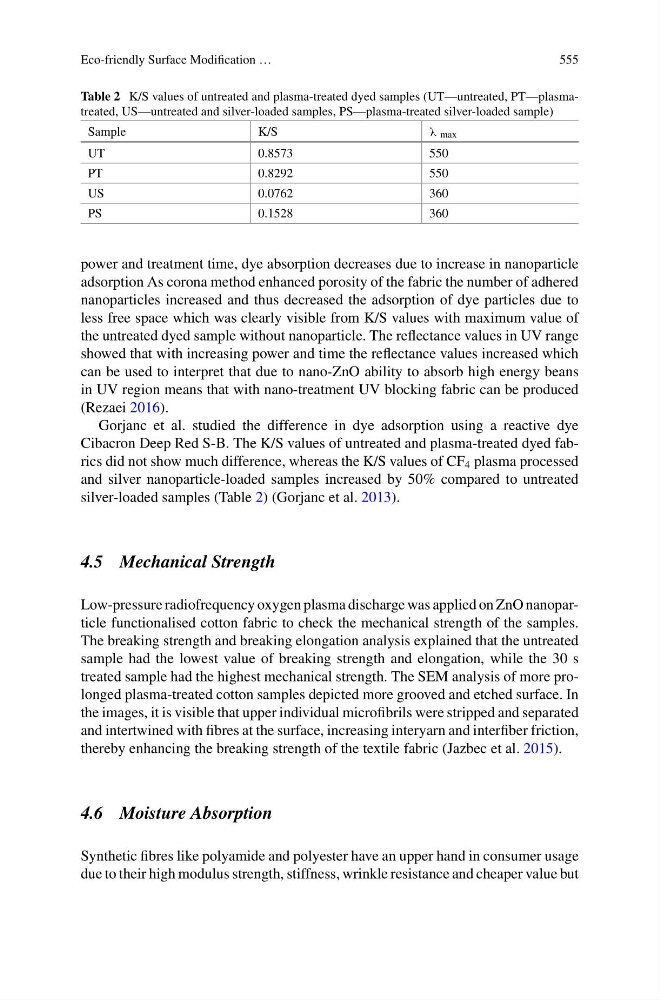
Table 2 K/S values of untreated and plasma-treated dyed samples (UT—untreated, PT—plasmatreated, US—untreated and silver-loaded samples, PS—plasma-treated silver-loaded sample)
Sample
K/S
λ max
UT
0.8573
550
PT
0.8292
550
US
0.0762
360
PS
0.1528
360
power and treatment time, dye absorption decreases due to increase in nanoparticle
adsorption As corona method enhanced porosity of the fabric the number of adhered
nanoparticles increased and thus decreased the adsorption of dye particles due to
less free space which was clearly visible from K/S values with maximum value of
the untreated dyed sample without nanoparticle. The reflectance values in UV range
showed that with increasing power and time the reflectance values increased which
can be used to interpret that due to nano-ZnO ability to absorb high energy beans
in UV region means that with nano-treatment UV blocking fabric can be produced
(Rezaei 2016).
Gorjanc et al. studied the difference in dye adsorption using a reactive dye
Cibacron Deep Red S-B. The K/S values of untreated and plasma-treated dyed fabrics did not show much difference, whereas the K/S values of CF 4 plasma processed
and silver nanoparticle-loaded samples increased by 50% compared to untreated
silver-loaded samples (Table 2) (Gorjanc et al. 2013).
4.5 Mechanical Strength
Low-pressure radiofrequency oxygen plasma discharge was applied on ZnO nanoparticle functionalised cotton fabric to check the mechanical strength of the samples.
The breaking strength and breaking elongation analysis explained that the untreated
sample had the lowest value of breaking strength and elongation, while the 30 s
treated sample had the highest mechanical strength. The SEM analysis of more prolonged plasma-treated cotton samples depicted more grooved and etched surface. In
the images, it is visible that upper individual microfibrils were stripped and separated
and intertwined with fibres at the surface, increasing interyarn and interfiber friction,
thereby enhancing the breaking strength of the textile fabric (Jazbec et al. 2015).
4.6 Moisture Absorption
Synthetic fibres like polyamide and polyester have an upper hand in consumer usage
due to their high modulus strength, stiffness, wrinkle resistance and cheaper value but
555
Table 2 K/S values of untreated and plasma-treated dyed samples (UT—untreated, PT—plasmatreated, US—untreated and silver-loaded samples, PS—plasma-treated silver-loaded sample)
Sample
K/S
λ max
UT
0.8573
550
PT
0.8292
550
US
0.0762
360
PS
0.1528
360
power and treatment time, dye absorption decreases due to increase in nanoparticle
adsorption As corona method enhanced porosity of the fabric the number of adhered
nanoparticles increased and thus decreased the adsorption of dye particles due to
less free space which was clearly visible from K/S values with maximum value of
the untreated dyed sample without nanoparticle. The reflectance values in UV range
showed that with increasing power and time the reflectance values increased which
can be used to interpret that due to nano-ZnO ability to absorb high energy beans
in UV region means that with nano-treatment UV blocking fabric can be produced
(Rezaei 2016).
Gorjanc et al. studied the difference in dye adsorption using a reactive dye
Cibacron Deep Red S-B. The K/S values of untreated and plasma-treated dyed fabrics did not show much difference, whereas the K/S values of CF 4 plasma processed
and silver nanoparticle-loaded samples increased by 50% compared to untreated
silver-loaded samples (Table 2) (Gorjanc et al. 2013).
4.5 Mechanical Strength
Low-pressure radiofrequency oxygen plasma discharge was applied on ZnO nanoparticle functionalised cotton fabric to check the mechanical strength of the samples.
The breaking strength and breaking elongation analysis explained that the untreated
sample had the lowest value of breaking strength and elongation, while the 30 s
treated sample had the highest mechanical strength. The SEM analysis of more prolonged plasma-treated cotton samples depicted more grooved and etched surface. In
the images, it is visible that upper individual microfibrils were stripped and separated
and intertwined with fibres at the surface, increasing interyarn and interfiber friction,
thereby enhancing the breaking strength of the textile fabric (Jazbec et al. 2015).
4.6 Moisture Absorption
Synthetic fibres like polyamide and polyester have an upper hand in consumer usage
due to their high modulus strength, stiffness, wrinkle resistance and cheaper value but