

Eco-friendly Surface Modification …
543
3.3 Application of Nanoparticles in Textile Surface
Modification
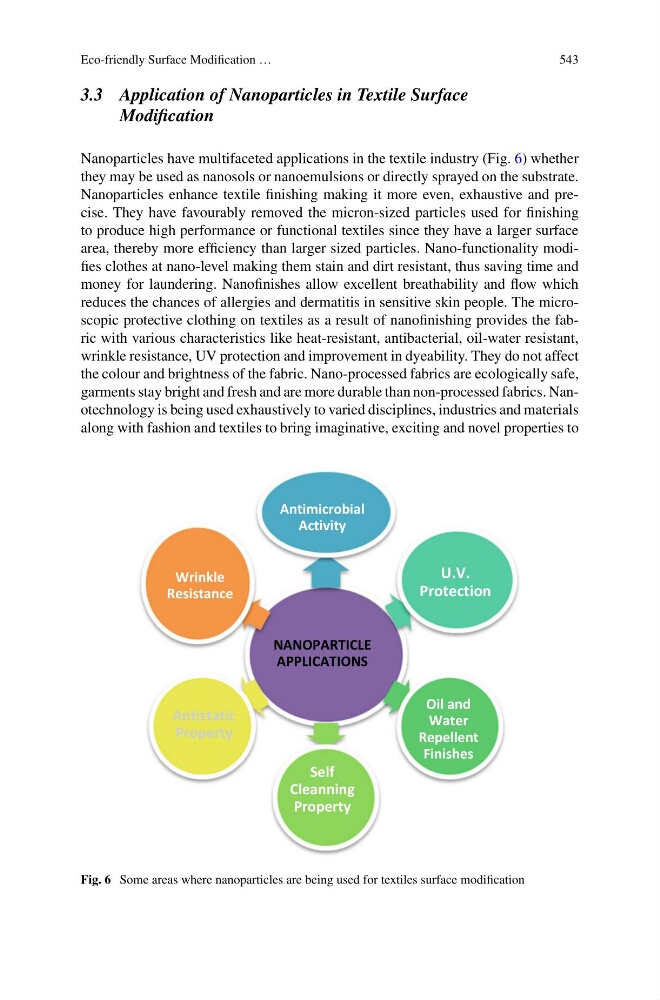
Nanoparticles have multifaceted applications in the textile industry (Fig. 6) whether
they may be used as nanosols or nanoemulsions or directly sprayed on the substrate.
Nanoparticles enhance textile finishing making it more even, exhaustive and precise. They have favourably removed the micron-sized particles used for finishing
to produce high performance or functional textiles since they have a larger surface
area, thereby more efficiency than larger sized particles. Nano-functionality modifies clothes at nano-level making them stain and dirt resistant, thus saving time and
money for laundering. Nanofinishes allow excellent breathability and flow which
reduces the chances of allergies and dermatitis in sensitive skin people. The microscopic protective clothing on textiles as a result of nanofinishing provides the fabric with various characteristics like heat-resistant, antibacterial, oil-water resistant,
wrinkle resistance, UV protection and improvement in dyeability. They do not affect
the colour and brightness of the fabric. Nano-processed fabrics are ecologically safe,
garments stay bright and fresh and are more durable than non-processed fabrics. Nanotechnology is being used exhaustively to varied disciplines, industries and materials
along with fashion and textiles to bring imaginative, exciting and novel properties to
NANOPARTICLE
APPLICATIONS
Antimicrobial
Activity
U.V.
Protection
Oil and
Water
Repellent
Finishes
Self
Cleanning
Property
Antistatic
Property
Wrinkle
Resistance
Fig. 6 Some areas where nanoparticles are being used for textiles surface modification
543
3.3 Application of Nanoparticles in Textile Surface
Modification
Nanoparticles have multifaceted applications in the textile industry (Fig. 6) whether
they may be used as nanosols or nanoemulsions or directly sprayed on the substrate.
Nanoparticles enhance textile finishing making it more even, exhaustive and precise. They have favourably removed the micron-sized particles used for finishing
to produce high performance or functional textiles since they have a larger surface
area, thereby more efficiency than larger sized particles. Nano-functionality modifies clothes at nano-level making them stain and dirt resistant, thus saving time and
money for laundering. Nanofinishes allow excellent breathability and flow which
reduces the chances of allergies and dermatitis in sensitive skin people. The microscopic protective clothing on textiles as a result of nanofinishing provides the fabric with various characteristics like heat-resistant, antibacterial, oil-water resistant,
wrinkle resistance, UV protection and improvement in dyeability. They do not affect
the colour and brightness of the fabric. Nano-processed fabrics are ecologically safe,
garments stay bright and fresh and are more durable than non-processed fabrics. Nanotechnology is being used exhaustively to varied disciplines, industries and materials
along with fashion and textiles to bring imaginative, exciting and novel properties to
NANOPARTICLE
APPLICATIONS
Antimicrobial
Activity
U.V.
Protection
Oil and
Water
Repellent
Finishes
Self
Cleanning
Property
Antistatic
Property
Wrinkle
Resistance
Fig. 6 Some areas where nanoparticles are being used for textiles surface modification