

Eco-friendly Surface Modification …
541
3.2 Synthesis of Nanoparticles
For the practical applications of nanoparticles, some conditions are required to be
met like ensuring uniform and desired particle size by overcoming their immense surface energy, preventing agglomeration of particles establishing uniform morphology,
chemical composition, microstructure and crystallinity (Vigneshwaran 2009).
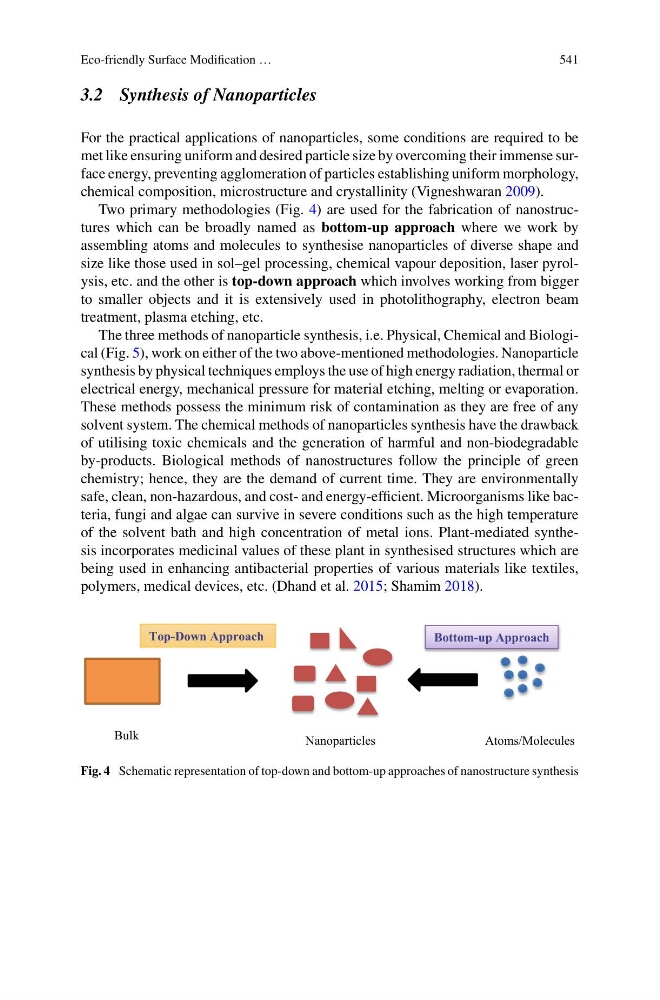
Two primary methodologies (Fig. 4) are used for the fabrication of nanostructures which can be broadly named as bottom-up approach where we work by
assembling atoms and molecules to synthesise nanoparticles of diverse shape and
size like those used in sol–gel processing, chemical vapour deposition, laser pyrolysis, etc. and the other is top-down approach which involves working from bigger
to smaller objects and it is extensively used in photolithography, electron beam
treatment, plasma etching, etc.
The three methods of nanoparticle synthesis, i.e. Physical, Chemical and Biological (Fig. 5), work on either of the two above-mentioned methodologies. Nanoparticle
synthesis by physical techniques employs the use of high energy radiation, thermal or
electrical energy, mechanical pressure for material etching, melting or evaporation.
These methods possess the minimum risk of contamination as they are free of any
solvent system. The chemical methods of nanoparticles synthesis have the drawback
of utilising toxic chemicals and the generation of harmful and non-biodegradable
by-products. Biological methods of nanostructures follow the principle of green
chemistry; hence, they are the demand of current time. They are environmentally
safe, clean, non-hazardous, and cost- and energy-efficient. Microorganisms like bacteria, fungi and algae can survive in severe conditions such as the high temperature
of the solvent bath and high concentration of metal ions. Plant-mediated synthesis incorporates medicinal values of these plant in synthesised structures which are
being used in enhancing antibacterial properties of various materials like textiles,
polymers, medical devices, etc. (Dhand et al. 2015; Shamim 2018).
Bottom-up Approach
Top-Down Approach
Bulk
Nanoparticles
Atoms/Molecules
Fig. 4 Schematic representation of top-down and bottom-up approaches of nanostructure synthesis
541
3.2 Synthesis of Nanoparticles
For the practical applications of nanoparticles, some conditions are required to be
met like ensuring uniform and desired particle size by overcoming their immense surface energy, preventing agglomeration of particles establishing uniform morphology,
chemical composition, microstructure and crystallinity (Vigneshwaran 2009).
Two primary methodologies (Fig. 4) are used for the fabrication of nanostructures which can be broadly named as bottom-up approach where we work by
assembling atoms and molecules to synthesise nanoparticles of diverse shape and
size like those used in sol–gel processing, chemical vapour deposition, laser pyrolysis, etc. and the other is top-down approach which involves working from bigger
to smaller objects and it is extensively used in photolithography, electron beam
treatment, plasma etching, etc.
The three methods of nanoparticle synthesis, i.e. Physical, Chemical and Biological (Fig. 5), work on either of the two above-mentioned methodologies. Nanoparticle
synthesis by physical techniques employs the use of high energy radiation, thermal or
electrical energy, mechanical pressure for material etching, melting or evaporation.
These methods possess the minimum risk of contamination as they are free of any
solvent system. The chemical methods of nanoparticles synthesis have the drawback
of utilising toxic chemicals and the generation of harmful and non-biodegradable
by-products. Biological methods of nanostructures follow the principle of green
chemistry; hence, they are the demand of current time. They are environmentally
safe, clean, non-hazardous, and cost- and energy-efficient. Microorganisms like bacteria, fungi and algae can survive in severe conditions such as the high temperature
of the solvent bath and high concentration of metal ions. Plant-mediated synthesis incorporates medicinal values of these plant in synthesised structures which are
being used in enhancing antibacterial properties of various materials like textiles,
polymers, medical devices, etc. (Dhand et al. 2015; Shamim 2018).
Bottom-up Approach
Top-Down Approach
Bulk
Nanoparticles
Atoms/Molecules
Fig. 4 Schematic representation of top-down and bottom-up approaches of nanostructure synthesis