

Eco-friendly Surface Modification …
539
• These are non-toxic due to they are nanosize, as, by a rule, toxicity decreases when
particle size increases (Mishra 2014).
Further, the mechanical and thermal properties of nanomaterials depend on several
features like particles size, pores and their distribution, impurity percentage, method
and duration of their application, the method used for their production, pH and
temperature conditions (Joshi and Bhattacharyya 2011). Nanoparticles due to their
small size, large surface area and exceptional surface properties have shown great
potential for a wide variety of applications may it be drug delivery, biosensors,
food technology, antimicrobial coatings, quantum science, lasers or textile finishing
technology (Dhand et al. 2015).
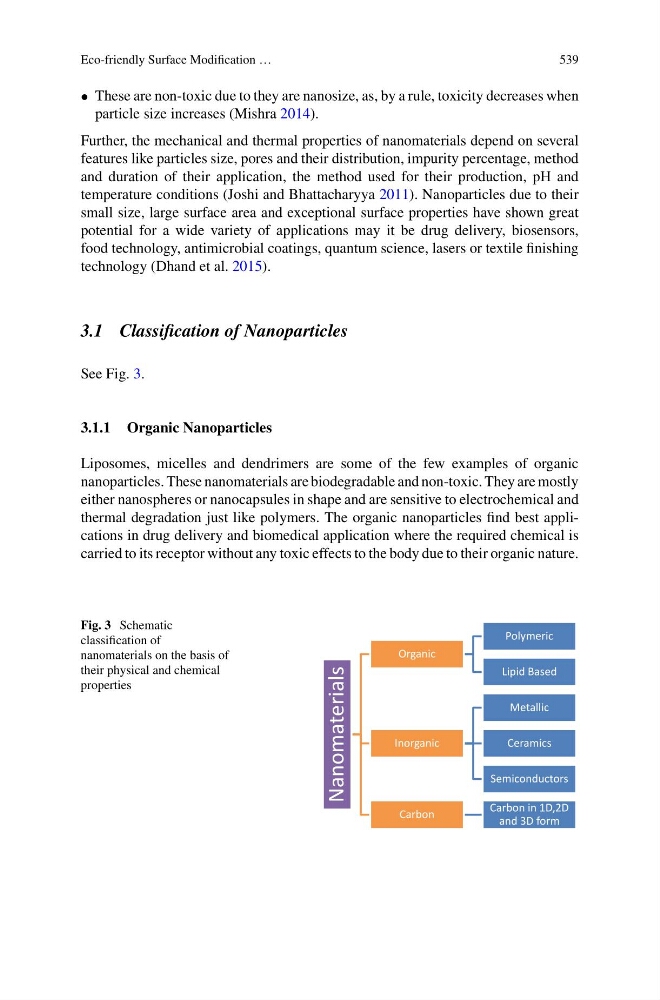
3.1 Classification of Nanoparticles
See Fig. 3.
3.1.1 Organic Nanoparticles
Liposomes, micelles and dendrimers are some of the few examples of organic
nanoparticles. These nanomaterials are biodegradable and non-toxic. They are mostly
either nanospheres or nanocapsules in shape and are sensitive to electrochemical and
thermal degradation just like polymers. The organic nanoparticles find best applications in drug delivery and biomedical application where the required chemical is
carried to its receptor without any toxic effects to the body due to their organic nature.
Fig. 3 Schematic
classification of
nanomaterials on the basis of
their physical and chemical
properties
Nanomaterials
Organic
Polymeric
Lipid Based
Inorganic
Metallic
Ceramics
Semiconductors
Carbon
Carbon in 1D,2D
and 3D form
539
• These are non-toxic due to they are nanosize, as, by a rule, toxicity decreases when
particle size increases (Mishra 2014).
Further, the mechanical and thermal properties of nanomaterials depend on several
features like particles size, pores and their distribution, impurity percentage, method
and duration of their application, the method used for their production, pH and
temperature conditions (Joshi and Bhattacharyya 2011). Nanoparticles due to their
small size, large surface area and exceptional surface properties have shown great
potential for a wide variety of applications may it be drug delivery, biosensors,
food technology, antimicrobial coatings, quantum science, lasers or textile finishing
technology (Dhand et al. 2015).
3.1 Classification of Nanoparticles
See Fig. 3.
3.1.1 Organic Nanoparticles
Liposomes, micelles and dendrimers are some of the few examples of organic
nanoparticles. These nanomaterials are biodegradable and non-toxic. They are mostly
either nanospheres or nanocapsules in shape and are sensitive to electrochemical and
thermal degradation just like polymers. The organic nanoparticles find best applications in drug delivery and biomedical application where the required chemical is
carried to its receptor without any toxic effects to the body due to their organic nature.
Fig. 3 Schematic
classification of
nanomaterials on the basis of
their physical and chemical
properties
Nanomaterials
Organic
Polymeric
Lipid Based
Inorganic
Metallic
Ceramics
Semiconductors
Carbon
Carbon in 1D,2D
and 3D form